Daniel Haiem paid $140 for a calculator in ninth grade. Years later, standing on the other side of the classroom as a physics teacher, he watched students wrestle with the expense of much the same machine. Their phones had changed. The required purchase had scarcely budged. For someone inclined to build things, the arrangement practically issued an invitation.
The obvious answer was a calculator app. The less obvious question was whether a school would let anyone use it. A phone could draw a graph, certainly. It could also deliver a message, open a browser and make an exam considerably more collaborative than the teacher intended. Haiem's problem had a price tag, a software component and a roomful of adults with perfectly reasonable objections.
That combination runs through his career. Today he leads AppMakers USA in Los Angeles, helping other people build mobile and web products. His earlier work on ClassCalc keeps resurfacing in the way he talks about customers, engineering and trust. He began with arithmetic. The education turned out to be considerably broader.
A phone asking permission
Haiem studied at UCLA and taught AP Physics at Yula Boys High School. ClassCalc put him at the intersection of two familiar worlds: the student trying to afford the equipment and the teacher trying to run a class. A cheaper calculator had to satisfy both people. The teacher's confidence was part of the product.
The app combined graphing and scientific calculation with classroom controls. Teachers could place students in a test mode; leaving the app could alert the teacher. The proposal was practical: use a device students already carried, while addressing the distractions that made schools reluctant to allow it.
By November 2018, following a September release, ClassCalc had about 1,000 users and 10,000 students on district waitlists. Those figures describe an early moment, before a much larger agency portfolio entered Haiem's story. They also reveal the distance between someone trying an app and an institution agreeing to adopt it. A waitlist contains enthusiasm. It also contains waiting.
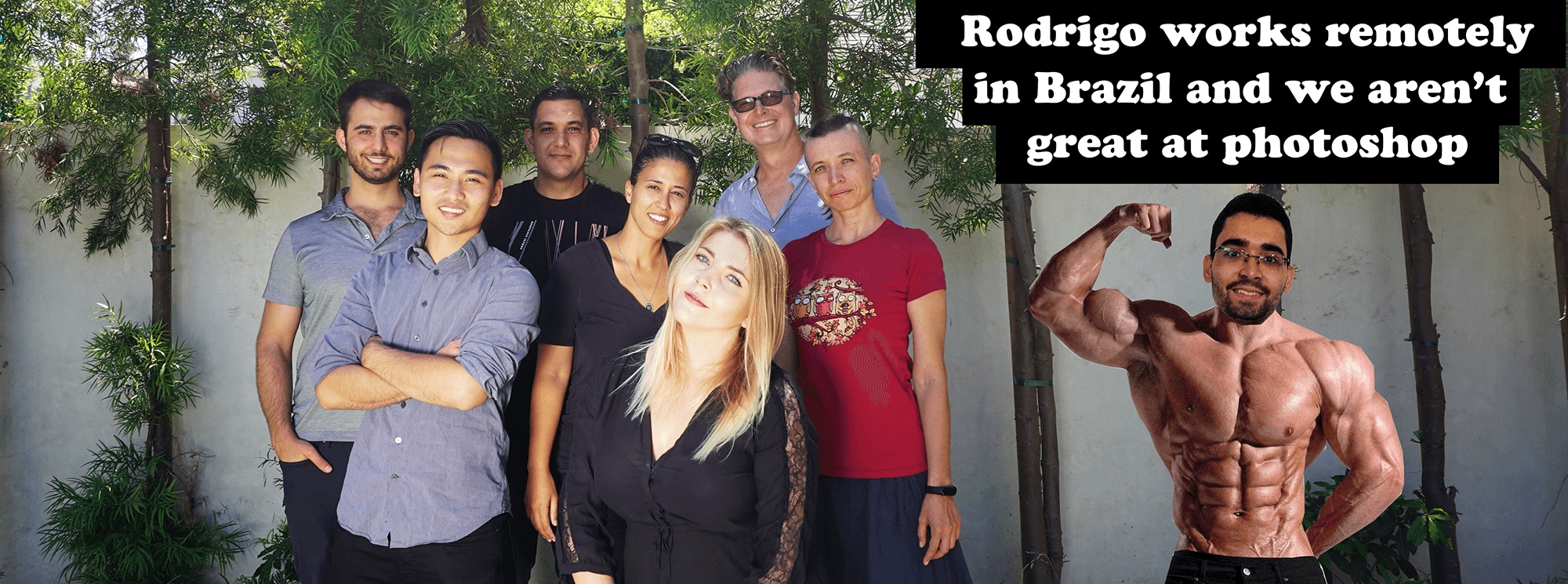
The international team brought its own reasons to care. Engineer Rodrigo Borges de Oliveira described graphing calculators costing $250 to $300 in Brazil. The price problem travelled rather well. ClassCalc's own team page lists colleagues from countries including Brazil, Armenia and Israel, gathered around a shared interest in mathematics and access.
The meeting beyond the equation
Haiem remembers entering a school-district meeting expecting to discuss software. Instead, he found himself confronting the habits and institutional relationships surrounding the calculator business. His account puts the industry's value at $300 million. The number matters less to his story than the discovery: improving a tool does not automatically rearrange the system that buys it.
“ClassCalc was the real crucible.”
Daniel Haiem
He began paying closer attention to where trust and decision-making authority sat. An institution has obligations a developer cannot simply dismiss as friction. Teachers need confidence that a lesson or an exam will work. Districts need reasons to accept the disruption of a change. The meeting enlarged the job description.
In 2019, Haiem described USC Rossier's EdVentures accelerator as useful help in navigating education technology. At that point, he said he was living with his parents because he had invested his money in ClassCalc. The domestic detail gives the venture a human scale. Changing classroom purchasing habits involved going home to a familiar address.
The last lesson was about college
There is another classroom scene that explains Haiem's approach. On the last day of a physics class, after the AP exam, he decided to talk with students about choosing a university. They had finished the test. They still had consequential decisions ahead of them.
He later wrote about having chosen UCLA partly by asking friends where they were going and what they considered a good university. He enjoyed his experience, but wanted his students to examine their choices more deliberately. He asked them to work backwards from what they hoped college would accomplish, including earning a living, exploring careers and enjoying themselves.
His argument connected mathematics with the broader practice of working through problems. A calculator could handle operations; the student still needed to decide which question to ask and which tools might answer it. The college conversation made that distinction tangible. You could get the calculation right and begin with a poor question.
That is a useful scene to hold beside his present job. A founder arrives asking for an application, just as a student asks which university to attend. In either case, asking about the desired outcome changes the conversation before anyone starts comparing features.
Learning to buy what he would later sell
ClassCalc also gave Haiem experience as a customer of software developers. He has described outsourcing difficulties that left him dissatisfied with both the work and the candour surrounding it. In his telling, learning to build was partly a response to the difficulty of getting others to deliver his ideas.
His explanation for AppMakers' approach follows directly from that experience. He wanted engineering competence and visibility into the process. The company describes development, design, product work and quality assurance as in-house responsibilities. Haiem's pitch carries the memory of being the person waiting for an answer.
He has also described a change in which projects the agency accepts. Early willingness to take almost everything gave way to choosing work where the team believed in the people and the product. That is a decision about daily life inside a company as much as its sales pipeline. Every accepted project becomes somebody's working week.
His stated leadership principles put kindness and honesty alongside pursuing opportunities. They include hiring people who enjoy the work and treating clients with empathy. These are intentions he describes for himself. The more interesting question is how such intentions survive deadlines, growing demand and the inconvenient moment when someone must deliver unwelcome news.
What a former teacher listens for
For Haiem, explaining is part of leading. He describes teaching as practice in slowing down, finding what another person already understands and building from there. A founder and a technical team can talk past each other while each believes the conversation is perfectly clear.
His suggested test for an engineer is revealing: listen to the person explain something difficult without jargon or a whiteboard. The ability to carry another person along matters to him. It is an old classroom concern wearing a different set of meeting invitations.
“The best engineers I have worked with are all secretly teachers.”
Daniel Haiem
There is a colleague's perspective, too. Dovrat Yaish, who says she began working with him as a technical manager in 2017, recalls being encouraged to become a leader before she considered herself one. Her recommendation describes someone who listens closely and helps people grow into responsibility. It offers a concrete example of the teaching habit extending to his own team.
The bill comes due after the demo
By 2026, Haiem's public writing was dwelling on the work that follows an impressive first demonstration. In June, he described his team's experience rescuing 37 applications over several years. He said 20 had problems connected to AI-assisted builds with limited review. These are his team's reported experiences, rather than a survey of the industry.
The situations he describes are ordinary enough to be instructive: someone submits a form twice, loses a connection during a transaction or reaches an unexpected address. A demonstration can proceed exactly as planned. A customer has made no such promise.
His May writing examined the compounding cost of postponing a known problem. Patches can accumulate around the original fault until a new feature has to navigate all the previous workarounds. For a founder, the consequence arrives as a slower release, a larger bill or a product that feels unreliable.
- UnderstandWhat is the person trying to accomplish?
- ExamineWhat happens when the expected path breaks?
- OwnWho maintains the product after release?
AppMakers' work still brings him back to education. Its Number Hive case study describes building and scaling a classroom mathematics game used by more than 700,000 students worldwide, a reach figure attributed to Number Hive. The agency's account centres on supporting adoption across devices and strengthening the foundation as use grew. Haiem's original audience has not entirely left the room.
Intelligence with some boundaries
Haiem's ambitions now include interfaces where AI participates in the work itself. He has described a customer-management system that suggests next steps and adapts around a sales process. His interest is in changing what a product helps someone do, beyond adding another place to type a question.
He pairs that interest with questions about responsibility. In May 2026, he wrote about deciding which information remains on a device and which can enter a cloud service. His recommendations include documenting the boundary, planning fallbacks and deciding how updates can be reversed. The excitement has an operating manual.
Outside work, Haiem says he spearfishes, free-diving to depths of 20 to 25 metres and making sushi from his catch. It is a pleasingly specific answer to the customary question about hobbies. Even his dinner sometimes has a development process.
The classroom remains the more revealing connection. Haiem once tried to make a required tool cheaper and easier to use, then discovered how much depended on the people around it. He now sells his experience of that larger problem. The calculation may fit on a phone. Earning permission, explaining the workings and keeping the thing useful require somebody to stay in the conversation.