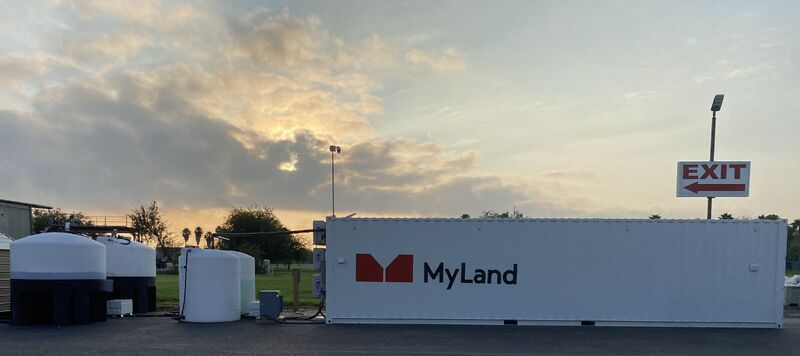
The photograph Dane Hague shared from Texas offers a modest vision of agricultural change. A white MyLand unit sits beside tanks, under a sky doing considerably more showing off than the machinery. There is an exit sign. There is very little glamour. Hague, however, was delighted: another system had arrived in the countryside, and he wanted people to know how much he appreciated the team putting it there.
That is a useful place to meet him. Hague is MyLand’s co-founder and chief executive, a former attorney whose business now depends on growing living microalgae and returning them to farm soil. The equipment may be conspicuous. The organisms doing the work are rather less available for a ribbon-cutting photograph.
His public enthusiasm tends to gather around those two things: growers seeing a result, and colleagues making a complicated service function. In the Texas post, he called the sight of the systems “very cool (and humbling).” It is a small remark, but it brings the scale of his ambition down to something you can picture: one installation, in one place, becoming part of someone’s working farm.
Before the algae, there were agreements
Hague’s route into agriculture ran through finance and law. He studied finance at Fort Hays State University, then attended the University of Kansas School of Law from 2003 to 2006. He earned his Juris Doctor and went into legal practice, including work at the Phoenix firm Gallagher & Kennedy.
There is a pleasing food-business connection in that earlier career. In 2012, Hague and Steven Lawrence were named as counsel to Sunflower Farmers Market in its proposed merger with Sprouts Farmers Market. The announced combination was to bring together 139 stores and approximately 10,000 employees. Long before his business involved what happens beneath a crop, his legal work had touched what happens when food reaches the shop.
His work also involved representing startups and early-stage companies. Eventually he joined their ranks. MyLand dates its founding to 2014, and marked its tenth anniversary on World Soil Day in December 2024. The move put Hague on the operating side of a business whose responsibilities would spread well beyond negotiating its paperwork.
His remit has included financing, planning, manufacturing, system design, intellectual property and regulatory compliance. Read together, those duties explain why a law-and-finance background belongs in this story. A living organism may be the starting point; keeping equipment, capital, people and customers moving together is the occupation.
A farm already has its own inhabitants
MyLand’s founding team includes Andrew Ayers and Bob Thompson alongside Hague. Ayers had been experimenting with microalgae applications before the company was established. One early experience stayed with Hague: a treated 200-acre portion of a 9,000-acre Del Monte operation that, in his telling, began producing more per acre than the rest of the ranch.
That recollection is an origin story, rather than a promise about every field. Its significance for Hague was the possibility it suggested. A neglected biological part of farming might become a practical business, provided the company could deliver it consistently.
MyLand works with microalgae native to each farm. Its scientists select and culture organisms from the grower’s soil, and its equipment reproduces them on site. Existing irrigation carries the living cells back into the ground. There is something satisfyingly circular about the arrangement: the farm supplies the starting material for a service intended to improve the farm.
- 01 Sample the soil
- 02 Select native microalgae
- 03 Grow them on site
- 04 Return through irrigation
MyLand operates and maintains the equipment throughout the service.
The company describes microalgae as a food source for the soil’s microbial community. Its intended effects include improved soil structure, nutrient availability and water retention. Hague returns to this relationship between the organisms and their surroundings when explaining the business. The pitch begins with something living beneath the crop, then works outward toward the grower’s costs and harvest.
The choice to work with living, locally selected organisms has consequences for the company delivering them. MyLand calls its model Soil as a Service. That name carries an obligation: the company remains involved after installation, with remote monitoring, field visits, maintenance and continuing support. The sale starts a relationship that someone must keep servicing.
The customer has a farm to run
Consider the proposition from a farmer’s side. Another technology can mean another task, another machine to understand, another demand during a season that was already full. MyLand’s model integrates with irrigation already in use and leaves responsibility for its own system with MyLand. The design gives Hague a concrete answer to the question of who will do the extra work.
It also gives him a demanding company to run. A service delivered at individual farms needs people and processes capable of working across distance. In August 2025, MyLand appointed Aaron Vickles as vice president of operations, with responsibility for national operations, infrastructure planning and field performance. Vickles would report directly to Hague.
In March 2026, Sarah Lee joined as vice president of people, also reporting to him. Her remit covered recruitment, leadership development and organizational design. These appointments belong to the less photogenic part of a founder’s story: arranging for a growing business to keep its promises when the founder cannot personally attend to each one.
Hague has acknowledged the challenge of refining a highly individualized service while expanding it. The complication follows directly from the proposition. Every additional grower is a customer with particular land, equipment and circumstances. A growing installation count therefore brings more relationships to maintain, along with more machinery.
Capital has to reach the countryside
The financing history shows how much infrastructure sits behind the biological idea. In September 2023, MyLand announced an approximately $23 million Series B round led by Climate Innovation Capital and the Borden Family. The stated expansion plans included Texas and the Pacific Northwest.
In January 2025 came another $23 million round, this time led by Proterra Investment Partners. That announcement followed a $20 million Hardware as a Service loan facility from PaceZero Capital Partners in October 2024. The transactions served related purposes, but they were separate events: investment in the company and financing for the equipment supporting its service.
For Hague, raising money is tied to a physical requirement. Systems have to be built, installed and maintained before the service can do its work. There is no especially elegant way around that expense. The white box in the Texas photograph has to get there somehow.
Public programs have also helped extend the service. In February 2025, MyLand announced a $4.8 million Washington initiative targeting 9,000 acres, supported by state agencies and Climate Commitment Act funding. A further $2.4 million expansion followed that July. Eligible growers were offered their first year without charge, reducing the initial cost of trying the service.
Meanwhile, the company’s collaboration with Texas A&M AgriLife Research was expanding. In October 2025, MyLand said research and data collection had extended across 12,000 Texas acres, with a new phase set to add 10,000 more. For a founder trying to persuade growers across different regions, that research addresses an essential question: how does the approach perform under the conditions here?
A promise with a number attached
In March 2026, Hague’s company put a more explicit financial proposition beside its soil work. A crop warranty program, developed with Growers Edge for apples, pistachios and almonds, offered a guaranteed benefit of at least $250 per acre based on yield and quality outcomes. It was a defined program for specified crops, rather than a universal forecast for everything MyLand touches.
“The Growers Edge warranty reinforces our confidence in MyLand’s outcomes”Dane Hague, March 2026
The number gives an otherwise sprawling discussion a point of contact with a farm budget. Soil biology is complex; the grower still has to decide whether adopting a service makes financial sense. A warranty makes the company’s confidence part of that decision.
There was a parallel effort to keep testing the proposition. In July 2026, MyLand received a $50,000 F3 Innovate grant for research at Terra Linda Farms, a California pistachio orchard. Selected from 65 applicants, the project was intended to add independent validation of its service. Growth and further measurement were proceeding together.
The long view, measured one grower at a time
Hague’s ambition extends beyond the places where MyLand began. He has described a focus on irrigated agricultural regions, particularly higher-value specialty crops, with grower profitability central to the plan. In January 2026, the Gulfood program in Dubai listed him for discussions of resilient food systems and agricultural technology serving the Gulf’s food-security agenda.
Back in Arizona, he appeared in the PBS series Wild Foods alongside grower Steve Martori Sr. The company’s July 2026 account of its expansion put its reach at more than 80 farms nationwide. The subject that once drew Hague out of legal practice had become a business spanning laboratories, installations, research partnerships and orchard economics.
Yet his Texas photograph remains an apt portrait of the work. A unit is in place. Tanks stand beside it. A team has made something happen far from a conference stage. Hague’s pleasure in that ordinary scene makes sense. His business depends on repeating it, then showing up for what comes next.