Dan Wall wanted a job that would do for the time being. His father drove a truck, and Wall intended to follow him. At eighteen, he needed something to occupy the interval. A messenger position at Expeditors, carrying customers’ customs documents in Seattle, seemed a reasonable place to wait.
He failed the interview.
There are grander obstacles in business biographies, but this one has the virtue of being familiar. Wall had reached the room where employment was being discussed without having learned quite how the discussion worked. A prospective employer saw a candidate who did not interview well. A future chief executive was available, although admittedly without much evidence of the fact.
Four weeks later, the opening came up again. He returned and got the job. He joined Expeditors in March 1987. On April 1, 2025, he became its president and chief executive officer. The temporary arrangement had lasted thirty-eight years.
“I did a terrible job because I didn’t know how to interview.”
Dan Wall, recalling his first application
The education before the degree
Wall’s early ambition was concrete: do the kind of work his father did. College was outside his immediate plans. His own account of school performance is cheerfully unadorned. He describes himself as average, a useful antidote to the executive biography in which every childhood activity appears to predict an eventual board appointment.
What changed was the work around him. Tim Barber gave him the opportunity to run documents. Other employees taught him the industry and the manners of office life. He moved into office responsibilities. Customs brokerage and airfreight became things he did, rather than distant categories of international commerce.
There is a small detail from this period that deserves more space than an organizational chart allows. A mentor took him shopping for his first suit and helped him understand the business environment. Before there was a discussion about leadership credentials, there was a trip to buy clothes.
It is an unusually precise picture of what help can look like. For someone already comfortable in a professional office, the rules may seem obvious. To someone arriving from elsewhere, they require translation. The person explaining them can change the usefulness of the entire opportunity. An open door still leaves quite a lot to learn on the other side.
Denver was a classroom, too
By May 1992, Wall had been promoted to district manager. He led Denver, which received Quality Branch of the Year recognition in 1995. In 1996, he moved to project work in Detroit and managed the Central Process Center. In 1997, he became Seattle’s district manager.
Seattle subsequently won Quality Branch of the Year in 1999 and Global Branch of the Year in 2000. These were branch distinctions, earned by offices full of people. In Wall’s career, they also marked the period when his responsibilities had moved decisively beyond learning his own job to helping other people do theirs.
That progression matters to the eventual CEO appointment. A district asks a manager to deal with work where customers, employees, service commitments, and daily exceptions meet. Moving between districts adds another complication: the same company looks different from a different desk. Wall’s route supplied several desks.
- 1987Seattle
Document messenger - 1992Denver
District manager - 1997Seattle
District manager - 2002Global accounts
Customer relationships - 2025President & CEO
Expeditors
In March 2002, he became global director of account management. Vice president of order management followed in January 2004, then senior vice president of ocean services that September. The subject changed from one office’s performance to accounts and services extending across the company. Each appointment widened the map.
His qualifications included a U.S. customs broker’s license and IATA/FIATA certification. They add a technical dimension to a career often summarized by its starting point. The messenger-to-CEO description is memorable, but the years between those jobs contained specific disciplines. Customs documents were the beginning of an education that eventually extended across air and ocean freight.
The account-management role added another perspective: retaining and developing major global customers. There is a difference between seeing an operation through its reporting lines and seeing it through the needs of a customer using several parts of the business. Wall’s appointments put both perspectives within his experience. The promotions are easier to understand when the work behind the titles remains in view.
A homework assignment with a payroll
The formal education came after Wall was already well into his working life. Expeditors encouraged him to study at Seattle University’s Albers School of Business and Economics. He attended its Executive Leadership Program and earned a Leadership Executive MBA. The university identifies him with its 2008 graduating class.
His capstone project was Opportunity Knocks. It took an experience that could easily have remained a grateful recollection and gave it an operating form: paid internships for young people, with professional development and mentoring. The company formalized the program in 2008.
The practical question behind it was whether the support Wall had received could become something a company provided deliberately. A lucky encounter with a helpful colleague is valuable. A program requires an employer to decide who will help, what a participant will do, and how progress will be judged.
An early account of Opportunity Knocks describes community organizations helping identify candidates, workplace expectations applying to the students, and managers developing a more structured approach to mentoring. The ambition was to create people who could succeed in the work. That meant teaching the conventions as well as providing the vacancy.
The first interview in Wall’s story gives this design a particular resonance. If a candidate has never learned how to interview, an interview can measure the absence of instruction. Employers still need to judge readiness and performance. Wall’s experience supplies a reason to ask how much of that readiness they are prepared to teach.
The program’s published history now describes opportunities for more than 700 young people across 50 cities in seven countries. Those figures describe its reported reach. The individual work is smaller in scale: learning an unfamiliar task, receiving useful feedback, and getting another chance to do it well.
There is a commercial logic alongside the personal one. An early case study described Wall’s hypothesis that investing in employees could build loyalty, particularly among people arriving with limited career direction. The employer gains a way to develop talent. Participants gain paid experience and a work record. Neither benefit requires anyone to pretend the arrangement is effortless.
The long route to the corner office
In June 2015, Wall became president of global products. He moved to global services in January 2023, then global geographies and operations in January 2024. By the time the CEO succession was announced in February 2025, he had held senior leadership responsibilities for more than twenty years.
The board elected him unanimously. Jeffrey S. Musser would retire at the end of March; Wall would take over on April 1 and join the board. Chair Bob Carlile emphasized Wall’s ability to motivate people and his relationships with customers and carriers. The appointment put an extensive internal career at the center of the company’s next chapter.
The succession also handed Wall responsibility for making decisions in the present. Experience supplies context; a new title supplies a different set of consequences. A career spent moving through the organization becomes relevant only as it helps the person now responsible for all of it choose what happens next.
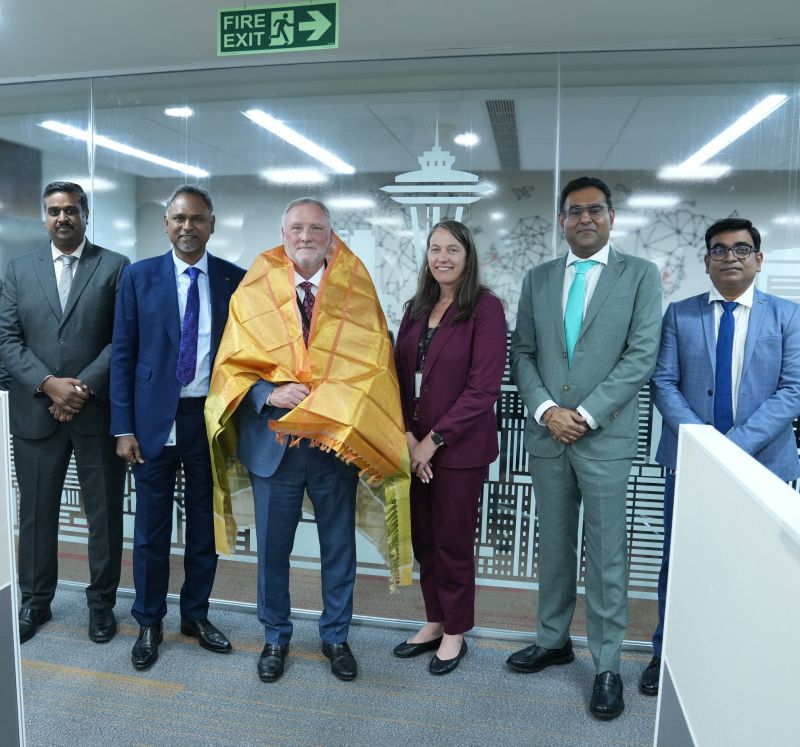
A visit to the Chennai office with chief information officer Courtney Hawkins offered a less abstract view of the job. They presented service pins to employees, discussed ways to improve, joined colleagues for photographs, and shared a lunch featuring Tamil Nadu’s food. The occasion combined operating discussion with the ordinary rituals by which a workplace recognizes its people.

What the messenger signs now
In his first annual letter as CEO, covering 2025, Wall returned to his arrival as an eighteen-year-old document messenger. He also described a company undergoing leadership changes and set out priorities involving productivity, technology, and modernized operations. The personal history was now attached to responsibility for the business’s future.
By August 2026, the financial update supplied a recent measure of that work. Expeditors reported second-quarter revenue of $3.5 billion and operating income of $350 million, increases of 32 percent and 41 percent respectively over the same quarter a year earlier. Wall pointed to execution across regions and products and discussed expanded aircraft-on-ground logistics capabilities.
One quarter cannot describe a leadership tenure. It can put a date on the story. The former messenger was now explaining the performance of a global logistics business, with customers and employees depending on decisions made across a network far larger than the Seattle office where he began.
In October 2025, he had returned to Seattle University to speak about his evolution from manager to leader. A November podcast appearance revisited the same career, including his views on titles and the importance of people throughout the organization. The subject has stayed close to the beginning even as the responsibilities have expanded.
There is a temptation to read the first rejection backward, as though the interviewer should have recognized the eventual CEO. Nobody hiring a messenger has access to thirty-eight years of future performance. The more useful detail is that Wall got another interview, then encountered people willing to teach him once he arrived.
Opportunity Knocks gives that detail somewhere to go. A second chance in one person’s career became paid work and mentoring for others. Wall’s first application ended with a refusal. The more interesting part of his story is how many beginnings followed it.