The first thing to go wrong was the timetable. An automotive manufacturer importing parts from East Asia through Manzanillo, Mexico, was waiting 43 days for shipments. Congestion, inland delays and cargo rolled onto later sailings had reduced reliability to roughly 60%. The response was familiar: hold more inventory and put urgent freight on airplanes. A bargain on the water was acquiring some rather expensive accessories.
- Change the route: one automotive lane went from 43 days to 25.
- Count the whole bill: Ascent reports over $500,000 in annual savings.
- Keep options open: PEAK carrier bidding, logistics teams and USA Jet provide different ways to meet a deadline.
The boat that made the plane unnecessary
Ascent Global Logistics proposed a modest experiment: one trial lane. Its Fast Boat service brought the freight through U.S. ports, followed by in-bond transport to Laredo and delivery into Mexico. According to Ascent’s published case study, transit fell to 25 days and annual spending on that lane dropped by more than $500,000, with less emergency airfreight and inventory. The figures describe a company-reported customer result.
Eighteen days disappeared from the journey. That is about a 42% reduction. The interesting part is the intervention: change the route and its connections before assuming that every late shipment needs a faster aircraft. Geography, it turns out, can be negotiable. The factory’s deadline usually has poorer manners.
from the journey≈42%shorter transit
An auction with an airline attached
Ascent occupies a particular corner of logistics: freight whose lateness threatens something larger than the freight itself. Its customers include Ford, General Motors and John Deere. It also serves aerospace, industrial manufacturing, technology and healthcare businesses. A missing component can matter out of all proportion to its size. Transportation becomes a question of what must continue working at the destination.
The company’s answer combines several tools. PEAK, its proprietary marketplace, lets vetted carriers bid on shipments and gives customers quote options, tracking and shipment notes. The automotive offering lists more than 1,300 asset-based carriers. Behind the screen are logistics specialists working around the clock, with control towers in the U.S., Mexico and Europe.
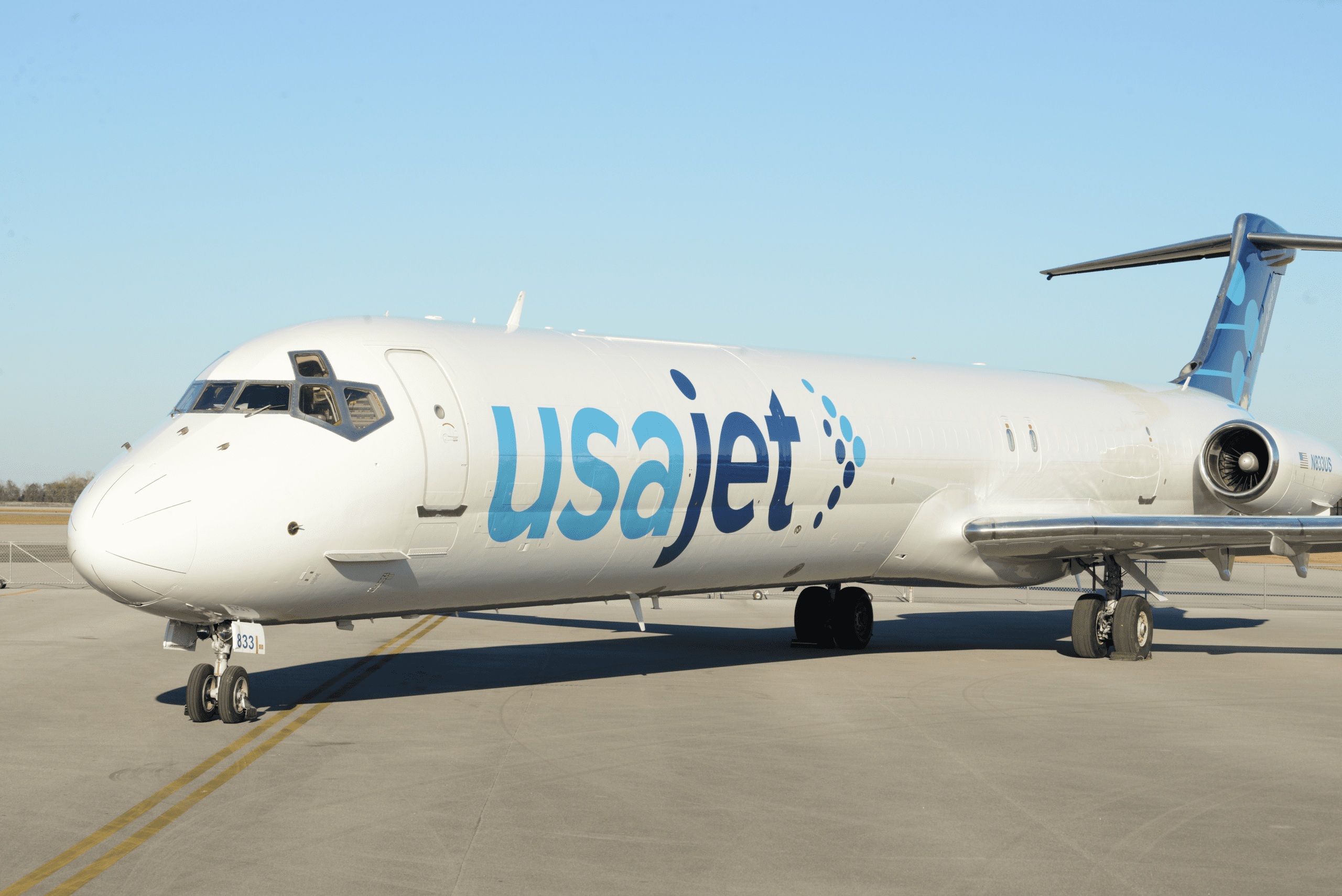
Then there is USA Jet, Ascent’s owned cargo airline. This is a useful wrinkle in a business commonly described as brokerage: the company can arrange capacity in the wider market while also having access to aircraft within its own organization. Ownership does not abolish weather or operational constraints, but it changes the resources available when the clock becomes persuasive.
Customers can buy ground expedite, charter aircraft, book airfreight or use an on-board courier. Less urgent work can move through truckload, less-than-truckload and ocean forwarding services. Customs brokerage and trade compliance address the paperwork that speed alone cannot solve. Managed transportation adds carrier negotiations, reporting and freight audit and payment. The point is having several answers to the same shipping requirement.
PEAK Connect extends that work into a customer’s existing business systems. Its API connects with enterprise planning and warehouse software, carrying workflows such as shipment tendering, status updates and documentation. For an operations team, the appeal is practical: fewer separate places to enter information, and a clearer view of what is moving.
A young name, older machinery
The Ascent name dates to January 2017, when Roadrunner rebranded its Global Solutions business. This was an assembly of existing operations, rather than a tidy garage-founder tale. Active On-Demand became Ascent On-Demand in 2020. That August, Roadrunner spun off Ascent as an independent, privately held company.
An H.I.G. Capital affiliate acquired Ascent in December 2023, following an agreement announced that August. The announced terms kept management as shareholders and Elliott affiliates with a minority stake. H.I.G. described a growth agenda involving technology, capabilities, geographic expansion and the carrier network. In October 2025, Ascent announced Rob Walpole as CEO, bringing experience from Delta Cargo, DP World and DB Schenker.
“We take ownership and follow through.”Ascent’s published guiding principles
A principle becomes more interesting when someone keeps score. In May 2026, Ascent announced its eleventh consecutive John Deere Partner-level supplier recognition, for 2025 performance. Deere’s evaluation covers quality, delivery, process alignment, value creation and relationships. Repeated recognition is a more useful signal here than a stirring adjective: logistics is an exercise in doing the next shipment properly, too.
The bill behind the bill
Ascent earns its place by arranging and delivering transportation and related services for businesses. PEAK supports that transportation business by bringing bids, tracking and documents into its service workflows. Transport Topics lists $1.082 billion in gross revenue and $175 million in net revenue for data through December 2025. Gross revenue should not be mistaken for profit. The two revenue measures alone do not reveal earnings.
Broad alternatives include freight brokers such as C.H. Robinson and RXO, and global forwarders such as DHL Global Forwarding and Kuehne+Nagel. The relevant comparison depends on the lane and deadline. Ascent’s distinguishing combination is time-critical expertise, carrier bidding and owned air capacity, rather than any claim that it alone can move a truck or clear customs.
Try one lane before changing the map
The lesson a reader can copy is a method: examine one unreliable lane, count inventory and rescue freight alongside transportation, then test another route. In the automotive case, the trial supplied the evidence for change. Savings are one side of the payback calculation; the cost of implementing the change belongs on the other.
That method still needs suitable connections, customs handling and enough time. A 25-day ocean route cannot rescue a part needed tomorrow. The useful choice is the least costly option that reliably meets the actual requirement. Ascent’s case invites a better purchasing question: how much are we spending to compensate for the route we already bought?