A single letter can be expensive. Put an N on the side of a sneaker and it can summon a familiar company, a particular shape of shoe, and the expectation that somebody stands behind the stitching. Put a sufficiently similar N on somebody else’s sneaker and you may have the beginnings of a lawsuit. Dan McKinnon spent years dealing with that second possibility at New Balance. The alphabet was small. The job was international.
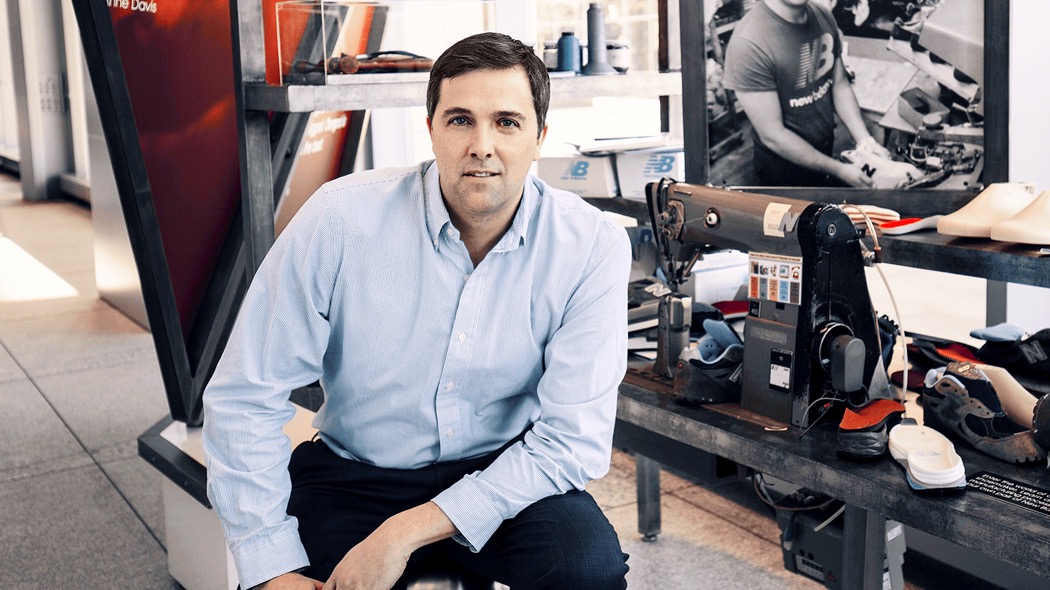
In a photograph from his New Balance years, McKinnon sits beside a sewing machine and a workbench of footwear. It is a useful setting for a lawyer whose business was protecting what those machines helped make. Brand protection can sound like an occupation conducted entirely in correspondence. Here are the objects at stake: shoes, materials, a recognizable mark, and the labor that turns them into something a customer chooses.
His subsequent move has taken that relationship between object and reputation into another business. In June 2021, Proof Authentication appointed him chief executive as it closed its Series A financing. After a career defending a footwear company’s identity, he became responsible for a company selling ways to authenticate products. The familiar question follows him: how does a buyer know that the thing in front of them belongs to the brand on the label?
A letter crosses the border
McKinnon’s connection to New Balance predates the court victories that made headlines. A July 2007 trademark filing identifies him as the company’s corporate in-house trademark counsel. By 2019, he was appearing publicly as head of global brand protection and senior counsel. Those titles cover a range of work, from maintaining legal rights to deciding how to respond when someone starts borrowing them.
China became a conspicuous part of that work. In 2017, New Balance secured a judgment of roughly $1.5 million against businesses selling footwear with lookalike branding, including New Boom. McKinnon was associated with the company’s enforcement effort. A copycat name like New Boom practically supplies its own punchline; the legal problem underneath it is less entertaining. Recognition can travel from one product to another without the maker’s permission.
The New Barlun dispute made the point again. In January 2021, the Shanghai Huangpu District Court ordered New Barlun and Shanghai Shiyi to pay RMB25 million, then approximately $3.85 million, to New Balance. The case concerned sneakers bearing an N similar to New Balance’s mark. The court also considered continued manufacturing and sales after an interim injunction. These were arguments about commercial conduct, alongside arguments about appearance.
The amounts deserve their dates. The $1.5 million result and the RMB25 million result belong to separate proceedings, rather than a tidy sequence of annual scores. The Shanghai Intellectual Property Court’s final judgment in March 2022 held New Barlun and Shiyi jointly liable for RMB25 million. By then McKinnon had moved to Proof. The litigation continued beyond his change of job.
What makes these cases part of his story is the persistence of the underlying dispute. A company can spend years establishing what a mark means and still have to defend that meaning product by product, defendant by defendant. The courtroom offers a way to impose consequences. It also makes clear how much work sits behind a customer’s apparently effortless recognition of a shoe.
- 2017Approximately $1.5 million
China judgment involving New Boom and other defendants - 2021RMB25 million
Shanghai first-instance judgment against New Barlun and Shiyi - 2022RMB25 million
Joint liability in the final Shanghai IP Court judgment
The complaint with something to say
McKinnon’s public remarks about litigation reveal a more practical interest than collecting courtroom drama. At a trademark litigation event, he described using substantial, detailed complaints to encourage an earlier settlement. His reasoning was that a complaint with the substance of a preliminary injunction motion could help move the dispute toward resolution without taking precisely the same procedural route.
He put the desired result plainly: “you get to settlement faster.” The remark gives the work a human scale. A lawyer deciding how much detail to put in a complaint is deciding what another person needs to see before changing their position. Thoroughness has a purpose beyond looking thorough. It can reduce the space in which a dispute is allowed to drift.
Technology was already part of his enforcement vocabulary at New Balance. In a public testimonial for BrandShield, he discussed finding damaging online infringements, recognizing patterns across abusive cases, and using those patterns to identify larger networks. He also emphasized the interface and the efficiency of managing enforcement. His interest extended to choosing where a team should spend its attention.
That is a useful detail in the career of a future authentication CEO. Online monitoring, legal complaints, and product checks operate at different points in the same commercial problem. One helps locate an infringement; another sets out the case against it; another helps establish whether a physical item is genuine. The work asks for both evidence and a usable way to act on it.
“you get to settlement faster”
Dan McKinnon, on substantive legal complaints
A different signature in 2021
The change of job came with a change in what McKinnon was signing. The public stock purchase agreement for Proof’s acquisition of DSS Digital bears his signature as Proof’s chief executive. The company was buying an existing authentication business from Document Security Systems. It was a transaction involving technology already in use, rather than a business beginning with only a pitch and a proposed product.
VCFA Group led the financing associated with the deal. The announcement connected the investment both to the secondary buyout and to growth capital. For McKinnon, the move put business decisions alongside the legal and enforcement experience he brought from New Balance. An acquisition, a financing, and a CEO appointment arrived together.
The proposition Proof presented in 2021 paired a printed authentication mark with a custom smartphone application. Its description was straightforward: a person could check a product in real time. The company said multiple Fortune 100 businesses were already using its authentication solutions. The customer holding a phone now had a role in a process that otherwise might remain inside a brand’s investigative or legal department.
McKinnon’s public ambition at the time centered on the relationship between buyers and brands. He spoke of “transforming how people interact with the brands they love.” That wording places authentication within the experience of owning something. The mark matters because of the object carrying it, and because somebody wants reassurance about that object. A favorable judgment and a successful product check answer related questions at very different speeds.
The buyer gets a part
McKinnon also appears on the other side of intellectual property paperwork. A US patent application published in October 2021 names Daniel McKinnon as inventor of a system for product authentication using a blockchain. The application describes linking authentication to the release of a payment. Assignment records later connect it to Proof Authentication. It is an application, rather than evidence of a granted patent or a product launch.
The idea in that filing adds another angle to his public record. Authentication can have a consequence for a transaction, rather than serving only as information that a buyer reads afterward. The proposal concerns making verification part of how the exchange proceeds. The distinction is worth keeping: a published proposal tells us what was put forward, while commercial adoption is a separate matter.
His public conversations have stayed close to those everyday exchanges. On the IP Goes Pop! podcast, he joined attorneys Michael Snyder and Joseph Gushue for an episode about sneakers and intellectual property. Its subjects included counterfeiting, logos, design patents, authentication technology, and consumer education. The discussion connected the cultural attraction of sneakers with the legal protections around them.
The sneaker is a good object for this conversation. It can be equipment, a collectible, or simply a shoe somebody likes. The person buying it should not need a legal qualification to identify the maker. McKinnon’s work keeps returning to that gap between the sophistication of an enforcement operation and the simplicity a customer expects when making a purchase.
In February 2023, he published a LinkedIn article titled Beware the QR code. The following month, he announced Proof’s membership of the International Anti-counterfeiting Coalition. Alongside the company role, these publications show him continuing to address the people who evaluate authentication and organize brand protection. The audience includes professionals choosing a system as well as consumers encountering one.
The mark meets the manufacturing line
By August 2024, Proof had entered a partnership with Corsearch, connecting its authentication offering with a company providing brand protection and trademark services. McKinnon’s explanation focused on a surprisingly ordinary item: the master art file. He said a brand could incorporate Proof’s mark into that file, without buying additional inks or dyes.
“Our Proof mark can be effortlessly incorporated into any master art file.” It is a sentence about production, far removed from the monetary awards associated with his New Balance years. Yet it addresses an equally important decision: whether a brand can put authentication onto its products through the processes it already uses. Security has to reach the item before anyone can check it.
The partnership connected online brand protection with authentication on the product itself. That pairing gives the career a concrete continuity. McKinnon had used tools to help locate infringements online; at Proof, he was explaining how a mark could be incorporated into manufacturing artwork. The point of intervention had moved closer to the object.
He continued appearing in the legal world, too. Villanova’s April 2024 fashion law symposium listed him on a sneaker law panel alongside Antonio Burrell and Christiane Schuman Campbell. Years earlier, he had joined a Northeastern Law discussion with trademark practitioners and academic Alexandra Roberts, moderated by Susan Montgomery. These settings put him in conversation with people examining the same questions from different jobs.
Proof’s website now keeps its technical discussion brief, citing the confidentiality of its work with clients. The public-facing business asks prospective customers to make contact rather than browse an extensive product explanation. That restraint suits a subject in which a clear customer experience can depend on details that are carefully controlled.
For McKinnon, the change from counsel to CEO has preserved a very tangible concern. Someone makes a shoe. Someone puts a mark on it. Someone else decides whether to buy it. His New Balance work defended the connection among those acts through legal rights and enforcement. His Proof work offers buyers and brands another way to examine it. The letter still matters. So does the shoe underneath.