The surprising thing about Dalton is not that an advertising agency says it understands people. Every agency says that, usually somewhere between the slide labeled “insight” and the slide labeled “activation.” The surprising thing is that Dalton keeps attaching numbers to the claim. Eighteen percent became 36 percent. A basketball promotion became a 15 percent rise in child well-check visits. One extra day became 258 new volunteers. The soft language of empathy keeps returning as hard arithmetic.
This is a useful way to understand the independent agency founded by Jim Dalton in Jacksonville in 1989. Dalton now works from Jacksonville, Atlanta and Nashville, selling strategy, branding, advertising, public relations, paid media, social, websites, video, research and experiential design. That is a long menu. Its clients have included CareSource, VyStar Credit Union, New York Life Investments, Porsche, SCAD, Change Healthcare, Zoo Atlanta and New York Cares. Dalton is the sort of shop a marketing chief can call when the problem refuses to stay inside one department.
The agency grew by collecting missing pieces
The footprint did not appear all at once. Dalton acquired Kilgannon in Atlanta in 2012, then Ant Hill Communications in 2013. It entered Nashville through a 2017 merger with Bill Hudson Agency, a firm with deep McDonald’s experience. Anode followed, adding interactive exhibits, live corporate shows and technologies such as augmented and virtual reality. In 2020, Dalton merged with the Bradford Group, strengthening public relations, social and content in Nashville. The combined operation then counted 93 people across three cities.
Acquisitions often fail first at the seam: two teams, two client lists, two definitions of “how we do things.” Dalton’s answer was not to invent a grand theory of synergy. In 2022 it chose a conversational line that could apply equally to a media planner, a publicist or an exhibit designer. “We get people” is deliberately ordinary. President Brendan Cumiskey described the intent as leaning into why people connect, while also enjoying the clients and the work.

“Instead of yelling into the abyss, say one meaningful thing.”Dalton’s own description of its work
The campaign begins with a human hinge
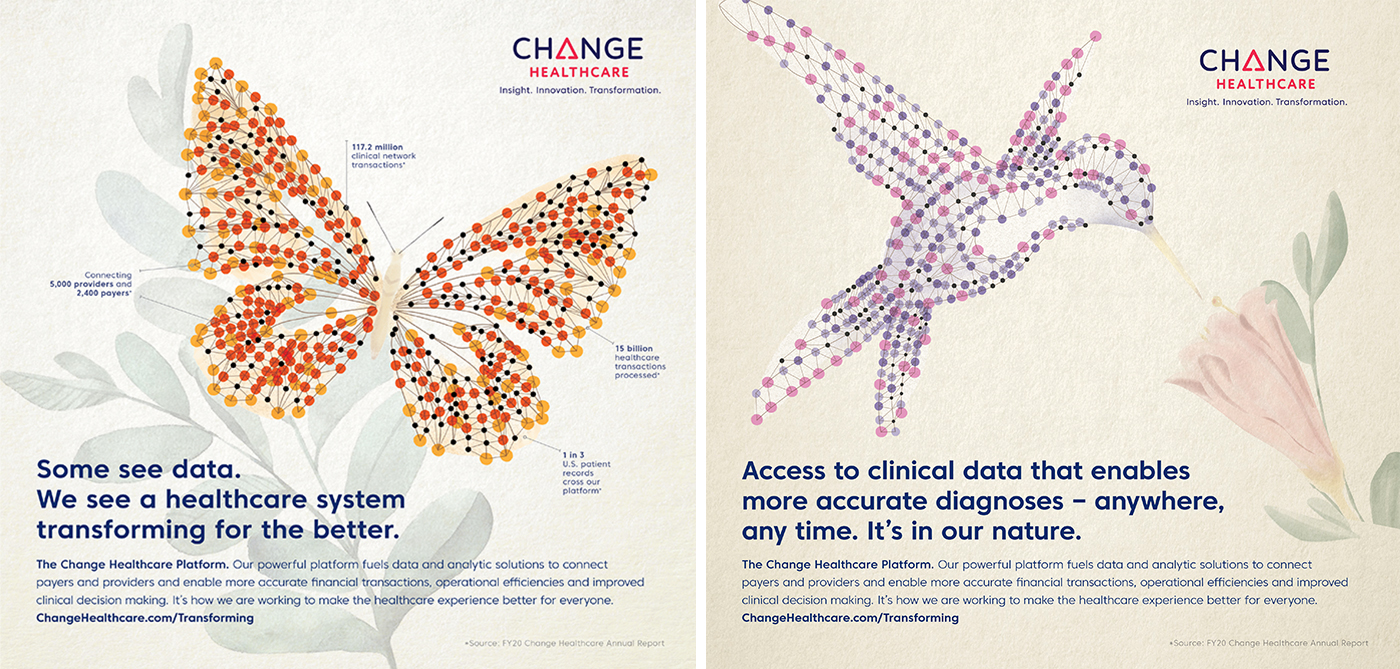
Consider Change Healthcare. The client sold a technology platform to healthcare executives, an audience accustomed to diagrams, specifications and chilly promises of efficiency. Dalton paired data visualization with images from nature. It made an abstract system feel alive. The campaign outperformed benchmarks across nearly every media placement and lifted aided awareness from 18 percent to 36 percent.
The same structure appears in Dalton’s work for CareSource. The problem was not simply that parents lacked information about annual checkups. CareSource’s data showed a local gap in care around College Park, Georgia. Dalton joined with the College Park Skyhawks and turned the familiar anxiety of a missed free throw into a reminder not to miss a well check. There were in-game challenges, LED signs, announcements, social content and providers on the concourse who could schedule visits. The result was a reported 15 percent year-over-year increase in child well-check visits in the market.
One free day, carefully spent
The most charming proof arrived on February 29, 2024. Cumiskey had held onto an idea for four years: what if New Yorkers treated Leap Day as an extra day for helping the city? Dalton developed Extra Day of Care for New York Cares, then expressed it through video, digital banners, social posts, public relations, radio, email, outdoor signs and Times Square billboards. Every piece led to a landing page with volunteer, partnership and donation options.
The campaign’s media placements, worth more than $200,000, were donated. Paid placements produced more than 15 million impressions and news coverage added another 22 million. Hundreds of people joined 46 volunteer projects. Volunteers packed more than 1,500 bags of food. The landing page recorded 258 new sign-ups in one day. The ingenious part was not merely noticing Leap Day. It was giving each channel a precise task, then making the unusual calendar date feel like a social invitation.
VyStar’s “Endless Summer Sweepstakes” was more commercial and no less specific. The credit union offered three million rewards points, worth $30,000. Dalton created a character named Dan, tested television spots, built a landing page and deployed the idea through radio, connected TV, outdoor, branches, email and social. The eight-week campaign produced a 98 percent year-over-year increase in transactions and new cards opened, plus a 313 percent rise in social awareness. Dan also carried home a credit-union marketing Diamond Award. A rhyming spokesman with a symmetrical set is not strategy by itself. Here, he was a memory device attached to an offer and a distribution plan.
What clients are actually buying
Dalton sits between two familiar alternatives. A specialist shop can go deeper in one channel. A holding-company network can marshal armies across continents. Dalton’s pitch is regional closeness plus enough in-house breadth to keep the idea intact from research to reporting. The business earns fees from retained relationships and projects; it does not publish a rate card. The more revealing economics are in the outcomes it chooses to publish: nearly 40,000 leads and a $206.4 million year-over-year sales uplift for a New York Life Investments municipal-bond campaign; more than 104 million advertising impressions for Zoo Atlanta’s IllumiNights; and a 38 percent stock-price increase alongside 44 percent revenue growth during the first year of an international campaign for Blackline Safety.
Gate Hospitality shows what changes a buyer’s mind. Four Northeast Florida clubs had accumulated different agencies and different voices. The first thing to fail was coherence. After considering more than 10 agencies nationally, Gate picked Dalton to treat Ponte Vedra Inn & Club, The Lodge & Club, Epping Forest and The River Club as a connected collection. Branding, creative, media, PR, social and video would share a strategy, while each property retained its own character. Dalton also proposed augmented reality around the guest experience. The work was only beginning in 2026, so the result remains a plan rather than a victory lap.
The useful limit
Integration is not magic. It works when a client has a shared business objective, enough activity to justify several disciplines and the willingness to measure across them. It is less persuasive when the need is a narrow technical assignment, when internal teams cannot agree on the outcome, or when every channel is judged by a different calendar. A full-service agency can remove handoffs; it cannot remove indecision.
Dalton’s own 2026 survey makes the pressure explicit. Forty-nine percent of marketing leaders named high costs and unclear return as their biggest agency frustration. Nearly 45 percent expected to move more work in-house, and 31 percent planned to consolidate their agency rosters. Those numbers are both a warning and a market brief. Clients do not need an outside partner merely because execution is difficult. They need one when outside perspective, a unifying idea and defensible results are difficult to build alone.
Four things worth copying
- Name the audience tension in ordinary language before choosing a channel.
- Give one idea many jobs instead of giving every channel a different idea.
- Set the behavioral measure early: a visit, a lead, a sign-up or a sale.
- Publish the number that matters, not just the object that won an award.
That is why Dalton’s plain little sentence earns its keep. “We get people” could have been a warm slogan pasted over a complicated firm. Instead, the best case studies turn it into a sequence: notice the person, find the hinge, coordinate the work and count what moved. Three words on the door. A calculator in the room.
Keep looking