The long apprenticeship
Craig Chambliss did not arrive in the chief executive's chair by teleportation. His route began in pharmaceutical sales, where strategy has to survive a locked calendar, a skeptical customer and the small indignity of waiting in a hallway. He moved from Bristol Myers Squibb to Alza Pharmaceuticals, then through marketing, business development, commercial operations and company formation. By the time he co-founded Neurelis in San Diego in 2007, he had learned the industry at human scale and balance-sheet scale. The résumé looks tidy now. Living it required rather more calendar.
That range became his operating advantage. Chambliss holds Bachelor of Science degrees in both finance and accounting from Missouri State University. The pairing sounds almost aggressively sensible, but drug development rewards sense. It is a field where promising science must pass through expensive, sequential gates. A founder needs conviction, certainly. A founder who can also read the cost of conviction has a better chance of reaching the next gate with the company intact.
First, learn every handoff
At Alza, which he joined as its commercial organization launched in 1994, Chambliss worked across sales and marketing. At Elan Pharmaceuticals he became director of business development for central nervous system assets. In 2001, he joined former Dura and Elan executives to launch Xcel Pharmaceuticals, a CNS start-up. He led commercial operations there until Valeant acquired Xcel for $280 million in 2005.
The useful detail is not the acquisition price. It is the sequence of jobs before it. Sales taught him how a product meets the market. Marketing taught him how a market is described. Business development taught him how assets and partners are evaluated. Commercial operations taught him how an organization makes a promise repeatedly, across territories and through systems. Founders are often advised to stay in their lane. Chambliss spent years learning where the lanes merge.
“Doing the right thing for the right ethical reasons will continue to garner trust.”Craig Chambliss, in Neurelis's code of conduct
After Xcel, he led commercial operations at Questcor Pharmaceuticals from 2005 to 2007, helping build the infrastructure for a relaunch and a sharper CNS focus. He was also chief business officer at NextWave Pharmaceuticals, where he helped raise a $45 million Series C round as the company repositioned around CNS. Pfizer acquired NextWave in 2012 in a transaction valued above $700 million. By then Chambliss had seen a start-up launched, a company reworked, two meaningful financings and two acquisitions from the inside. Experience had stopped being a list of functions. It had become a map of dependencies.
Seven stops, one accumulating toolkit
Then, respect the long middle
Neurelis makes the clean milestone story inconvenient. It was founded in 2007. Its lead program received FDA approval in 2020, followed by commercial launch. Thirteen years sit between those sentences. They contained clinical work, regulatory work, financing, manufacturing preparation, market-access planning and the assembly of a specialist team. A company can announce a milestone in a morning. It takes rather longer to build the ability to announce it honestly.
Chambliss has described a foundational product as the base from which a biotech can build broader capabilities. The phrasing is revealing. A product is not merely an item on a pipeline slide. It can be the organizing fact that justifies clinical systems, regulatory expertise, commercial infrastructure and durable relationships. The first success pays rent twice: once in revenue, and again in organizational competence.
The company-building flywheel
The first program does more than cross a finish line. It leaves behind people, systems and judgment for the next lap.
Capital enabled the sequence. Chambliss has raised more than $300 million for Neurelis. A $114 million Series D round in 2021 supported commercial growth and pipeline expansion. Fundraising is often reported as though cash were applause. In a development company, it is closer to oxygen with a timetable. Every round must purchase enough evidence, infrastructure and credibility to make the next decision possible.
Raise for the next capability, not merely the next announcement. Capital is most useful when it leaves the organization smarter than it found it.
Neurelis also acquired Aegis Therapeutics in 2018, bringing drug-delivery and formulation technologies into the company. The move fits Chambliss's broader pattern: own or assemble the capabilities that make a focused strategy repeatable. Specialist companies do not become integrated by printing the word “platform” on a presentation. They become integrated when technical assets, operating teams and commercial judgment can work through the same decision process.
The plural pronoun CEO
Read Chambliss's public remarks and a pattern appears. He speaks in plurals. The team assembled the capabilities. Shareholders supplied support. Communities clarified the unmet need. The language is consistent with the company he had to build: no single discipline can carry a medicine from a promising asset into a functioning commercial organization. The heroic-founder costume would be especially ill-fitting here. There are too many lab coats, regulatory binders, capital plans and customer conversations in the room.
His published introduction to Neurelis's code of conduct is similarly operational. Trust, respect, accountability, integrity and teamwork are presented as expectations, not decoration. Compliance, in his formulation, runs through culture rather than sitting beside it. That may lack the glamour of a product reveal. It is also how a regulated company earns the right to continue revealing products.
“Together we share a commitment to continually assess the needs of communities we serve.”Craig Chambliss, after receiving the 2026 regional award
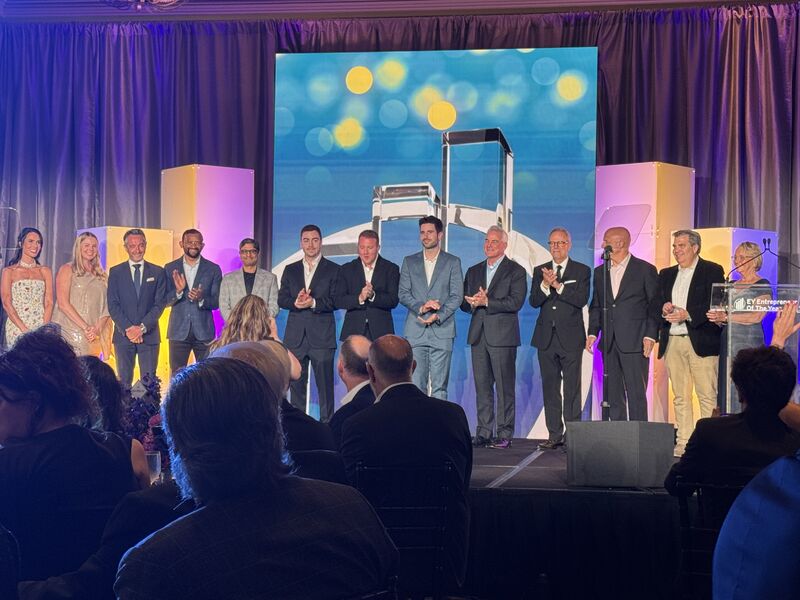
The recognition arrived in June 2026, when EY named Chambliss an Entrepreneur Of The Year Pacific Southwest Award winner. He joined a cohort drawn from Southern California, Arizona and Nevada and advanced for consideration at the national awards. The photograph is the sort of bright, compressed moment business culture adores: suits, stage lights, glass trophies, everyone briefly standing still.
The better portrait is the career behind it. A finance student becomes a salesperson. The salesperson learns marketing. The marketer learns assets and partnerships. The business-development operator learns launches, restructurings and acquisitions. The founder spends thirteen years reaching a commercial milestone, then keeps building. Chambliss's story is not about escaping the details on the way to the corner office. It is about collecting enough details to make the office useful.
Numbers need verbs
The transaction figures around Chambliss can make his career sound like a row of celebratory zeros: $280 million for Xcel, more than $700 million for NextWave, more than $300 million raised at Neurelis. But a number without a verb is just confetti. Xcel was launched. Questcor was repositioned. NextWave was financed. Neurelis was integrated. Each figure became meaningful because an operating team changed what the company could do before the deal arrived.
This is where his finance-and-accounting education meets the hallway lessons of sales. Finance can tell a founder how long the runway is. The field can tell the founder whether anyone wants to board the aircraft. Chambliss's career kept those perspectives unusually close. He learned that commercial reality should inform development early, while the product still has time to become usable, explainable and supportable. He also learned that commercial enthusiasm cannot substitute for evidence. The disciplines restrain each other usefully.
His acquisition record carries another quiet instruction. An exit can reward a company, but an acquisition can also educate an operator. At Xcel, Chambliss saw a focused start-up move from launch to sale. At NextWave, he participated in a financing and repositioning that preceded Pfizer's purchase. At Neurelis, he sat on the buyer's side when the company acquired Aegis. Seller, builder, buyer: the nouns changed. The underlying question did not. Which capability becomes more valuable when joined to the rest?
By early 2026, Neurelis was talking about cash-flow generation and a sound financial foundation. Those phrases are sober by design. For a company built through long development cycles, financial footing creates strategic time. It allows a team to evaluate the next program without treating every decision as an emergency. Chambliss's public comments still emphasized continued investment and expansion. The accountant in him had not defeated the entrepreneur. It had bought the entrepreneur another calendar.
What the next lap requires
Neurelis now describes itself from a position Chambliss spent years trying to reach: financially grounded, commercially established and able to keep developing CNS-focused programs. His stated aspiration is continuation rather than victory. Assess needs, extend reach, add capabilities, advance the pipeline. The verbs are deliberately unfinished.
There is a lesson here for founders outside pharmaceuticals. The glamorous parts of company-building are events. The valuable parts are systems. Learn how work crosses functional boundaries. Give the first successful product a second job as a teacher. Treat capital as a tool for buying competence. Use values as operating instructions. And when an award finally puts everyone beneath agreeable lighting, remember that the stage is a punctuation mark, not the sentence.