The first thing to understand about Neurelis is that its signature product is not a new drug. Diazepam arrived in American medicine in the 1960s. The cleverness is in getting a familiar molecule into a small, single-use nasal device that a person or care partner can carry into the unpredictable geography of epilepsy: a kitchen, a classroom, a soccer field, the back seat of a car.
That practical change is VALTOCO, Neurelis' prescription diazepam nasal spray for seizure clusters. The Food and Drug Administration first approved it in January 2020 for people ages 6 and older, then extended the label in April 2025 to children ages 2 to 5. Neurelis says more than 12,000 patients in that younger group were prescribed the product after the expansion. The indicated event is specific - an intermittent, stereotypic episode of frequent seizure activity that differs from the patient's usual pattern - and the treatment remains a controlled benzodiazepine with boxed warnings. This is rescue medicine, not wellness mist.
The hard part was hiding in plain sight
A nose is a promising route for urgent treatment. It is accessible, vascular and does not require swallowing. It is also stingy. It accepts little liquid. Diazepam is hydrophobic and poorly soluble in water. A formulation must carry enough medicine in a tiny volume, move it through nasal tissue consistently and avoid making the experience so irritating that the elegant route becomes a bad joke.
This is what failed first - not the therapeutic idea of diazepam, but straightforward formulation logic. Earlier intranasal attempts in the field wrestled with variable or suboptimal absorption and unpleasant solvents. Neurelis' own history describes years spent exploring formulations to address solubility and bioavailability. Its eventual recipe used vitamin E to help dissolve the active ingredient and Intravail, an absorption enhancer licensed from Aegis Therapeutics, to help move the drug across the nasal membrane.
The formulation logic, simplified
The distinction matters. A drug-delivery company can look less romantic than a molecule-discovery shop, but delivery is where chemistry meets the patient. The FDA granted orphan exclusivity and recognized the intranasal route as a clinically superior contribution to patient care compared with the previously approved diazepam rectal gel. That language turned usability into regulatory value.
The product was not “diazepam, but smaller.” It was a redesign of the rescue moment.YesPress analysis
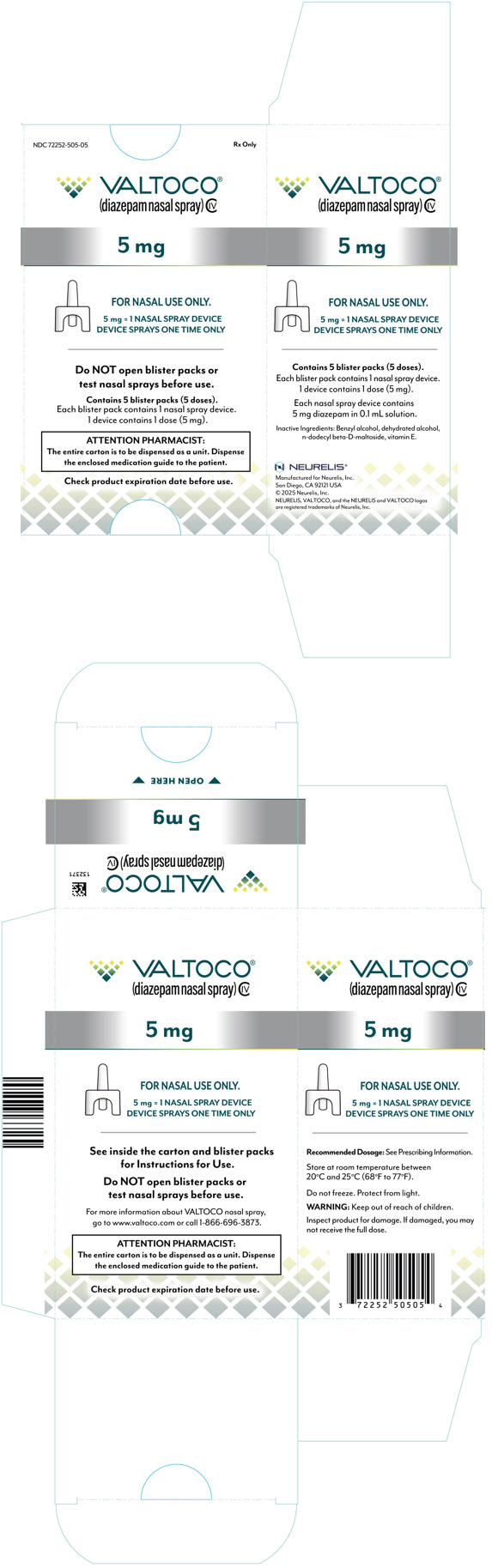
The box has more instructions than swagger. Good. During a seizure cluster, packaging is part pharmacist, part checklist, part tiny fire extinguisher.
The company bought the shovel
Neurelis was formed in San Diego in 2007 by a group including CEO Craig Chambliss and director David Hale. Chambliss had already worked on central-nervous-system products and seizure rescue. The company licensed Intravail, ran proof-of-concept work, earned orphan designation in 2015, received Fast Track status and filed its New Drug Application. Then, in December 2018, it changed the shape of the bet: Neurelis acquired Aegis.
Buying Aegis meant the company no longer merely rented a crucial ingredient in VALTOCO. It owned Intravail plus the ProTek and Hydrogel stabilization technologies. The choice created two businesses under one roof. Neurelis could commercialize an owned rescue product, and it could participate when other companies used the platform. Its current pipeline page points to three FDA-approved partner programs: TOSYMRA for acute migraine, neffy for severe allergic reactions and OPVEE for opioid overdose.
This is the moment that appears to have changed management's mind about what Neurelis could be. The company began as a CNS product developer. After buying Aegis, it also became the owner of a reusable delivery layer. That does not make every molecule a candidate for nasal delivery. It does mean the expensive learning from one product can travel.
Who pays, who prescribes, who actually uses it
The user is a person with epilepsy who has a prescribed seizure action plan, often with a parent, teacher, school nurse or other care partner nearby. The customer map is more crowded. Clinicians prescribe. Pharmacies dispense. Distributors move inventory. Insurers decide access and patient cost. Advocacy groups help families discuss rescue plans before an emergency. A product can be clinically sound and commercially inert if any one of those handoffs breaks.
Neurelis built a specialty commercial organization rather than licensing away the United States. It reported coverage of more than 175 million insured lives within three months of launch and later more than 285 million. Internationally, it chose partners: China Medical System holds rights in several Greater China and Asian markets, while Aculys Pharma covers specified Asia-Pacific territories. That division preserves the home-market economics while avoiding a do-everything-yourself fantasy overseas.
The funding matched the phase. In March 2021, after approval, Neurelis closed a $114 million Series D led by a group including Cormorant Asset Management and Decheng Capital alongside existing investors LYZZ Capital and HBM Healthcare Investments. Five months later, OrbiMed provided a senior term-loan facility of up to $150 million. Equity supported commercial penetration and pipeline expansion; the staged credit facility added scale and optionality. By the end of 2025, Neurelis reported more than $175 million in cash, no bank debt and an EBITDA margin above 30 percent.
VALTOCO does not have the rescue market to itself. UCB's NAYZILAM is a midazolam nasal spray. DIASTAT and authorized diazepam rectal gels remain alternatives. Aquestive's LIBERVANT places diazepam in a buccal film. The routes, age ranges, dosing and payer positions differ, and no head-to-head trial crowns a universal winner. Neurelis' differentiation is a bundle: a nasal route, weight-based configurations across ages 2 and older, formulation IP, a substantial evidence program, market access and a long-duration patent estate that the company says includes issuances extending to 2032.
What a reader can steal
The copyable part is not “put medicine in a nose.” It is the sequence. Neurelis chose an urgent, specific job where the existing workflow carried a real human cost. It paired a known active ingredient with enabling technology. It gathered the clinical and regulatory evidence needed to make convenience count as care. It then bought the enabling layer, built distribution around one commercial wedge and let partners validate the platform in adjacent categories.
Find the moment where users hate the current workaround, not merely the product category.
Separate the proven core from the unsolved interface. Here, diazepam was known; delivery was the frontier.
Own the bottleneck when it becomes strategic. Neurelis licensed Intravail, then acquired Aegis.
Use one sharp wedge to finance a platform, instead of asking the platform story to finance itself.
There is a second lesson in what Neurelis did not do. It did not launch ten consumer sprays and call itself a platform. It spent more than a decade getting one regulated rescue product across the line. The platform claim became credible after the wedge worked, after partner products reached the market and after the commercial organization demonstrated reach.
Where the playbook breaks
This approach fails when the new route does not materially improve care, when absorption cannot be predictable, when local tolerability is poor, or when frequent use magnifies irritation. It also struggles when reimbursement cannot support years of trials and regulation, when patent protection is weak, or when a simpler generic alternative is good enough. A delivery platform is leverage only after one demanding use case proves it.
The second-act question
VALTOCO is now the engine. Neurelis estimated 2025 net sales of $295 million to $300 million, more than twice the prior year. The question is whether it can turn that engine into a repeatable neuroscience portfolio. NRL-1004 is an investigational Intravail-based program for acute agitation. NRL-1049 is a different kind of bet: a Phase 1 Rho kinase inhibitor licensed from BioAxone for cerebral cavernous malformations, a rare condition with no FDA-approved drug treatment. Neurelis reported dose-proportional exposure and a favorable safety profile from the early study, but an early safety result is a starting line, not a product.
That tension makes the company worth watching. Neurelis has already answered the first hard question: can a small company turn an old molecule and a better route into a substantial commercial franchise? Yes. The next question is less tidy: can the same culture of formulation patience, clinical detail and commercial focus produce another owned product that is not VALTOCO?
Chambliss likes the phrase, “Progress is our passion. The patient is our purpose.” Corporate mottos are cheap. A 13-year development clock is not. Neurelis' most convincing statement is the sequence of decisions: stay with the ugly technical problem, buy the technology underneath it, finance the launch after approval and widen the age range through more evidence. The spray is small. The discipline behind it is not.