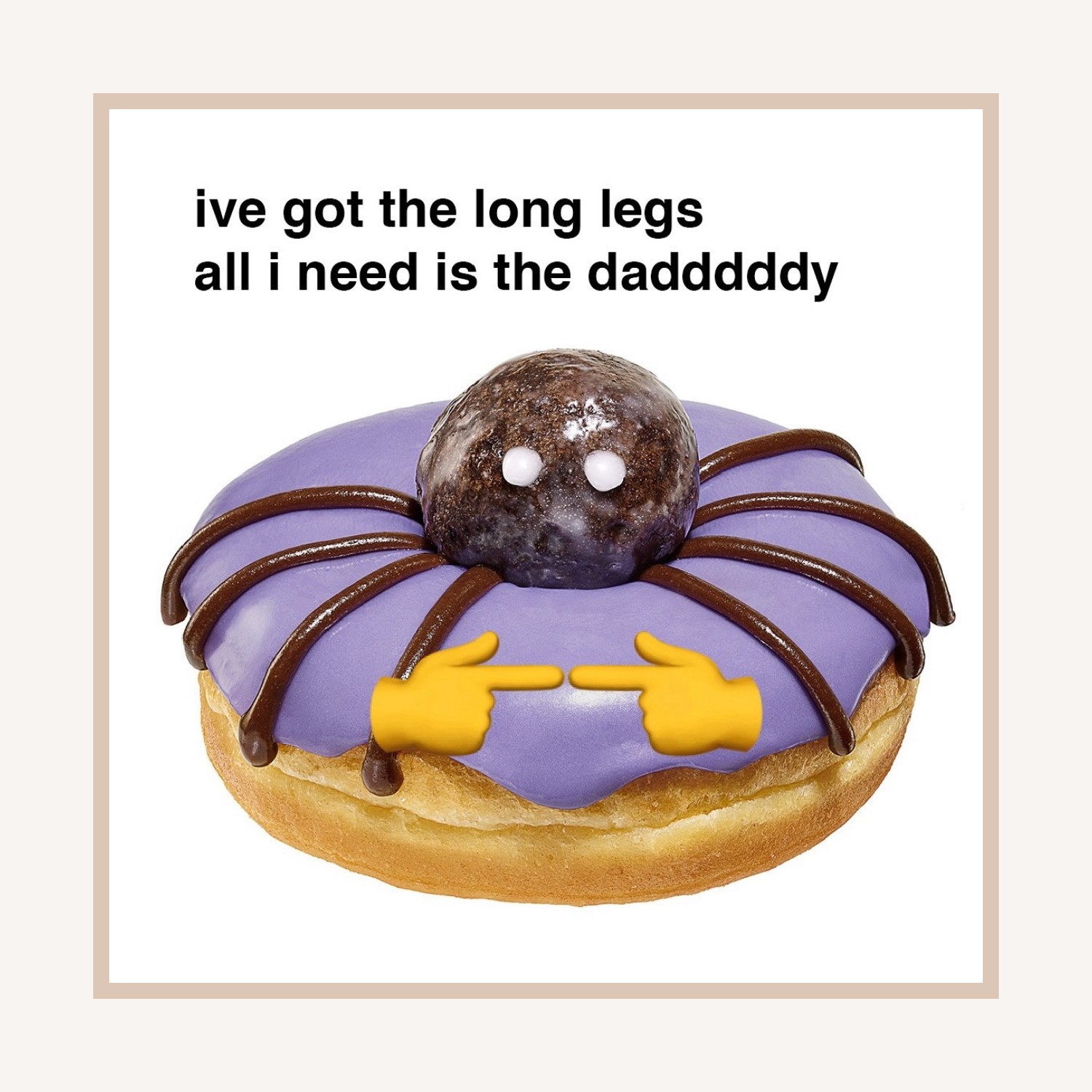
In October 2024, Dunkin's social accounts were commandeered by a purple-frosted doughnut with a chocolate Munchkin for a head, eight icing legs, and the literacy of a raccoon on cold medicine. He called himself Spidey D. He changed the profile pictures. He insulted the audience. He announced, in the manner of a tiny pastry despot, that he was in charge.
For one week, the character posted 28 times across Dunkin's channels. The team behind him replied to people more than 1,000 times. His last offense was leaking the holiday menu, which became Dunkin's most-liked product launch at the time. Then the brand killed him off in a mock apology that concealed a message: SPIDEY FOREVER.
The numbers sound like the sort of slide an agency would animate slowly. More than 700,000 shares. More than 30,000 comments. More than 2.5 million engagements. One hundred thousand new followers. An additional 2.9 billion earned impressions as television hosts, newspapers, influencers, and ordinary people carried the joke. The Spider Donut had its best-selling year. There was no paid media. Production cost less than $5,000.
The people who knew the old plan
Cornelia Creative was founded in New York in 2021 by people who had watched attention migrate away from the places where advertisers were accustomed to buying it. Conor Mason had spent seven years at Anheuser-Busch InBev, managing digital work for Busch and Bud Light. His résumé included an Area 51 beer can, a search for a Chief Meme Officer, and bringing Dude With Sign to the Super Bowl. The experiments changed his mind about what a small, shareable unit of culture could do.
Mason joined Molly Fedick and Kristina Mulle, creators and marketers steeped in meme advertising, and George Resch, better known as Tank Sinatra. Resch had already built enormous comedy accounts, including Tank's Good News and Influencers in the Wild. Their premise was not simply that memes were popular. It was that the people making them understood an overlooked form of distribution.
“The focus shouldn't be about what the brand is saying. It should be on what people are going to say about what the brand is saying.”Conor Mason, on designing Spidey D for sharing
This distinction is Cornelia's business. A conventional creative agency makes an artifact and may hand it to a media agency. An influencer shop finds a personality and negotiates the post. A social team keeps the calendar filled. Cornelia folds these jobs together: brand voice, short-form creative, a network of meme pages and creators, posting, community management, reporting, and analysis.
The company sells three plainly named services. Meme campaigns place custom creative through relevant pages. Organic social gives a brand an ongoing voice that can survive Tuesday afternoon, not only launch day. Earned-media concepts are designed to provoke the screenshot, reply, remix, newsroom item, or group-chat forward that advertising budgets cannot directly purchase. Its public clients include Dunkin', Lyft, Chomps, DoorDash, and Sonic. The buyer is usually a consumer-brand marketing team with a familiar problem: the brand is visible, but its social presence feels as though it was approved by twelve people in a windowless room.
A plot, not a post
The Spider Donut was already a seasonal product with a cult following. What failed first was not a piece of creative. It was the old assumption that modest awareness could be repaired by adding impressions. Dunkin' had an ambitious sales goal, almost no production money, and no above-the-line support. Organic social was the only lever.
Cornelia examined what had performed on Dunkin's channels and found a permission slip in the data: the more absurd, surprising, and comic the posts became, the better they tended to travel. So the team did not make a series of attractive doughnut announcements. It made a character with a motive. Spidey D hijacked the accounts, posted several times a day, heckled followers, leaked confidential information, and met an ominous end. Each installment gave the audience a reason to return and another object to pass around.
Use channel behavior to locate the tone an audience already rewards.
A character with wants can create the next post; a slogan usually cannot.
Replies, hidden messages, escalating antics, and an open plot invite the audience inside.
More than 1,000 responses turned community management into the live performance.
That last line matters. “Going viral” is often described as a lightning strike because that lets everyone ignore the person standing in the rain holding a metal pole. Cornelia could not order 2.9 billion impressions. It could, however, publish with unusual frequency, write a voice sturdy enough for improvisation, respond at scale, and arrange each beat so the audience had something new to discover. The outcome was uncertain. The labor was not.
The client buys permission, too
Cornelia's model depends on a particular bargain. The agency brings cultural fluency and a creator network; the client permits behavior that a normal approval chain might sand smooth. Spidey D worked because Dunkin' could tolerate misspellings, mock hostility, a fake account takeover, and the theatrical death of its own product mascot. The concept fit an inexpensive, silly Halloween doughnut and an audience already inclined to play.
Favorable conditions
A familiar consumer product, a playful voice, fast approvals, active community management, and an audience that already makes culture around the category.
Poor conditions
High-stakes claims, regulated messages, a solemn brand promise, slow legal review, or any campaign that needs predictable reach on a fixed date.
This is also where the approach stops being a universal recipe. Meme-native work can underperform when a brand treats internet fluency as borrowed slang, when every reply requires three approvals, or when comedy trivializes the customer's problem. Earned reach is not guaranteed inventory. A launch that must reach a known number of people by Friday still needs a dependable distribution plan. The lesson is not to fire the media buyer. It is to stop asking paid placement to make uninteresting work interesting.
The 2025 return of Spidey D shows what happens when a brand keeps the permission. The character moved beyond the phone: a Salem shop was marked up, menu boards and apps were invaded, merchandise appeared, a million coffees were given away, and billboards joined the fiction. Sales and social engagement passed the prior year's totals before Halloween. Cornelia and Dunkin' had converted a viral post cycle into a small recurring universe.
Steal the structure, not the slang
The most copyable part of Cornelia's work is not the lowercase typing or the deliberate chaos. Those are costumes. The portable idea is to design backward from voluntary distribution. Ask what a person receives by sharing: a laugh, a useful signal, a way to declare taste, or an invitation for someone else to join. Then give the campaign a sequence rather than a pile of interchangeable assets.
- Start with a behavior the audience already rewards, not a trend the brand discovered yesterday.
- Create a character, tension, or question that can produce several distinct beats.
- Plan the comments and replies as carefully as the headline posts.
- Leave an opening for the audience to change, extend, or decode the story.
- Measure what escaped the account: shares, remixes, pickup, conversation, and sales.
Cornelia occupies a narrow and useful place in the market. It is small enough to write in the rhythms of the feed, but its founders have sat on the brand side and understand why marketing leaders want reporting, control, and business results. The agency is neither a software product nor a marketplace. It is a creative-services business whose edge lives in taste, relationships, speed, and the unglamorous ability to answer the 863rd comment without breaking character.
The Shorty Awards eventually gave the 2024 takeover three category wins and several additional honors. Nice hardware. But the cleaner verdict came earlier, in the oddest possible form: people repeatedly asked a multinational restaurant chain to bring back a rude, badly spelling doughnut. The audience did not behave like an audience. It behaved like a fandom. For an agency selling earned attention, that is the receipt.
Continue down the rabbit hole