In August 2017, a ticket to Color Factory cost $32. It bought admission to a temporary San Francisco exhibition, not membership in a venerable institution. The first month sold out. By the time another 26 days were released, those tickets disappeared too. On Craigslist, resellers were asking around $80. For an exhibition about color, the market was sending a remarkably plain message: people wanted in.
- A temporary exhibition became permanent venues in three cities.
- Visitors participate in the art, with treats and photo stations along the way.
- Local artists and references give each location its own character.
- Tickets, private events, and retail support a for-profit business.
The interesting question is what those people were buying. Certainly, there were photographs to collect. Yet a picture alone seems an incomplete explanation for the appeal of rooms you can smell, taste, move through, and share. Color Factory packages an occasion: a manageable outing where the activities have already been invented and nobody has to volunteer to be the entertaining one.
A month was too small a container
Jordan Ferney, the creator of the celebration blog Oh Happy Day, conceived the original experience. Artist Leah Rosenberg became its creative director; designer Erin Jang served as art director. Their 12,000-square-foot, two-story San Francisco space held 15 installations, with contributors including Jacob Dahlgren and Tosha Stimage. A party-minded sensibility met the practical work of commissioning art and getting people through a building.
The sold-out opening run supplied evidence that a temporary timetable could be stretched. New York followed in 2018, Houston in 2019, and Chicago in 2022. Calling these venues museums places them in a familiar cultural category. Their commercial proposition sits equally comfortably among attractions, date-night destinations, and family entertainment. You buy a visit, then become part of what happens inside.
Pop-up
Permanent venue
Permanent venue
Permanent venue
The room asks you to do something
Consider Chicago. Visitors can sit opposite a partner for a guided exercise in connection and creativity. They can encounter a theater designed for mouths, matching flavors and colors through a viewfinder. Confetti borrows the palette of the city’s flag. These are specific invitations, useful to a visitor who might find an ordinary gallery intimidating or struggle to keep an entire family interested in the same activity.
Color Factory’s expertise is in combining artist collaboration, spatial design, sensory cues, and visitor movement. Its Chicago collaborators include Christine Wong Yap and Emilie Baltz, alongside organizations such as MCA Chicago and 826CHI. Local specificity matters. A repeatable business needs familiar activities; an appealing destination also needs reasons to belong where it stands.
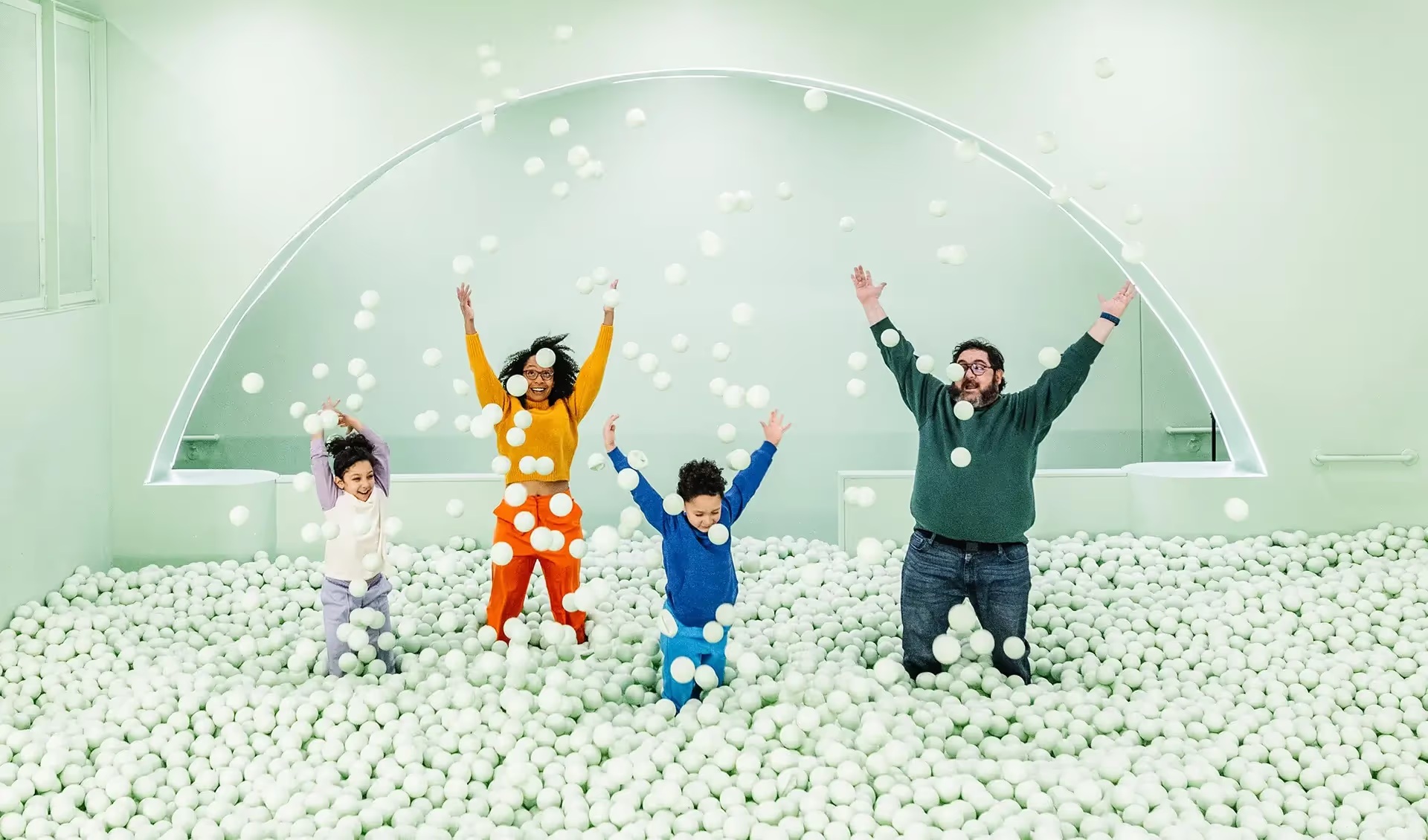
That green room makes the point economically. The activity is immediately understandable, while the reference gives it a Chicago accent. Houston has drawn colors from NASA, Astrodome seating, and Shipley doughnut frosting. The attraction can expand without requiring each city to pretend it is somewhere else. The Houston walkthrough makes those connections visible.
A photograph without the photographer’s exile
There is a pleasing contradiction in a photogenic attraction encouraging visitors to put away their phones. Installed photo stations offer one practical answer: everybody can appear in the picture. Registration connects a visitor’s QR code to their photos. The person who ordinarily records the family outing gets a chance to inhabit it.
CEO Tina Malhotra has described encouraging visitors to put down their phones and pay attention to the experience. The interview connects color with familiar sensory associations, including the relationship between a scent and the color it brings to mind. The picture remains a souvenir, while the room offers something a scrolling feed cannot supply.
“We encourage our guests to put their phones down, to be present”Tina Malhotra, Color Factory CEO
The economics behind the confetti
Color Factory operates for profit. Individual admission is the obvious sale, but private events and full venue buyouts sell the space to a different customer: someone arranging a celebration or company gathering. Online and on-site shops add merchandise. Gift cards sell a future outing. These offers turn the same creative infrastructure into several purchases.
The early price points are instructive: $32 in San Francisco and $38 at the New York launch. They are historical prices, not today’s quote. Current admission varies by location and day. Dealroom records a $10 million Series A in May 2021 involving Kickstart Fund. That figure describes financing; it does not tell us the price of building a room or whether a venue is profitable.
When the visitors could not come
The pandemic exposed the model’s dependence on physical attendance. Houston closed for roughly two months in 2020; New York for three to four, according to a 2022 executive interview. The company considered a digital version and focused instead on reopening. An installation that asks people to share a room has a difficult time replacing that room with a browser.
For someone building an experience business, the copyable lesson is modest: test demand with a bounded run, make participation legible, and solve small visitor frustrations. The analogy has limits. Buildings require upkeep, staffing, and sufficient paid attendance. A photogenic launch provides evidence of interest; it cannot by itself establish the economics of a permanent attraction.
Color also needs a volume control
In February 2026, Sensory Friendly Hours introduced reduced capacity, softer lighting, and lower sound. They run on the second Thursday of the month from 3 PM until closing, subject to availability. KultureCity bags provide additional support; EnChroma glasses are available to borrow for red-green color blindness, with results varying by user.
These changes acknowledge that abundant stimulation is not equally comfortable for everyone. September’s Haunted Hues announcement adds seasonal novelty for another visit. Together, the quieter sessions and changing rooms suggest a company working on the occasion it sells. The useful question for a visitor is whether this particular form of shared play suits their companions. The useful question for a business is how carefully it has made joining in possible.
Go see the colors
Visit and book · Plan your visit · Latest news · Private events
Instagram · LinkedIn · X · Facebook · TikTok
Watch Color Factory on YouTube · Watch the Houston tour with Tina Malhotra