The most revealing thing about Conor Flynn's career may be the job he decided against. During a summer internship at Merrill Lynch, the investment banking future he had imagined lost its appeal. Financial models could describe what might happen to a property. He wanted to see the property change. There is a considerable difference between completing a spreadsheet and walking past something that used to exist only inside one.
He joined Kimco Realty as an asset manager in 2003. His father had worked with the company's founders, Milton Cooper and Marty Kimmel, so this was familiar territory. Flynn acknowledges that connection when telling his story. He also describes himself as an “old school company man.” By January 2016, the company man had become chief executive. He had spent the intervening years learning what the company actually did.
His subject is the open-air shopping center: the grocery store, the neighboring shops, the places visited between other obligations. It is an unceremonious setting for a career in public-company leadership. That is part of its interest. A shopping center has to earn the next visit, then the one after that. Flynn has built his professional life around finding reasons for people to return.
An apprenticeship with a balance sheet
The route to the corner office ran through the operating business. Flynn held leadership posts including president of Kimco's Western Region, chief operating officer and chief investment officer. When the board named him president in August 2014, he retained the other two corporate titles. His responsibilities stretched from leasing and construction to property management and investment decisions. The job description was practically a guided tour of the business.
A shopping center offers plenty of ways for a promising investment to become an awkward afternoon. A tenant needs a different space. A redevelopment needs a different budget. An attractive acquisition needs someone to ask an unattractive question. Experience across those functions gives an executive more ways to interrogate a proposal before approving it. Flynn's advancement put him on several sides of the same decisions.
His education supplied another part of that preparation: an undergraduate degree from Yale and a master's in real estate development from Columbia. The latter connects his financial training with his interest in physical change. In October 2023, he returned to Columbia's architecture, planning and preservation school for an event organized by its real estate development program. The former student was now the visiting executive.
The advice that survived the promotion
Before Flynn succeeded David Henry, his predecessor gave him a warning about the distance that can open between headquarters and the people paying rent. Henry urged him to keep close to retailers and the everyday fundamentals of the business. Flynn said he had taken the advice seriously. The promotion would enlarge his responsibilities; it would also make maintaining those relationships a deliberate task.
At the time, Kimco had a program called KEYS that offered qualifying entrepreneurs a year of free rent and other benefits, with the possibility of becoming long-term tenants. Another initiative, LABS, invited employees to propose ideas for the business. These were practical expressions of an operating concern: a landlord's future depends partly on whether other people get the chance to build theirs.
Flynn put it plainly in 2015: “It's all about people.” That is an easy sentence to applaud and a harder one to make useful. A shopkeeper needs workable terms, an employee needs a hearing, and a property needs someone who will notice its problems. The business becomes more convincing when the sentiment has an address.
“It's all about people.”
Conor Flynn · 2015
A smaller map, a closer look
Taking over Kimco did not mean treating its existing shape as sacred. In 2016, Flynn described a company moving away from a broad international footprint toward a more concentrated American portfolio. Mexico had been exited; the Canadian exit was nearing completion. Within the United States, a scattered collection was giving way to clusters around major metropolitan markets. There was also a push to simplify joint ventures and gain more control of assets.
The logic was partly managerial. A collection of properties can look reassuring on a map while making daily operations more complicated. Concentration asks a different question: how much can a company understand about the places where it already works? Knowing a market means knowing which tenants want to enter it, which buildings need attention and which redevelopment ideas deserve another meeting.
Flynn also talked about shopping centers as a kind of alternative main street. The phrase gives a social purpose to the operating plan. A collection of leases becomes a place where a neighborhood spends time. The aspiration is easy to state; the difficult work is arranging the businesses and spaces so that people have a reason to stay.
The grocery list as a business plan
Kimco's current portfolio emphasizes grocery-anchored centers and mixed-use properties in first-ring suburbs of major metropolitan areas, including coastal markets and Sun Belt cities. The tenant mix centers on everyday goods and services that can bring shoppers back several times a week. By June 30, 2026, the company held interests in 564 U.S. shopping centers and mixed-use assets totaling 100 million square feet.
The attraction of groceries is the repeat appointment. Dinner has an inconvenient habit of needing to happen again tomorrow. That recurring trip can give neighboring businesses access to customers who already have a reason to be nearby. A landlord still has to choose tenants and manage costs, but the setting comes with a useful starting point: an ordinary errand.
In June 2025, Flynn pointed to roughly 13 years with virtually no new supply of open-air shopping centers. He paired that observation with continuing retailer expansion and an emphasis on convenience and value. Limited construction can strengthen the position of existing owners. It also makes the question of how to use an existing site more consequential. The next opportunity may sit inside a property already on the books.
An empty shop can be a beginning
Flynn's public comments about retail often return to the changing use of space. In 2024, he described converting more than 30 former Bed Bath & Beyond locations for tenants including off-price retailers and grocery operators. He reported a 40 percent rent increase on those backfilled spaces. A retailer's departure had become a leasing assignment, with a different set of names above the doors.
He has also emphasized the interplay between online and physical shopping, including buying online and returning in a store. That makes the store useful beyond the transaction completed at its checkout. The appeal to a property owner is straightforward: a building can participate in more than one part of a customer's shopping routine. Retail's changing habits give the same square footage new jobs.
This helps explain the continuity in Flynn's career. The early attraction was seeing a before and after. The executive version involves arranging the capital, leases and construction that allow that transformation to occur. Even at a portfolio of hundreds of properties, the work eventually comes back to a particular piece of space and the question of what belongs there next.
Buying more places to get right
Redevelopment has been accompanied by acquisition. In January 2024, Kimco completed its purchase of RPT Realty, adding 56 open-air centers and 13.3 million square feet to its portfolio at the time. The transaction expanded its presence in target markets and brought opportunities to combine operations. Flynn framed the deal around growth, economies of scale and maintaining the balance sheet.
The distinction matters. Buying properties changes the size of a company immediately. Making those properties work together takes longer. Tenant relationships, leasing decisions and investment priorities have to survive the change in ownership. An acquisition announcement can fit into a morning; integrating a portfolio has a much less cooperative calendar.
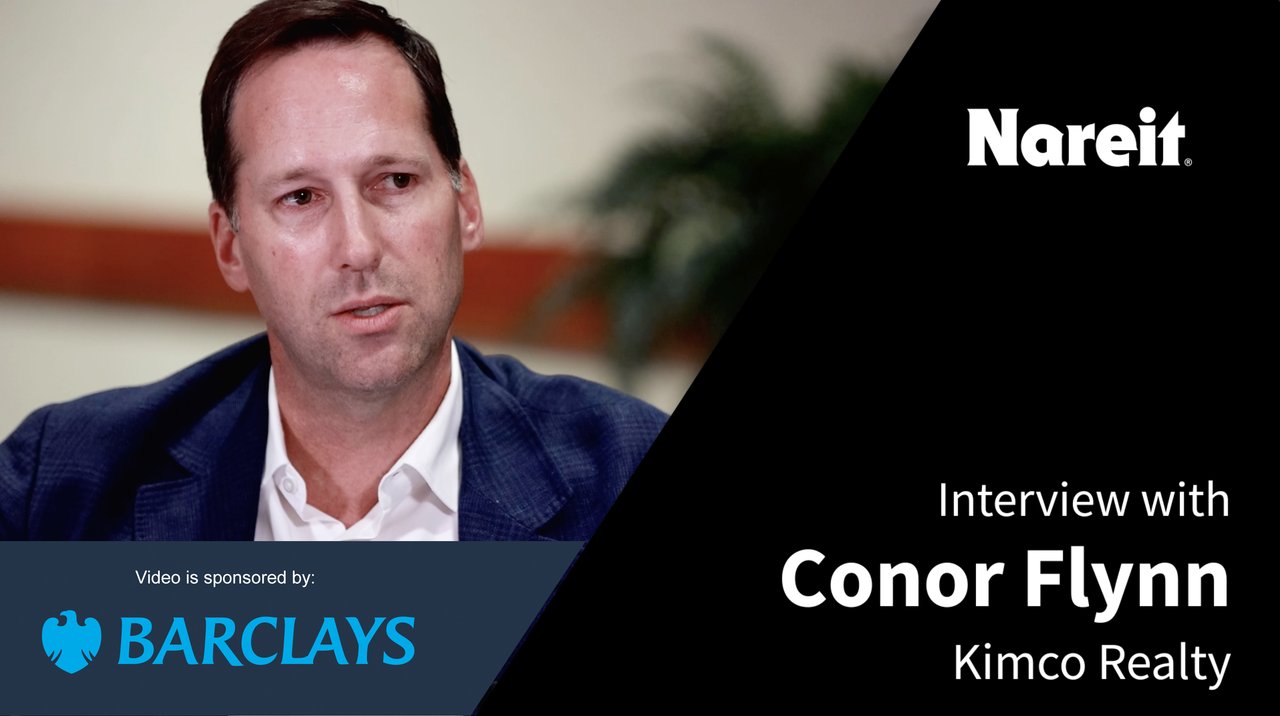
Flynn's work has also extended into industry leadership. He served as Nareit's chair in 2025 and is ICSC's vice chairman in 2026. Those roles place a shopping-center operator inside broader conversations about property ownership and investment. His remit has widened since the asset-management job. The underlying concerns remain recognizable: who uses the space, what they need and how an owner pays for improvements.
The rent roll meets the real world
How much space was leased?
The second quarter of 2026 supplies a dated view of the business he leads. Kimco reported pro-rata leased occupancy of 96.4 percent and small-shop occupancy of 92.9 percent. It executed 461 leases totaling 2.5 million square feet. Same-property net operating income rose 3.5 percent from a year earlier. The figures describe a particular quarter, with all the limits that implies, rather than a permanent condition.
The same results included the $142.3 million sale of The Milton, a 253-unit apartment building at Pentagon Centre in Virginia. It was Kimco's first multifamily asset disposition. A site can accommodate different uses; an owner can also decide when to sell one of them. Development brings a building into the portfolio. Capital allocation decides how long it should remain there.
There is room in this career for interests beyond leases. In a 2016 interview, Flynn listed golf, tennis and paddleboarding among his hobbies and Watch Hill, Rhode Island, as a favorite vacation spot. Those are details from that moment, a small glimpse of a person whose public conversations otherwise tend to involve property. They offer a pleasant reminder that even an asset manager may occasionally leave the assets alone.
Still, the professional thread is unusually consistent. Flynn wanted work whose outcome could be seen, joined a company he already knew and learned it from several desks before taking charge. His career can be followed through promotions and portfolio totals. Its more tangible record sits in the buildings themselves: a new tenant, a changed use, another reason to stop by on the way home.
Keep the conversation going
More from Flynn, on screen and in print.
YouTube · Flynn in conversation with Terry Montesi ↗Listen · The evolving open-air shopping center ↗Read · Kimco’s 2020 Vision, a 2016 interview ↗Company results · Second quarter 2026 ↗Kimco Realty · Official website ↗Conor Flynn · LinkedIn ↗Kimco · X ↗Kimco · Facebook ↗