RETAIL REAL ESTATE Federal Realty acquires The Summit in Birmingham for $508 millionRETAIL REAL ESTATE Federal Realty acquires The Summit in Birmingham for $508 million
Company / The economics of place
Federal Realty bets on the second errand
A shopping center gets you through the door. Federal Realty wants to give you a reason to stay - and another reason to come back tomorrow.
On November 7, 2002, Santana Row opened with 35 retailers and no restaurants. For a development intended to make shopping, dining and living feel like parts of the same day, this was an awkward introduction. Eighty days earlier, a fire had destroyed residential construction in its largest building. Federal Realty Investment Trust had to begin selling a neighborhood while important pieces were missing.
THE STORY IN THREE STOPS
The business: own retail locations and keep making them useful.
The mechanism: combine tenants and uses that give people reasons to return.
The price: patient ownership still demands substantial reinvestment.
A year later, the company reported more than 90 stores and over a dozen restaurant choices. Urban Outfitters had signed a lease after its sister brand Anthropologie established itself there. The initial opening had been incomplete; the response from tenants supplied something a rendering could not: evidence that businesses wanted more of the address.
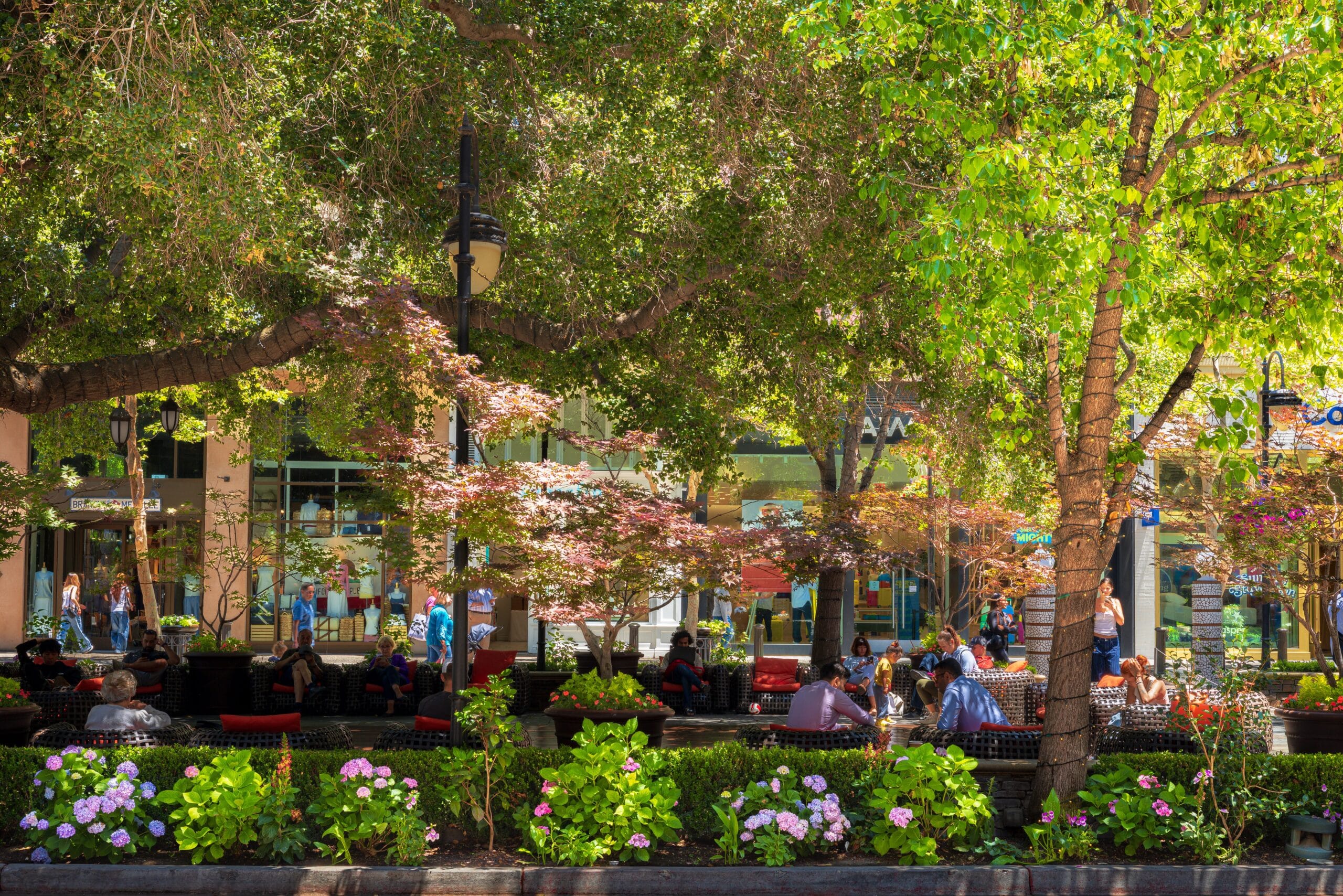
The seats are occupied. The shops are right there. At Santana Row, even the pause between purchases has somewhere to happen.
01 / The tenant next door is part of the product
That detail helps explain Federal Realty. The company owns and operates shopping centers and mixed-use districts, collecting rent from the businesses and residents inside them. Its real operating puzzle is what belongs next to what. A supermarket, an apartment building and a restaurant draw people on different schedules. Put them within convenient reach, and one address can serve several parts of a week.
Samuel J. Gorlitz co-founded the trust in 1962 through purchases of three Washington-area properties, including Congressional Plaza. The portfolio now spans everyday shopping centers and places such as Santana Row in San Jose, Pike & Rose in Maryland and Assembly Row near Boston. The common thread is the search for locations where tenant demand exceeds available supply.
For a shopkeeper, Federal Realty offers premises, property management and a surrounding mix of businesses. Office tenants get workplaces near food and services; apartment residents get homes within an active district. Shoppers are essential participants, although the rent-paying customer is usually the tenant. Public shareholders own an interest in the enterprise through NYSE-listed FRT.
HOW THE ADDRESS EARNS ITS KEEP
01Bring people inGroceries & daily services
02Give them optionsDining, shops & shared space
03Bring them backHomes, offices & repeat routines
One address, several reasons to visit. A schematic of the mixed-use logic, not measured customer behavior.
Assembly Row makes the proposition tangible: retail and restaurants alongside offices, apartments, a six-acre riverfront park and a dedicated MBTA station. Access belongs in the business model. A tenant’s potential audience includes people who can arrive without making a special driving expedition. The park gives them somewhere to spend time between appointments.
02 / A $32 million rearrangement
The quieter version of this strategy happens at an existing shopping center. At Andorra in Philadelphia, Federal Realty outlined a $32 million reinvestment in February 2026. Its plan reworks roughly 70,000 square feet, introducing a 50,000-square-foot GIANT supermarket in place of Acme and reshaping smaller spaces, including room for childcare.
There are changes outside the stores, too: landscaped plazas, outdoor dining, curbside pickup and better pedestrian access. Each has an ordinary purpose. Make the grocery trip easier. Let dinner happen nearby. Help another tenant benefit from the reason someone came in the first place.
“Taking a well-located asset and making it stronger.”
Don Wood President and CEO, on Andorra
The company anticipated incremental returns of 7% to 8% from the project. That was an expectation, not a delivered result. The distinction matters because a redevelopment spends money before the new arrangement proves itself. Construction, leasing and the eventual performance of tenants have to cooperate.
Competitors such as Regency Centers, Kimco and Brixmor also own shopping centers. Federal Realty’s particular combination adds substantial mixed-use development to the retail landlord’s toolkit. Its expertise runs from finding sites and negotiating leases to approvals, construction and the less glamorous work of keeping an established property functioning during change.
03 / Birmingham changes the map
In October 2026, Federal Realty bought The Summit in Birmingham, Alabama, for $508 million, or $498 million net. The purchase broadened its familiar coastal footprint. The attraction was an established open-air destination with more than 110 tenants, including numerous retailers operating their only Alabama location there.
The move suggests that scarcity can matter more than a coastal postcode. Federal Realty also announced a $72.3 million purchase of Congressional North in March, immediately beside its existing Congressional Plaza. One transaction entered a market; the other deepened control of an address it already understood.
TWO WAYS TO PUT CAPITAL TO WORK / 2026
$32m
Andorra Rework an existing center
$508m
The Summit Buy an established destination
Announced project investment and gross acquisition price, respectively. Different scopes, not equivalent measures.
The company’s 2017 joint venture with Primestor offers another route. Federal Realty invested approximately $345 million in a seven-property Southern California portfolio serving dense Latino communities. Primestor continued leasing and management. Local operating knowledge was part of what the partnership brought to the table.
04 / The patience has to be financed
These decisions depend on access to money. Federal Realty reported approximately $1.279 billion in 2025 revenue, mostly rental income. In August 2026, its operating partnership priced $400 million of exchangeable senior notes at 3.5%, due in 2031. Borrowing can support a long holding period, but interest and repayment obligations arrive regardless of how inviting the sidewalks look.
Behind every easy afternoon, a less leisurely spreadsheet. Federal Realty’s published team photograph puts faces to the work of managing the places.
Inside the company, a “Find a Better Way” award rewards employee ideas. Its sustainability policy describes rooftop solar arrangements and tenant construction standards. For a landlord that expects to keep owning a building, improvements to operations have years in which to matter. The dividend record, now 59 consecutive years of annualized increases, sits alongside that ongoing work.
The transferable lesson is to inspect the whole trip before choosing a location. Who brings customers nearby? How do they arrive? What gives them a reason to return? The economics become harder when spending is weak, tenants struggle, approvals stall or construction costs outrun rent. Attractive public space cannot repair those numbers. Federal Realty’s bet is that a carefully chosen address leaves room to keep improving them.