Cameron Lam had retired at 33, which is an excellent age to discover that golf cannot fill every available hour. He had built a real-estate portfolio that gave him freedom from a conventional working week. There were video games, time with his children, and rounds with golfers several decades older. At Disney World, he remembers telling a group of newly retired men that he had joined their club. They seemed surprised. The membership requirements had apparently changed.
He eventually went back to work. His next business would concern an object that rarely appears in anyone’s vision of financial independence: the trash can. Crew, the company he co-founded, moves bins to the curb and brings them back. Lam’s path to it runs through finance, competitive golf, rental ownership, and the discovery that a small chore can remain stubbornly manual after much of a business has been automated.
The freedom had a floor plan
Lam was raised in Los Angeles and went on to study at Brigham Young University, which his LinkedIn profile lists for 2010 through 2014. His early working life included finance at Intel. In a 2020 conversation about real estate, he described the value of keeping a salaried job while buying properties: employment helped him qualify for the loans that allowed the portfolio to grow.
That detail gives his story a more practical beginning than the familiar leap into entrepreneurship. A salary and an investment ambition could coexist. The job supplied a foundation while the properties offered a possible route toward greater control over his time. The arithmetic had to work before freedom could become a calendar entry.
He also had an ambition with a very different scorecard. By August 2021, he was discussing his effort to build rental income around the cost of pursuing professional golf. The portfolio described in that conversation had grown to more than 30 units in two and a half years and was generating over $240,000 in annual cash flow. Those were figures from that period, rather than a statement of his finances today.
Golf helps explain the appeal of buying time. Competitive play asks for hours that a conventional office schedule may be reluctant to surrender. Lam’s publicly referenced Instagram handle, passiveincomegolfer, neatly preserves that pairing. The investments and the sport occupied the same sentence well before Crew did.
Yet rental income has its own demands. A property must function as a place where someone can actually stay. Numbers on a spreadsheet become rooms, keys, cleaners, repairs, and guests. An owner can make the economics work and still have a long list of details to settle before the next arrival.
Lam’s experience included an expensive lesson in asking the practical question early. In the 2020 interview, he recounted buying a tiny home for a proposed backyard rental in Gilbert, Arizona, then discovering that his plan was not permitted there. A promising purchase could still collide with the place where he intended to put it. The spreadsheet had met the backyard.
A host’s education, one property at a time
His conference biography describes a portfolio of 30 owned rental properties built over four years, alongside another 15 under management. It also includes a wonderfully unpolished detail: in the early days, Lam cleaned his own properties while taking work calls. Before the company title and the pitch stage, there was a person trying to get the house ready.
That is a useful way to understand his expertise. Owning a rental gives someone exposure to an investment. Preparing it for a guest adds exposure to the work. Managing other people’s properties introduces another set of expectations. Lam’s biography brings those experiences together, with the same person close enough to see how one job affects the next.
For a founder selling to property owners, that background provides a recognizable starting point. He can talk about what happens at a house between bookings. The customer does not need a lengthy explanation of why preparation matters. They need a clear account of which task will be handled, when it will happen, and how they will know it is done.
“Hospitality lives in my blood.”
Cameron Lam
His choice of hospitality as a guiding word is telling. The guest encounters the property as a whole. Behind that experience sits a series of separate appointments and responsibilities. A pleasant stay depends on people who may never meet the guest, doing work the guest may never notice. Lam’s eventual business would take one of those jobs and give it an explicit owner.
The appointment nobody had claimed
The difficulty was timing. A cleaner arrives around a booking. A collection truck follows its own schedule. Bins need moving before the truck comes, and returning afterward. Lam found that cleaners, guests, and a handyman were imperfect answers to a chore that repeated regardless of the guest calendar.
At a single house, the journey to the curb can seem too small to discuss. Across a portfolio, repetition makes it a coordination job. Each property has a location. Each collection has a deadline. The task needs someone nearby who knows what to move and where to put it. Calling it simple does very little to make it happen.
Lam built Crew with Jordan Garn and Travis Zappia. The company was founded in 2024. Garn brought technology experience, including co-founding Nectar HR. Zappia brought operations experience from Walmart, where he had led a team of more than 1,200. Lam supplied the rental-owner perspective that had made the problem worth pursuing in the first place.
The division of experience matters because the service has to work in two places. Software can organize the appointment. A person must complete it at the house. Customers judge the result at the curb, a refreshingly literal destination for a technology company.
Crew now describes photo histories of service, centralized scheduling, and billing options for property portfolios. Its coverage page lists routes in select cities across 18 states. The geographical qualifier matters: a service built around visits has to be available where the property stands. A map becomes part of the promise.
The sales pitch was already in his week
Crew’s early growth received a push from Convoi Ventures’ accelerator. Lam credits the program with helping the team focus. In his account of those months, Jared Rodman urged him to call owners and explain his own experience. The advice placed the founder’s familiarity with the problem directly into a sales conversation.
Lam reported reaching about $150,000 in annual recurring revenue in eight weeks after those calls began. By July 2025, Crew had reached a reported $1 million ARR. Utah Valley BusinessQ later named it its No. 5 Startup to Watch. ARR describes an annualized recurring-revenue measure; it should not be read as the cash already collected in a year.
The telephone advice fits the business unusually well. An owner recognizes the missed appointment and the extra errand. Lam could start there, with a situation the listener already understood. The conversation then becomes a practical one about responsibility. Who will handle this next week?
July 2025
February 2026
Company financing milestones. Neither figure represents Lam’s personal wealth.
In July 2025, Crew announced a $3 million seed round led by RET Ventures, with participation from Tandem Ventures, Element Ventures, Forever 6, and Convoi Ventures. The platform had progressed from 100 properties in September 2024 to thousands across 125 cities in 20 metropolitan areas by the announcement.
The same announcement described plans to expand into a broader marketplace for services such as cleaning and maintenance. That ambition grows naturally from the property itself: several jobs need coordinating at the same address. The work would still have to earn a customer’s confidence one appointment at a time.
Confetti for a can-to-curb company
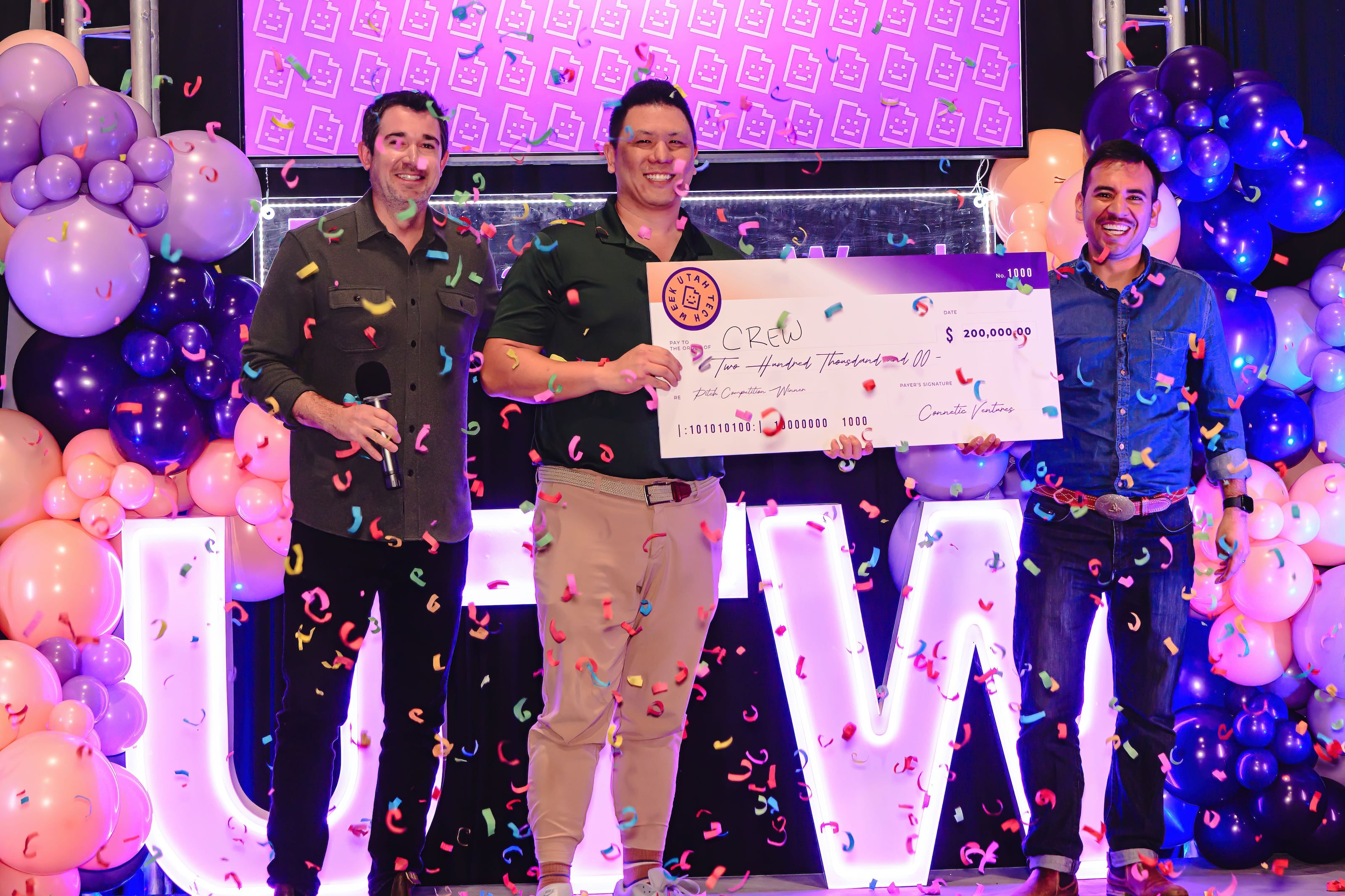
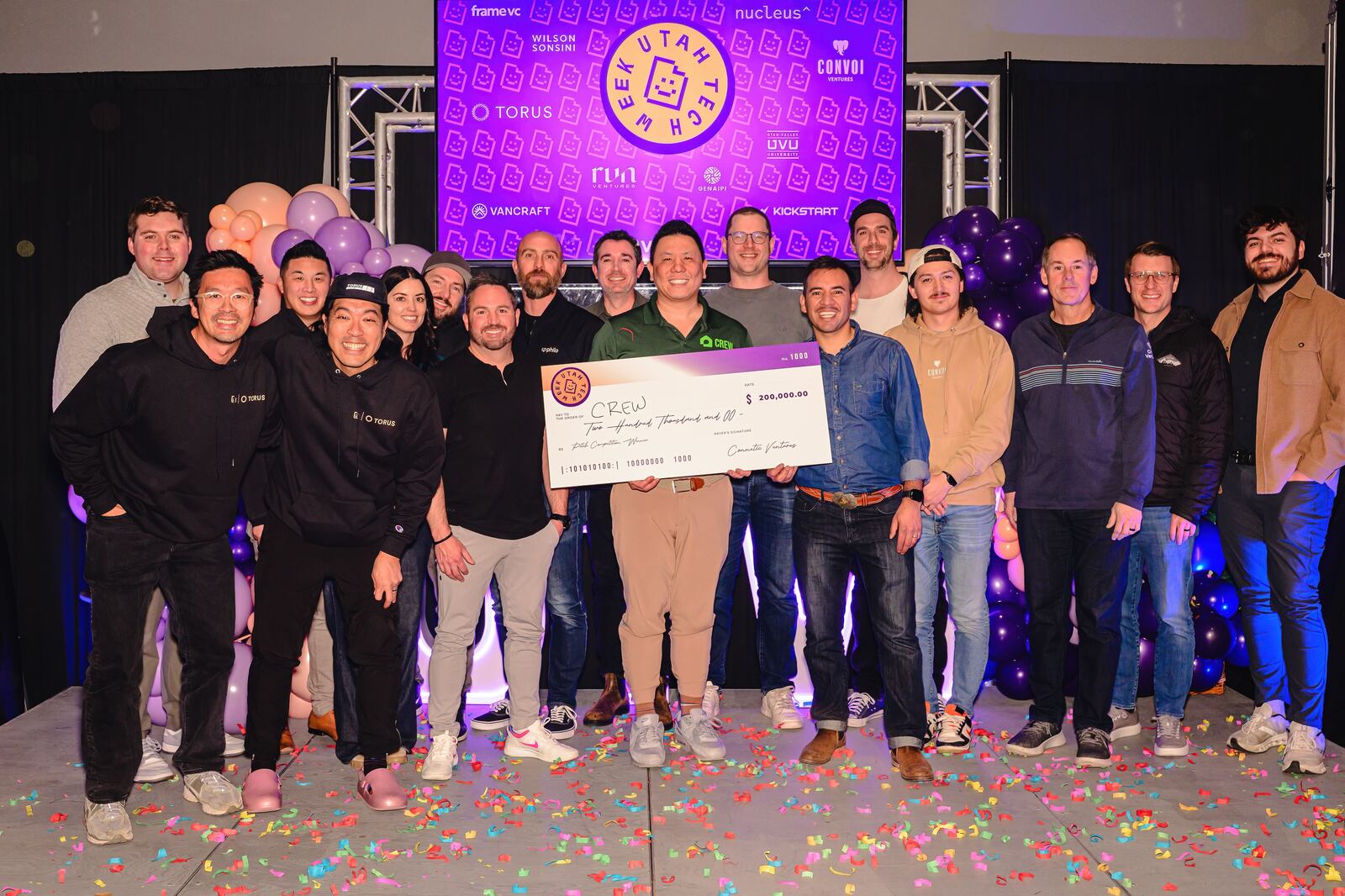
On February 2, 2026, Lam was the second of five founders to pitch at The Grid in Pleasant Grove. Around 500 people were in the audience. Crew won a $200,000 investment from Connetic Ventures. The photograph captures him holding the oversized check while confetti falls: a rather festive outcome for a business concerned with removing things.
He welcomed the investment community’s validation and described the next constraint. Crew had customers it could not yet reach. He said it was raising $2.5 million and had accepted a term sheet from Upstream Ventures. Those were his fundraising plans at the time, distinct from the seed round already announced the previous summer.
For Lam, expansion presents the same question in more locations. A customer wants help at a particular property, on a particular day. Growth must put the service within reach of that address. The pitch can win applause; the route still needs someone to run it.
A different answer to free time
Lam’s return to work gives the story an appealing loop. Rental properties helped him create time for himself. Operating them revealed a recurring task he could take off someone else’s calendar. Crew turned that observation into a company with a schedule to keep.
His story retains both kinds of ambition: the wish to choose how to spend a day, and the wish to build something useful during it. Early retirement was one answer. Crew became another. The next guest will arrive, the next collection day will come, and the bins will need moving again. Lam has chosen work with a particularly clear reminder of what tomorrow requires.
Follow the route
Explore Crew’s service and coverage, follow Lam on LinkedIn or Instagram, and watch Crew’s short advertisement on YouTube.
More reading: The July 2025 seed round · The Utah Tech Week pitch win · Lam’s conversation on The Winning Balance.