A five-cent garbage bag is an excellent thing to count if you wish to feel economical. Jeff Carleton’s property-management world counted them. Meanwhile, the heating bills were telling a rather less flattering story. Across the 150 New York buildings he managed, energy use per square foot could vary by 70% to 90%. His co-founder Lee Hoffman would later recall the absurdity: meticulous attention to a disposable bag, millions of dollars disappearing into fuel waste.
That discrepancy is the beginning of Carleton’s story at Runwise. It gives his business a more useful origin than a flash of inspiration. He was dealing with expenses that needed paying, buildings that needed running and a pattern that refused to make sense. The idea emerged from the job. A boiler room, it turns out, can provide an education in where a business stops looking.
Today, Carleton is Runwise’s CEO and co-founder. The company adds wireless controls and software to existing buildings. But the person behind it is best understood through the experience that preceded the title: an operator trying to make buildings behave, discovering how much of their behavior nobody could see. The bills were the first clue.
A portfolio was his classroom
Carleton’s LinkedIn profile lists Brown University from 1999 to 2003. His subsequent career took him into the working business of real estate. He spent seven years as General Manager of Beachlane Management, overseeing operations and energy management for 150 multifamily buildings in New York. That is a particular vantage point. You are close enough to the equipment to know its inconveniences, and responsible enough for the totals to notice when those inconveniences become expensive.
A portfolio also supplies comparisons. One building’s consumption can look unavoidable in isolation. Put it beside another building’s consumption, adjusted for floor area, and the question changes. Why this much? Why here? Carleton’s eventual company began with the refusal to accept those bills as a natural feature of owning buildings, like brickwork or stairs. His operating background supplied both the problem and a sense of what a usable answer would require.
His brother Dan appears in another chapter of that career. Carleton has written that they started Carleton Energy Consulting together. It is an unusually direct connection between the subject he would build a company around and the work he had already chosen to do. Energy efficiency was part of his working life before it became a financing announcement.
The window was doing the thermostat’s job
In Carleton’s account, the buildings could be uncomfortably hot while it was cold outside. Opening a window becomes an understandable response for a resident. For the person paying the fuel bill, it is a rather expensive form of temperature control. The building is producing heat, then politely offering it to the street.
The mechanical problem has a simple outline. An outdoor temperature reading can tell a boiler that the weather is cold. It cannot, by itself, tell the boiler what the apartments actually feel like. A system may keep delivering heat without adequate feedback from the rooms it serves. Carleton put it bluntly: Boilers and systems are essentially running blindly.
The response was to add information. Sensors, controls and cloud software sit on top of existing infrastructure, giving operators visibility and a way to change how it runs. The ambition depends on making the old equipment more responsive. That is a less photogenic proposition than a new tower, but the fuel bill has never been much of an architecture critic. Carleton’s explanation of the system starts with the blind spots.
Somebody still has to pay attention
Carleton did not describe the road to proprietary hardware as a pleasant excursion. In a December 2025 conversation, he recalled trying existing controls, then committing to building the team’s own in 2018. Getting hardware into buildings brought difficult stretches. It is the sort of detail that matters in a founder’s account: the moment when a promising idea acquires installation problems.
There was a second discovery. Operators could start enthusiastically, promising to log in every day, then stop checking. Carleton compared the pattern to his young son’s excitement about a new toy. The comparison is affectionate and devastatingly economical. A control has no way of reminding a busy adult that this was supposed to be their favorite purchase.
In the early approach, people did the watching. Carleton recalled bringing in his brother and checking roughly a hundred buildings each day. The later move toward automation grew from work that was already being performed. In that interview, the goal was an ongoing connection to the building, including knowing promptly when equipment stopped working. The customer needed attention to persist after the novelty wore off.
“Boilers and systems are essentially running blindly.”
Jeff Carleton, describing the problem behind Runwise
Three founders, one inconvenient problem
Carleton built Runwise with Lee Hoffman and Michael Cook. The combination joined property experience to technology and a business capable of getting a system into customers’ buildings. Carleton brought the operator’s requirements. Hoffman brought a career in software startups. A recurring practical frustration could now become something the team would try to reproduce, support and sell.
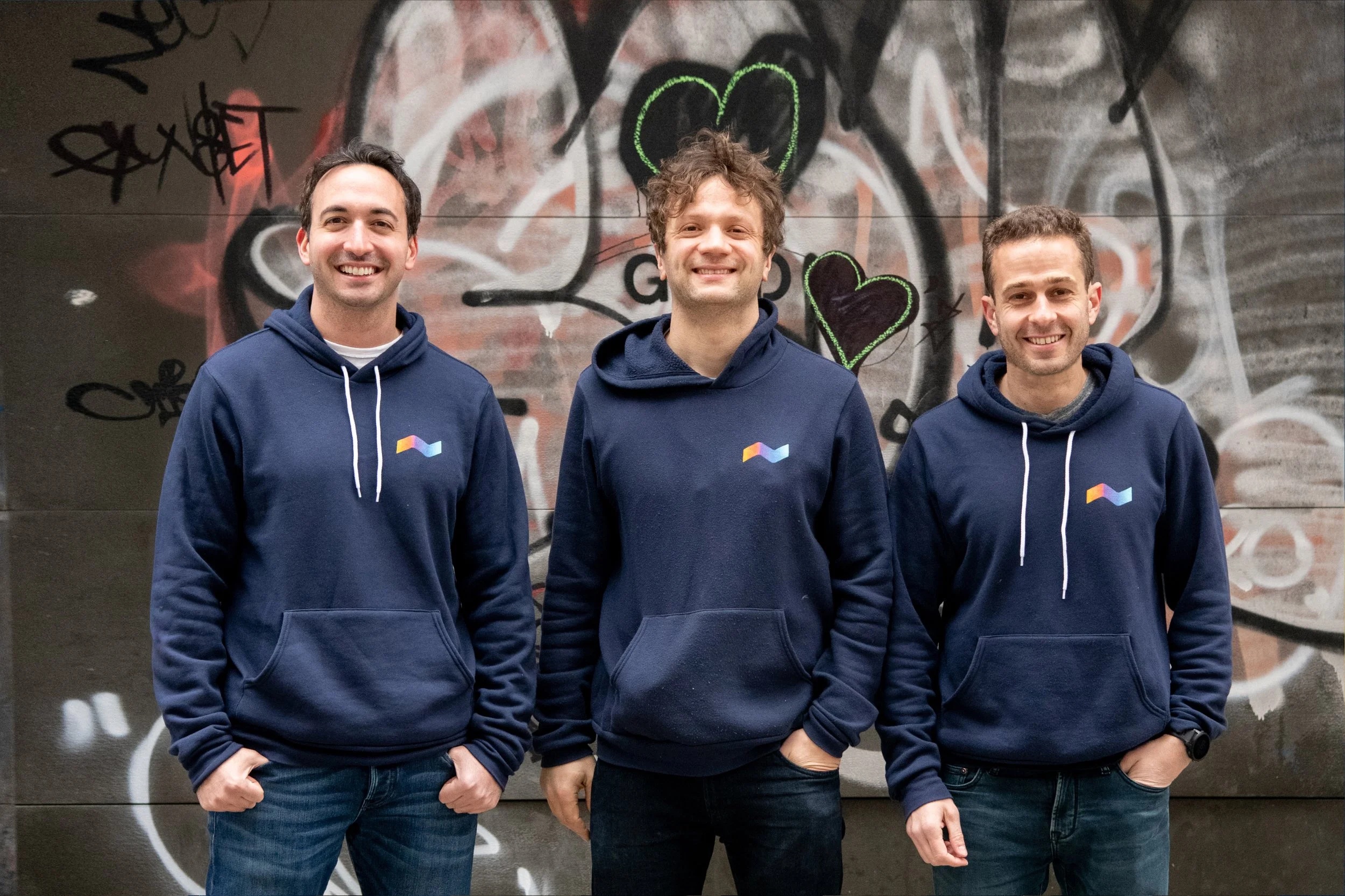
Menlo Ventures describes 2018 as the point at which the founders joined forces to commercialize the technology. The company’s own announcements date its founding to 2010. Those dates describe different stages of a long development story. The problem, the experiments and the scalable business did not all arrive together. The investor’s account emphasizes reliable operation, manageable installation and savings the customer can track.
That last requirement keeps the business close to Carleton’s original question. A claim about efficiency needs a consequence the owner can recognize. Otherwise, the customer is being asked to replace an unexplained bill with an unexplained promise. For an operator, evidence of improvement has to remain visible after the sales conversation ends.
A name that could leave the boiler room
The company once went by Heat Watch, a name with the virtue of saying what it did. In October 2021, it became Runwise as it prepared to expand beyond heating. Carleton discussed new non-heating services in the rebranding announcement. The name change marked a broader remit: more of the building’s recurring operations could benefit from monitoring and control.
By February 2024, the founders were discussing both product development and how the business had changed. Carleton opened with his property-management experience. Cook described the progression toward tailored, cost-effective solutions and more efficient installation. Hoffman spoke about the shift toward a comprehensive service model. The discussion also covered cooling and demand response. Their conversation returned repeatedly to what owners and managers needed the system to do.
It is a revealing collection of priorities. Hardware, service and installation all belong in the same account. A customer buys the result of their working together. The detail that appears minor in a product presentation can become the entire afternoon of the person responsible for the building.
The distance between a plan and a working building
Carleton’s public writing can be impatient. In November 2022, he described New York’s progress toward its climate goals as an inevitable, slow-motion shipwreck
. He included contractors, his own company among them, in the groups whose approach needed scrutiny. His proposed series would examine ownership fragmentation, implementation skills, financing and the technologies that might help.
The language carries some of the same irritation as the unexplained energy bill. A target can be clear while the route to completing the work remains muddled. Carleton wanted feedback that could inform a practical blueprint. His stated aspiration was to make the plan more executable, with the people responsible for buildings involved in the conversation.
His 2025 Montgomery County Energy Summit biography lists him as a Certified Energy Manager and Certified Building Commissioning Professional. The presentation paired building controls with a decarbonization pilot involving The Tower Companies. Those details place him in the professional work of implementation: translating an efficiency objective into changes to equipment operation. The summit presentation makes the building, rather than the slogan, the unit of attention.
Growth still has to get through the walls
In June 2025, Runwise announced $55 million in financing. Its own breakdown specified $30 million in Series B equity, led by Menlo Ventures, and $25 million in new debt from Multiplier Capital. The company said the money would support innovation, hiring and expansion. The financing breakdown matters because the total includes two different forms of capital.
Series B equity led by Menlo Ventures; new debt from Multiplier Capital.
At the time of the announcement, Runwise reported installation in more than 10,000 US buildings and more than $100 million in cumulative customer energy savings. These are company-reported figures, dated to June 2025. They describe a business that has moved far beyond Carleton’s original portfolio, while retaining a recognizable measure of success: customers spending less on wasted energy. The announcement tied the next stage to further deployment.
Deployment has its own stubborn physics. Discussing Runwise’s partnership with Texas Instruments, Carleton wrote that off-the-shelf sensor technology could not support the scale they needed. Battery-powered sensors and quicker installations were practical answers. His emphasis was on how many installations a team could complete, and how that affected customer economics. His partnership post reads like someone still thinking about the working day.
In September 2026, Carleton joined Diana Olick on CNBC’s Property Play to discuss sensors, automation and the cost of running older buildings. The subject remained familiar. Years after the first puzzling bills, he was still explaining how existing properties could become easier to operate. That conversation brought the boiler-room question to another audience.
The charm of Carleton’s story is its persistent scale of attention. A whole city’s efficiency can sound abstract. A building using too much fuel is a problem someone can investigate. The open window supplies the final bit of editorial judgment: whatever the plan says, the street is getting warm. Carleton’s business began when he decided that deserved a closer look.