A shopping center is a peculiar thing to call finished. The paint dries, the ribbon falls, somebody parks badly, and the place begins changing again. Don Wood has spent much of his career making a business out of that last part. For the president and chief executive of Federal Realty Investment Trust, an old property can still contain a new idea. The trick is to keep looking after everyone else has decided they know what it is.
Consider Congressional Plaza in Rockville, Maryland. Federal first bought an interest in it in 1965. Four decades and repeated redevelopments later, Wood was still discussing its next changes. Middle age apparently required a fairly ambitious education.
That example helps explain Wood better than a photograph beside a construction crane. His subject is the property you return to: the empty restaurant, the oversized store, the corner that could do more. There is a particular kind of ambition in looking at something already owned and believing its useful life has barely got going.
An accountant with grass on his shoes
Wood grew up in Clifton, New Jersey, one of four children. His father sold auto parts; his mother worked as a legal secretary. He ran a lawn-care business, then studied accounting at Montclair State College. The youthful enterprise had a refreshingly literal name: Don Wood Lawn Care. Before the mixed-use districts and investor presentations, there were lawns requiring attention.
He graduated with honors in 1982 and earned his New Jersey CPA qualification. In his later recollection, accounting offered a way to understand businesses across industries. That attraction makes sense alongside the lawn business: both put the relationship between work, cost and what a customer will pay within easy reach.
His first substantial training came at Arthur Andersen, where he worked from 1982 to 1989 and became an audit manager. Real estate clients included the Trump Organization. The next move took him to the Trump Taj Mahal operation in Atlantic City as vice president of finance. It was a considerable change of scenery for someone whose professional tools included an accountant's patience.
In 1990 he joined ITT, the New York conglomerate. Over the following years he worked in controller roles and became chief financial officer of Caesars World. His responsibilities included planning, capital allocation and financial analysis; he also participated in the 1995 breakup of ITT. The casino chapter supplied a setting with plenty of spectacle. Wood's work concerned the machinery behind it.
A very large test in San Jose
Wood arrived at Federal Realty in 1998 as chief financial officer. Operating and presidential responsibilities followed before he became chief executive in 2003. The company had been founded in 1962; this was an established institution with an existing portfolio and its own habits. Taking charge meant deciding what deserved to continue and where to put the next dollar.
Just before that transition, a project in California provided a brutal demonstration of development risk. Santana Row, Federal's mixed-use district in San Jose, was approaching its opening when fire broke out on August 19, 2002. The largest building contained a substantial share of the project's retail and residential space. Residential units under construction were destroyed.
The opening moved from September 19 to November 7. Construction and financial decisions had to be revisited while the project was still becoming a place. The wider setting offered little comfort: Silicon Valley was dealing with the collapse of the technology boom, and the aftermath of September 11 had added uncertainty to travel, shopping and investment.
It would be too convenient to turn this into a single executive's rescue scene. Santana Row involved colleagues, builders, retailers and years of work. For Wood, it formed part of the circumstances surrounding his move into the chief executive's office. The episode also puts necessary weight behind the word patience. A long holding period includes events that no attractive site plan can make pleasant.
The disappearing big box
Wood's explanations of redevelopment are often pleasingly concrete. In Leesburg, Virginia, Federal owned a center with a successful Giant supermarket and an underperforming Kmart. When Kmart closed, the choice was whether to replace its roughly 85,000-square-foot store with another occupant of the same size or reconsider the arrangement.
Federal chose smaller anchors and additional retail nearer the street. The business question was architectural as well as financial: could the land work differently? A closed store gave the landlord a chance to revise the property. In Wood's telling, the vacancy opened a decision that the old lease had kept closed.
There is humor in the apparent modesty of this. Finance likes a dramatic transaction, preferably accompanied by a very large number. Reworking a familiar center can sound like rearranging the furniture. Yet the arrangement determines who can trade there, what shoppers can find and how much income the property can produce. The furniture, in this case, has foundations.
A property in a market with barriers to competing supply.
A lease expires. A store closes. The neighborhood changes.
Different tenants, a revised layout or another use for the land.
Let the place do several jobs
Over time, the canvas expanded beyond the individual shopping center. Santana Row, Assembly Row in Somerville and Pike & Rose in North Bethesda bring retail together with other uses. The attraction is easy enough to understand on foot. A place with homes, workplaces and somewhere to eat can have reasons to be occupied at several different hours.
In a 2024 interview, Wood described an opportunity to add housing on excess land at existing shopping centers. Federal already had the sites. Adding another use could make the property more productive while drawing on experience developed at its mixed-use districts. It is a version of the same question asked at the vacant big box, with a taller answer.
By May 2026, he was discussing a residential development program expected to add nearly 800 units and about $27 million in operating income once stabilized. Those were expectations for projects over the next few years. The practical distinction matters: a pipeline is work in progress, with construction and leasing still between a plan and its eventual income.
The office side supplied a completed leasing milestone that spring. PNC Bank took the final 11,000 square feet at Santana West, bringing Santana Row's office portfolio to 100 percent leased. A district whose opening had once been postponed by fire had become an argument for the advantages of a particular location and its surrounding amenities.
Wood still drew limits around the next step. Asked about another office building, he said any such development at Santana would require a build-to-suit arrangement rather than speculative construction. That qualification belongs beside the leasing result. Experience can make an executive more willing to build something and more exacting about the conditions under which he will do it.
The calendar on the other side of the desk
A public company lives with two clocks. Properties change over years. Shareholders can change their minds before lunch. Wood has increasingly talked about the fit between those timescales. In 2025 he argued for an investor base aligned with the long life of real estate and for better understanding of the cycles the business goes through.
He also emphasized reinvestment in communities. A property owner's access to capital can help keep buildings useful, support jobs and improve the local surroundings. This is a larger claim than the success of any one restaurant or apartment building. It places repeated spending on existing places at the center of what a listed property company is supposed to accomplish.
Federal Realty's annual common-dividend increases through its July 2026 announcement. A company record that began decades before Wood became CEO.
That dividend history is part of the institution he inherited and has helped continue. In July 2026, Federal announced its 59th consecutive annual increase. The streak belongs to the company across generations of leadership. Wood's portion of it has required making current choices inside a much older promise of consistency.
Enjoy the job. Then return to the property.
Wood received Ernst & Young's Greater Washington real estate entrepreneur award in 2005, chaired Nareit in 2011-2012 and received its Industry Leadership Award in 2015. The honors trace a career that moved from understanding accounts to explaining how an industry could work. They also suggest how far he traveled from the lawn-care business without entirely leaving its concerns behind.
His advice to younger REIT leaders has been direct. “Enjoy the job.” He has urged executives to hire capable people, trust them and expand their freedom as they earn it. An organization that holds properties for decades needs other people who can see what should happen next. The chief executive cannot personally discover every promising empty corner.
“Enjoy the job.”
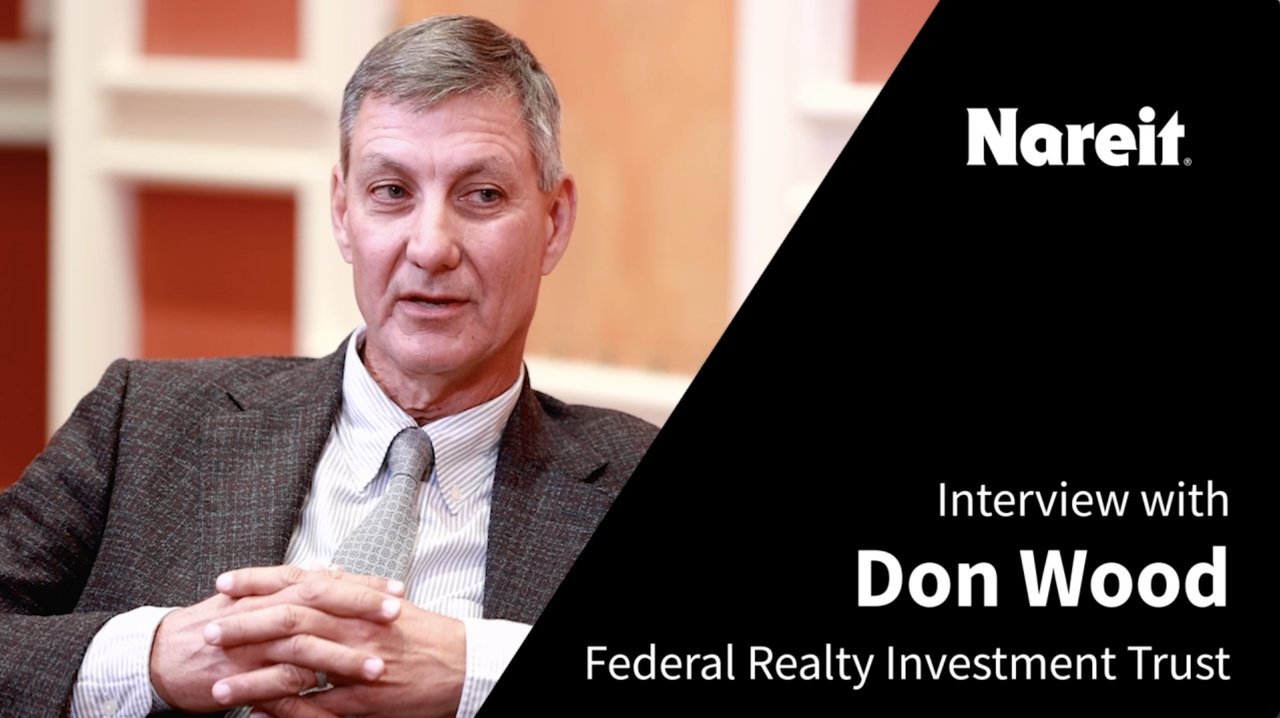
Don Wood, November 2015
The company around him includes finance chief Dan Guglielmone, investment chief Jan Sweetnam, legal and administrative leader Dawn Becker, and regional operating leaders Wendy Seher and Jeffrey Kreshek. Their different responsibilities make the recurring-improvement idea possible in practice. Finding the next use for a property requires people who can lease it, finance it, build it and deal with its complications.
Wood's appeal as a business character lies in the scale of the assignment he has chosen to keep revisiting. The properties are familiar. The questions keep changing. A restaurant leaves; a parcel becomes available; an office tenant signs; a neighborhood acquires different needs. Somewhere in that ordinary sequence, the accountant has another decision to make. The ribbon can stay in the drawer.