Before Justin Knight became responsible for hundreds of hotels, he had responsibility for the laundry. During graduate school, he worked shifts at a Homewood Suites near Salt Lake City: cleaning rooms, serving breakfast, folding linen and taking his turn at the front desk. His father’s company owned the property. The shifts introduced him to its moving parts.
It is a useful place to begin with Knight, now chief executive of Apple Hospitality REIT in Richmond. A hotel can be discussed as real estate, a brand affiliation or a stream of investment income. Someone still has to prepare the room. The distance between those two views of the same building is where much of his career has unfolded.
A surname, and an apprenticeship
Knight’s route to the executive office included a BA in political science, earned cum laude at Brigham Young University, followed by an MBA emphasizing corporate strategy and finance. Between 1996 and 1998, he worked as a senior asset manager and director of quality control at Cornerstone Realty Income Trust. His university biography also records an earlier job in web design. Buildings and websites both require maintenance, though only one usually comes with a breakfast buffet.
He joined the Apple REIT Companies in 2000. Glade Knight, his father, had launched Apple Suites in 1999. Justin went on to hold senior management and presidential roles across the family of Apple companies before becoming Apple Hospitality’s CEO in May 2014. He joined its board in January 2015. The long apprenticeship matters: the handover followed years inside the business.
The family relationship remains visible. Glade is executive chairman; Justin’s brother Nelson is president of real estate and investments. Around them are executives responsible for operations, finance, capital investment and legal affairs. The organization has both the continuity of a family enterprise and the formal responsibilities of a listed company. Those two descriptions sit side by side.
The bell rings. The rooms remain.
Apple Hospitality began trading on the New York Stock Exchange in May 2015. Later that year, Knight said the listing had changed the shareholder base more than the business of running the portfolio. His account of working with his father was similarly measured: they “attack issues slightly differently,” while sharing an interest in shareholder returns and restrained financial risk.
There is a quiet distinction here between a milestone and an operating instruction. Becoming publicly traded gives a company a new audience, a new market for its shares and plenty of occasions to explain itself. It does little to improve a guest’s shower. Knight’s comments treated the listing as a change in the investment setting while keeping the hotel proposition recognizable.
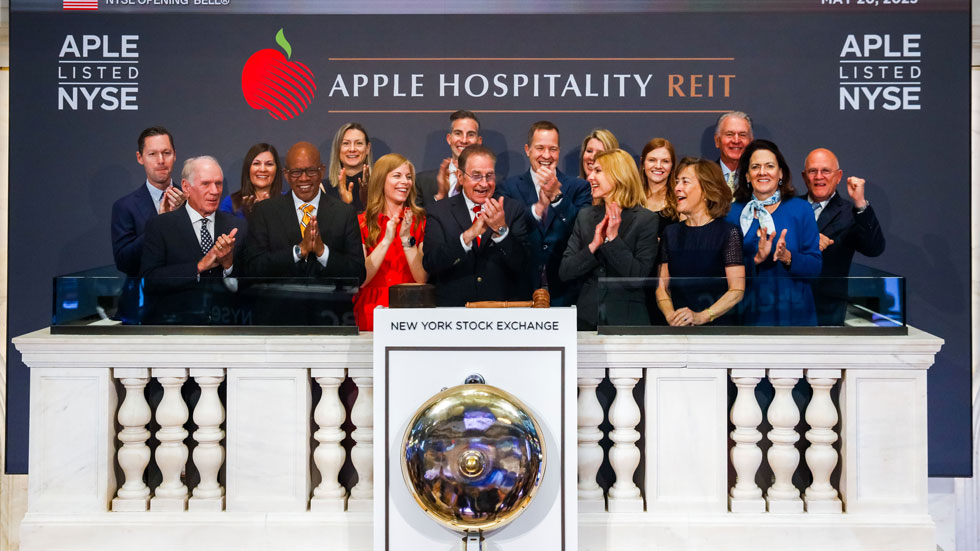
On May 20, 2025, the company returned to ring the exchange’s opening bell, marking ten years since listing and a quarter-century in lodging through its predecessor companies. The photograph supplies the familiar public-company ceremony: a balcony, applause, an enormous bell. Behind it lies work that is much harder to photograph: choosing what to own, what to sell and what to repair.
A good room earns its keep
Knight’s preferred vocabulary is revealing. He talks about “rooms-focused” hotels. In a 2022 interview, he described the essentials as a clean, thoughtfully arranged room, a useful fitness center and breakfast that is free or reasonably priced. Large lobbies and extensive meeting areas bring costs and complexity. Concentrating on the amenities guests use helps make the economics work.
This gives the guest a recognizable bargain. The hotel provides the practical base for a trip; the traveler chooses what to do beyond it. Knight has also pointed to efficient buildings, lighting, energy-management systems and water and waste initiatives as ways to reduce resource use. The operating idea extends from the floor plan to the equipment working behind the walls.
In 2019, with room-revenue growth becoming harder to find, he discussed productivity and energy efficiency as ways to protect profitability. The appeal of the select-service format, in his telling, persisted across economic conditions: a manageable operating model for the owner and a useful value proposition for the traveler. Good times do not abolish the electricity bill.
An editorial view of the priorities Knight describes. A concept diagram, not a financial forecast.
That is an investment thesis with a surprisingly domestic center. The discussion may reach debt ratios and transaction prices, but it keeps returning to whether the building offers something people will pay for tomorrow. A room ages. A competitor renovates. The owner’s job continues after the purchase agreement has been filed away.
Leave some room on the balance sheet
Geographic diversification has been another persistent part of Knight’s argument. In his 2015 discussion of the portfolio, he paired a spread of markets with limited borrowing. By the company’s August 2026 announcement, Apple Hospitality’s portfolio covered 37 states and Washington, D.C. A national spread makes local demand an issue to balance across properties rather than a single bet on one city.
The variety of travelers is equally practical. In June 2022, Knight described weekend business that included youth sports teams and families on vacation. Business bookings came from smaller local accounts as well as larger companies. These are trips that seldom require a magazine cover: a tournament, a meeting, a family visit. Collectively, they help explain why a familiar hotel beside an ordinary road can matter.
Financial flexibility gives Knight alternatives when prices move. In June 2025, he described a conservative balance sheet and a willingness to use hotel-sale proceeds for share repurchases. The distinction is important. Growth in the number of properties is only one possible use of money. At some prices, buying an interest in the existing portfolio can compete with buying another building.
There is no automatic answer. Acquisitions, reinvestment and repurchases each ask what a dollar can earn and what obligations come with spending it. Knight’s approach puts those choices in the same conversation. A hotel that looks attractive in isolation still needs to fit the portfolio and the company’s capacity to own it well.
“Today the momentum is positive.”Justin Knight, REITweek interview published July 2026
Richmond is more than the return address
One of Knight’s more distinctive project descriptions concerns a Courtyard and Residence Inn development in Richmond’s historic district. In 2015, he discussed the dual-brand format as an efficient way to serve different travelers. He also described an education center incorporated into the project, devoted to the history and idea of religious freedom.
The combination is an interesting expression of his thinking about place. A hotel belongs to a neighborhood with its own attractions and associations. The surroundings can enrich a stay without every experience having to be manufactured inside the property. Knight has argued for rooms-focused hotels near restaurants and other amenities that guests want to visit. A city can do some of the entertaining.
His connections extend into the industry’s collective business. He chaired the American Hotel & Lodging Association board in 2022 and serves in owner advisory roles involving Marriott and Residence Inn. He is also a trustee of Venture Richmond and a member of his business school’s National Advisory Council. The roles place him in conversations that reach beyond the next acquisition.
The people behind the familiar signs
For a business so often presented through buildings, Knight’s professional network is conspicuously human. His public LinkedIn exchange with Marriott colleagues thanked them for spending time with Apple’s team. Their gathering at Slate River Ranch included business conversations, shared meals and ATV rides. Even a long-term brand partnership occasionally leaves the conference table.
The detail fits the collaborative nature of hotel ownership. Capital, a brand name and an operating team have different jobs. The guest encounters the result of their cooperation in one stay. Knight’s leadership team includes specialists in operating performance and property investment; the management companies add the people doing the daily hotel work. The owner depends on relationships that an asset list cannot fully describe.
In the end, his early shifts provide a useful perspective on that dependence. Laundry, breakfast and front-desk work require coordination, even when the guest hardly notices. The investment business relies on that ordinary competence being repeated. Familiarity is part of the product. A traveler booking a known brand is buying a measure of confidence about what happens on arrival.
What the next check-in asks
In his REITweek interview published in July 2026, Knight described improving demand across leisure, business and group travel. He pointed to forward bookings as a key indicator and discussed selling properties, acquiring hotels or repurchasing shares according to market prices. The optimism came attached to specific decisions and observations, rather than a promise that travel would always move in one direction.
The company’s second-quarter release supplied a fresh test: comparable-hotel revenue per available room rose 5.3% from a year earlier. The portfolio mix was still recognizably tied to established brands, with Hilton and Marriott accounting for most properties. The numbers describe a particular period. The harder management task is preserving the ability to respond when the period changes.
Knight’s career brings that task back to a small set of tangible questions. Will the room suit the traveler? Will the building earn its upkeep? Does the next investment leave the company able to make the decision after it? His first hotel duties were immediate and physical. The executive version carries more zeroes, but the room still has to be ready.