A luxury hotel is an awkward thing to become sentimental about when your job includes selling it. There are the views, of course. The familiar name above the entrance. The satisfaction of having secured a property that rarely comes to market. Then a buyer appears, the numbers change, and the owner has to decide whether admiration is a good enough reason to stay.
Jim Risoleo has made that decision from both sides. In 2021 and 2022, Host Hotels & Resorts bought the Four Seasons resorts in Orlando and Jackson Hole. In February 2026, it sold them together for $1.1 billion. The purchases had cost $925 million. The Orlando condominium development stayed with Host. Even a transaction described in billions has a few things to pack separately.
That sequence offers a useful entrance to Risoleo’s working life. Hotels are places people visit to escape their obligations. For the owner, the obligations are the attraction: evaluating a location, choosing a manager, funding improvements, deciding what comes next. Risoleo arrived at that work through a career with considerably more turns than a hotel corridor.
A career without a floor plan
His beginnings were in Pittsburgh. As a high school student, he worked at Giant Eagle. He became the first person in his family to attend college, initially pursuing accounting at Duquesne. Politics interested him; a congressional internship and law school followed. His grandfathers had emigrated from Italy, one becoming a coal miner, the other a chef and restaurateur.
Business and law gave him two ways to examine a transaction. A balance sheet asks what something is worth. A contract asks who is responsible when events fail to match the balance sheet. Risoleo’s eventual work would require attention to both. The undergraduate and legal degrees came from Duquesne, a university he returned to as a business leader rather than a practicing attorney.
There is an early glimpse of his interest in people and institutions in the student newspaper. In September 1976, the student government president named Jim Risoleo was discussing tuition proposals and campus priorities. Decades before investor calls, there were meetings about budgets and competing demands. The scale would change. The need to get other people into the conversation would remain.
Twenty years, then a different job
At Westinghouse, Risoleo worked through a portfolio of real estate and loans covering several property types. Hotels became his preference when that assignment ended in 1993. By 1996 he had joined Host, initially overseeing acquisitions and development. He became chief investment officer in 2000, later led European activities, and added responsibility for West Coast investments in 2015.
The sequence matters because it gave him several versions of the same company. Acquisitions teach a person to imagine what a property might become. Asset management requires living with the result. International investment adds partners, jurisdictions and unfamiliar markets. By the time he succeeded Ed Walter as president and CEO in January 2017, Risoleo had spent twenty years inside Host.
He still described his first year at the top as a period of learning. Knowing a company from one seat does not eliminate the questions that appear in another. He wanted colleagues to bring ideas and exercise judgment. His compact instruction was: “I encourage people to be bold.” It is an appealingly economical sentence for an industry capable of turning a meeting-room name into a paragraph.
“I encourage people to be bold.”
Jim Risoleo, 2018
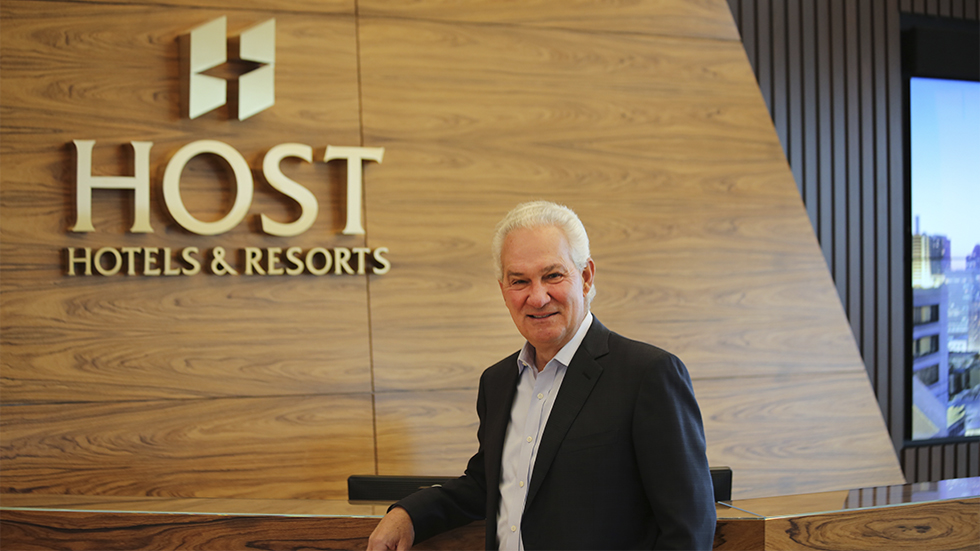
The hotel behind the name
Host owns hotels carrying names travelers recognize, while third-party managers handle their operations. Risoleo’s role sits within that relationship. The owner commits capital and evaluates performance; the management company brings its operating organization. A brand adds another set of expectations. The guest reasonably hopes that everyone has finished negotiating before check-in.
His European experience involved working with institutional partners, including APG and GIC. Those arrangements made the relationship between capital, expertise and incentives part of the investment itself. Owning a hotel abroad required more than selecting an appealing address. It required deciding who would invest alongside Host and how the venture would work.
The partnership with Noble Investment Group offers another example. Discussing it in 2022, Risoleo explained that it allowed exposure to select-service hotels while preserving Host’s focus. That year he also described a portfolio strategy involving both purchases and disposals, continuing the effort begun when he became CEO to improve the company’s earnings growth profile.
These are choices about the shape of a business. A company can enter an opportunity directly, take an interest through a partner, or pass. Each route creates different obligations. For an executive whose career crossed investment roles and geographies, the structure of an opportunity deserves as much scrutiny as the destination on the brochure.
The pleasure of owning; the discipline of selling
In early 2023, Risoleo described buying the Jackson Hole resort in an all-cash process completed in thirty days. He emphasized the scarcity of comparable properties and the constraints on new development around the destination. The enthusiasm was specific: the location and the ability to transact mattered together.
Three years later, the two Four Seasons resorts were sold. Host said it had needed no significant capital expenditures during its ownership period. The roughly $175 million difference between the reported combined purchase and sale prices is simple subtraction, not a calculation of investment profit. Operating earnings, transaction expenses, taxes and the timing of cash flows belong in a fuller accounting.
Orlando + Jackson Hole. Transaction prices, not investment returns. The Orlando condo development was excluded from the sale.
The next spending cycle also counted. Host expected the resorts to need about $88 million in capital expenditure over the following five years. In May 2026, the board declared a special dividend of $0.72 a share associated with the taxable gain from the sales, alongside its regular quarterly dividend. A hotel transaction eventually reaches people who may never have slept in either building.
Asked that May about further sales, Risoleo treated disposals as an active part of capital allocation. Buying is the decision that gets the celebratory photograph. Selling deserves equal attention. The discipline is to assess the asset from today’s position, even when yesterday’s purchase was a source of pride.
Renovation is a wager on tomorrow
A new acquisition is only one way to change a portfolio. Another is to change the properties already in it. In 2024, Host bought the 1 Hotel Nashville and Embassy Suites by Hilton Nashville Downtown for $530 million. In the same period, Risoleo was discussing renovations and the capacity to pursue further investments while retaining an investment-grade balance sheet.
The renovation question brings investment judgment into physical detail. A property can keep its address and still become a different proposition for the traveler. Rooms, meeting areas and restaurants compete for spending that cannot all happen at once. Construction has to be financed, scheduled and justified. The carpet is among the easier decisions to explain.
Host completed more than 180 capital investment projects in 2025, representing $505 million of investment. Its renovation partnerships included the second Marriott Transformational Capital Program and work with Hyatt. These are company efforts involving managers, designers and construction teams. The CEO’s responsibility is to keep those commitments connected to the investment case.
By August 2026, Host reported second-quarter comparable hotel revenue per available room growth of 7.0%. It raised its full-year growth outlook for that measure and total revenue per available room to a range of 4.75% to 5.25%. Those were forecasts, subject to changing conditions. The results offered a current test of the business; they did not remove the need for the next decision.
The machinery beneath the marble
Some reinvestment is conspicuous. Some happens where the guest has little reason to look. In April 2026, Host’s sustainability and resilience leader, Michael Chang, described using connected sensors and building data to identify operating inefficiencies. At three properties, the work had produced more than $700,000 in annual utility savings while avoiding 2,300 metric tons of carbon emissions.
This is a useful corrective to the idea that every hotel improvement needs a ribbon-cutting. Mechanical systems continue consuming resources long after the opening reception. Better information can help engineering teams decide where intervention pays. The owner benefits from a property that costs less to run; the environmental consequences sit in the same decision.
Host received Nareit’s 2026 operations award for large-cap REITs. Its current responsibility strategy describes more than 1,000 sustainability projects during 2021-2025 and $30 million in expected annual utility savings. Those figures belong to the company and its teams. They show the operating scale surrounding Risoleo’s capital decisions, rather than a personal tally of accomplishments.
He has also served as Nareit chair and participates in industry organizations including the American Hotel & Lodging Association and the Real Estate Roundtable. Hotel ownership reaches beyond individual properties into financing, regulation and the places where people work and visit. The executive’s calendar inevitably becomes less picturesque than the portfolio.
A room for the next generation
Risoleo’s own life has included a decision to step away from the expected route. In 2012, he moved to Arizona to be with Pam, who became his wife, while continuing to oversee Europe. He later described accepting lower pay with that choice. Advancement had to fit around a life, rather than occupy all of it.
When Penn State’s hotel and restaurant society named him its 2024 Hospitality Executive of the Year, he emphasized the responsibility to help future hospitality leaders develop. His public thanks after the event mentioned Pam, his son Christian, colleagues and business partners. The acknowledgment gave an industry honor a more personal geography.
That is a fitting place to leave a career shaped by changing circumstances. Risoleo’s work asks him to commit to places without assuming he will own them forever, and to depend on people whose expertise differs from his. The guest wants a room ready tonight. The owner has to consider the next renovation, the next generation of managers and the offer that might arrive tomorrow. Somewhere between those clocks, a decision has to be made.
Keep the conversation going
Career conversations, company updates and the decisions behind the story.
- Host Hotels & Resorts
- Jim on LinkedIn
- Watch: the 2025 career conversation
- Listen: investment decisions, 2024
- The February 2026 resort sale
- Second-quarter 2026 results
- The Pittsburgh-to-Host career story
- The first year as CEO
- The 2023 investment conversation
- Building analytics and resilience
- Host’s responsibility strategy
- Penn State recognition