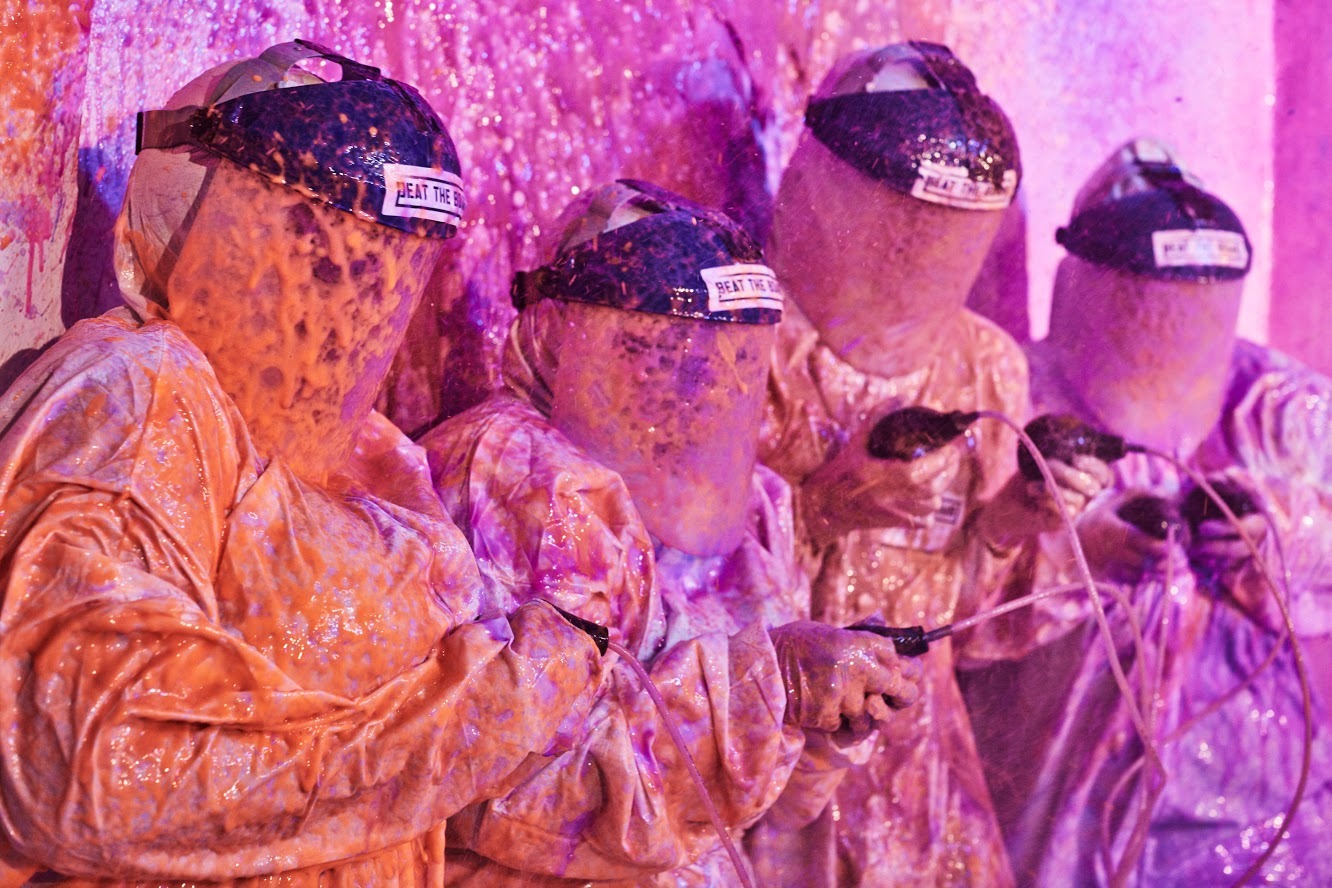
A grown adult is screaming about lasers
It is a weekday evening in Brooklyn. Inside a converted warehouse near the waterfront, six people in white hazmat suits are pressed against a wall, shouting coordinates at each other. A grid of green lasers crosses the room. Somewhere a clock is counting down. They are not first responders. Three of them work in accounting.
This is BEAT THE BOMB on an ordinary night - which is to say, not ordinary at all. The company has done something the entertainment business spent two decades failing to do: it got people to put their phones down by building a video game they have to physically climb inside. Four rooms. Touchscreens, motion cameras, projection walls, lasers. A team of four to six. And a Bomb Clock that does not care about your feelings.
Beat the clock and you walk out a hero. Lose, and you get blasted - paint, foam, or slime, depending on the room. More than half a million people have rolled those dice. Most of them lost. Almost all of them came back.
"Mission Impossible meets Double Dare."
- Alex Patterson, founder, on what the thing actually isFun got lonely
Here is the uncomfortable truth the founders noticed: entertainment had quietly turned into a solo activity performed in the same room as other people. We stream side by side and call it a night out. We attend "team-building" events that build mostly resentment. The escape room boom proved people craved a shared challenge, but most escape rooms are a quiet hour of reading clues off a wall - more library than adventure.
The gap was obvious once you saw it. There was no experience that was genuinely physical, genuinely social, and genuinely high-stakes all at once. Something that needed your whole body and your whole team. Something with consequences you could feel - or, better, wear home.
Escape rooms gave people a puzzle. BEAT THE BOMB gave them a reason to grab each other and run.
- The bet, in one sentenceAn obstacle guy walks into an arcade
Alex Patterson had a strange résumé for an entertainment founder: Harvard College, UVA Law, and an early-executive stint at Tough Mudder, the obstacle-race company that convinced hundreds of thousands of people to crawl through mud and electrified wires for fun. He understood something most people running law-degree careers do not - that humans will happily suffer, sweat, and look ridiculous, as long as they do it together and there is a story in it.
So he made a bet that sounds absurd written down: that adults would pay around $40 to wear a hazmat suit, get yelled at by a countdown clock, and possibly get covered in paint. He built the first version over the winter of 2016-17, found a space in Dumbo, and opened the doors in December 2017.
The bet, it turned out, was conservative.
The math nobody pitched on a napkin: a thousand strangers in month one, each paying for the privilege of getting slimed.
The blast radius, year by year
How the game actually works
The signature attraction is the Mission Experience: roughly one hour, four to six players, hazmat suits on. You move through a series of high-tech game rooms, each one a different test of communication, coordination, and the willingness to look foolish in front of your coworkers. Every room you clear earns time on your Bomb Clock.
The rooms
Touchscreens you slap. Motion cameras that read your whole body. Projection walls that turn the floor into a level. The famous laser maze, which has produced more undignified human poses than any yoga studio in the borough. None of it works if your team does not talk to each other - which is the entire point.
The Bomb Room
Then comes the finale. In the final room, the team faces what the company calls the world's largest paint, slime, or foam bomb. Disarm it before the clock hits zero and you escape clean. Run out of time and the bomb wins - dramatically, messily, and on camera. Either way, you find out what your team is made of. Usually it is made of paint.
Around the core game, BEAT THE BOMB has built the rest of a destination: private event space, food and drink packages, kids' birthday parties, school field trips, and STEAM summer camps that smuggle real learning into the chaos.
The genius isn't the lasers. It's that you can't win alone - and you can't lose quietly.
- Why the format sticksTurns out HR was the killer app
A funny thing happened on the way to building a consumer attraction: corporate America showed up with a credit card. The thing companies spend fortunes trying to manufacture - teams that actually trust each other - turns out to be a natural byproduct of being chased by a paint bomb.
The client list reads like a stock index: Amazon, Coca-Cola, Home Depot, Microsoft, Delta, PwC, Capital One, Citibank. They book the rooms for offsites, holiday parties, and the increasingly rare event where colleagues come away liking each other. The growth numbers tell the rest of the story.
Players per year, the early curve
Backed by Otium Capital and Conversion Venture Capital, the $15M Series B in September 2023 is earmarked for one thing: more rooms, in more cities, with bigger bombs.
Build the reason to look up
Strip away the slime and the pitch is almost wholesome. BEAT THE BOMB calls itself the world's first immersive social gaming experience, and the operative word is social. The whole machine - the rooms, the suits, the absurd finale - exists to do one thing the modern world keeps making harder: get a group of people fully present, in one place, depending on each other.
The ambition is not modest. The company is aiming for a national network of 50 to 100 company-owned venues, which would make "let's go beat the bomb" as ordinary a plan as dinner and a movie - and considerably louder.
In a world optimized for staring at screens alone, BEAT THE BOMB sells the opposite: a screen you can only beat together.
- The mission, minus the marketingBack in the laser room
Return to that Brooklyn warehouse. The accountants and their friends have made it through the lasers. The Bomb Clock has eleven seconds left. They are not screaming coordinates anymore - they have stopped being six individuals and become, briefly, one organism with a single goal. They hit the final sequence. The clock stops. The bomb does not go off.
For about four seconds, a room full of office workers behaves like they just won an Olympic medal. That feeling - earned, shared, slightly ridiculous - is the product. The paint is just the souvenir.
BEAT THE BOMB figured out that the future of entertainment might not be more immersive screens but fewer of them, replaced by the oldest technology there is: a few people, a hard problem, and a clock. The rest is just deciding which color you want to wear home.