Three months into Mitchell Krebs’s tenure as chief executive, a phone call exposed a peculiar problem for a mining company: it had failed to keep up payments on some of the ground it mined. Nevada claims had lapsed. A competitor had picked them up. Litigation followed, and the matter was settled. The episode gave the new CEO an unusually concrete lesson in the distance between owning a business and having an organization capable of running it.
Krebs later described centralizing those obligations and creating a dedicated land group. A mine could contain valuable metal and still depend on someone remembering a payment. The ore would wait. The deadline would not.
That small administrative disaster offers a way into a career usually described through much larger numbers. Krebs has spent more than thirty years associated with Coeur Mining, moving from acquisitions to finance to the chief executive’s office. The recurring question has been how to make the company capable of carrying the weight of its ambitions.
A long apprenticeship in buying things
Born in Storm Lake, Iowa, in 1971, Mitchell John Krebs took an economics degree at the Wharton School and an MBA at Harvard. Before Coeur, he worked as an investment banking analyst at PaineWebber. The formal training was in money: how to assess a business, arrange a transaction and decide what an asset might be worth.
He joined Coeur in August 1995 as manager of acquisitions. By February 2003 he was vice president of corporate development; in May 2006, senior vice president. In March 2008, he became chief financial officer. He added a spell as treasurer before becoming president, CEO and a director in July 2011.
The sequence matters. Buying an asset and operating it draw on different kinds of judgment. A transaction has an agreed closing date. An operation keeps presenting new facts. Krebs’s promotions moved him steadily closer to responsibility for what happened after the signatures.
Acquisitions
Capital and finance
The whole enterprise
Board leadership
Why Chicago belonged in the mine plan
In 2013, Coeur moved its headquarters from Coeur d’Alene, Idaho, to Chicago. A mining company choosing Chicago required some explanation. Denver and Toronto were more obvious mining addresses. Chicago offered access to a wider pool of management talent and transportation connections to far-flung operations.
The change also arrived at an awkward time. Gold and silver prices fell sharply in 2013, and Coeur’s shares lost 55.9 percent that year. An improved address could do little to sweeten those figures. Krebs’s effort to rebuild the company had to proceed while investors were questioning its ability to make money at prevailing metal prices.
There is something revealing about that combination. A headquarters relocation is controllable; a commodity price is not. His task was to improve the organization while knowing that the market might withhold a favorable verdict for reasons no organizational chart could fix. The distinction remains useful when judging the much larger Coeur he runs today.
The supervisor gets a seat at the table
An organization changes through the people making decisions each day. Coeur’s IMPACT training program provides a less theatrical view of that work than an acquisition announcement. In its 2019 form, the program brought together twenty people from different functions and locations for a year of development, with four off-site sessions and a senior mentor for each participant.
The curriculum moved from understanding oneself to leading a team, speaking up about operational problems and understanding the business. Executives ran financial and operating workshops. A bank analyst explained how the company was valued. Participants finished with a graduation dinner with the CEO. The program was translated into Spanish for front-line leaders in Mexico.
Those details place management somewhere more useful than a conference-room slogan. A supervisor gains a view of the company beyond one site. A financial decision becomes something that can be discussed with the people expected to execute it. The design treats communication as work that needs time, repetition and contact across departments.
Rochester, then Las Chispas
Years of investment eventually produced a different financial conversation. Coeur’s $725 million Rochester expansion in Nevada was a major commitment under Krebs. In a May 2025 interview, he described 2024 as a turning point: the expansion had been wrapped up in the first half, and the SilverCrest transaction announced in the second.
The SilverCrest acquisition closed on February 14, 2025, bringing the Las Chispas silver-gold mine in Sonora, Mexico, into Coeur. Krebs emphasized the deposit’s grade, operating margins and the acquired company’s lack of debt. His case for the purchase was that it improved the portfolio and helped repair a balance sheet stretched by earlier investment.
He was also explicit about the temptation accompanying stronger metal prices: “Getting bigger just for the sake of getting bigger won’t cut it.” The warning is a useful standard to apply to his own transactions. Scale has to produce something beyond a more impressive list of properties. Otherwise, the chief executive has merely acquired a longer agenda.
“Getting bigger just for the sake of getting bigger won’t cut it.”
Mitchell Krebs, May 2025
Two Canadian mines change the assignment
On March 20, 2026, Coeur completed its acquisition of New Gold. New Afton in British Columbia and Rainy River in Ontario joined the portfolio. The company now described seven wholly owned operations across Canada, the United States and Mexico, alongside the Silvertip exploration project in British Columbia.
The geography gives the change some shape. New Afton adds gold and copper; Rainy River adds gold and silver. They sit alongside Las Chispas and Palmarejo in Mexico, Rochester in Nevada, Kensington in Alaska and Wharf in South Dakota. A business rooted in silver now asks its chief executive to allocate attention across different metals, mining methods and operating schedules.
The transaction was paid for in stock, with New Gold shareholders receiving 0.4959 Coeur shares for each New Gold share. Issuing shares spreads ownership across a larger group of investors. Those investors then share in the enlarged business’s results. The arithmetic on closing day is exact; the benefits still have to be earned.
The quarter that put the promise to work
The second quarter of 2026 was the first full quarter with both Canadian operations. Coeur reported about $1.1 billion in revenue, $513 million in operating cash flow and $122 million in GAAP net income. Free cash flow, a non-GAAP measure, was approximately $388 million. The company also began paying a dividend and buying back shares.
There was qualification alongside the cash. Coeur revised expectations for underground ramp-up at Rainy River and development of New Afton’s C-Zone. Guidance at the five legacy operations remained unchanged. Krebs had a larger business, but its new parts did not arrive with immunity from schedules needing adjustment.
That is where the earlier organizational story becomes relevant again. Expansion multiplies the number of places where a plan can encounter reality. The executive must distinguish a timing change from a deeper problem, then explain the difference without treating every revision as either a catastrophe or a triumph.
Company results during Krebs’s leadership. Different measures, each describing a different part of the quarter.
There is still more ground to understand
September brought another reminder that a mining acquisition can remain unfinished in a geological sense. Coeur outlined an expected $158 million exploration investment for 2026, including approximately $24 million at New Afton and $18 million at Rainy River. At New Afton’s K-Zone, drilling had extended mineralization beyond its original footprint.
At Rainy River, the work pursued underground extensions and opportunities nearer the surface. These were indications of potential, with further drilling and engineering still necessary. An encouraging intercept does not become a working mine by appearing in a presentation. It changes the questions worth paying to answer next.
The distinction suits a company making long commitments. Cash generated today can fund work whose commercial result remains uncertain. Krebs’s responsibility includes deciding how much of that uncertainty to buy, how quickly to investigate it and when the evidence justifies another commitment.
The person behind the allocation
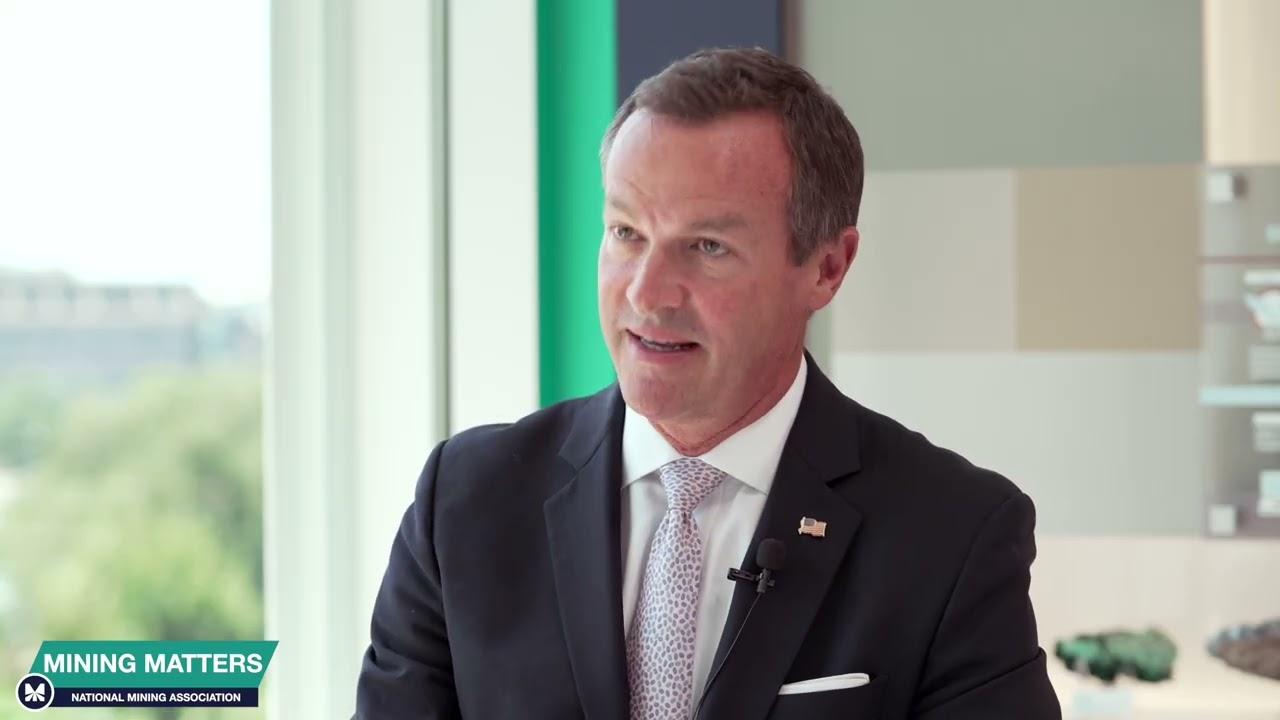
His professional connections extend beyond Coeur. Krebs became chairman of the National Mining Association in 2022 after serving in several leadership positions, including founding chair of its ESG task force. He is a past president of The Silver Institute and served on Kansas City Southern’s board from 2017 to 2023. His public biography also includes service on the Big Shoulders Fund board, supporting education in Chicago.
A 2013 questionnaire supplies a more domestic scale: Sunday newspapers with coffee, golf, movies and hiking. He listed big egos and typos among his dislikes. For an executive surrounded by forecasts, the appeal of an error that can be fixed with a keystroke is understandable. He called his management style collaborative while reserving final authority, and named becoming a father as his personal best achievement.
In June 2026, the New York Stock Exchange welcomed Krebs and Coeur’s guests to celebrate the New Gold transaction with its closing bell. It was a tidy public marker for work that resists tidy endings. The bell can announce a completed acquisition. Afterward come the operating plans, the drilling decisions, the people learning to work together and, somewhere in the machinery, the next payment coming due.