Colin Ardern’s proposition to a factory begins with an appealing courtesy: keep the machines. The raw material may change. Some of the petroleum can give way to plant fiber. But the equipment already standing on the floor should still have a job. For someone trying to sell an environmental improvement, allowing the customer’s machinery to remain comfortably employed is a useful opening gesture.
Ardern is the co-founder, president and chief operating officer of Applied Bioplastics. Before he entered materials manufacturing, he worked on software implementation. The settings have changed considerably. The practical difficulty has a familiar shape: a promising system must fit into the place where people are expected to use it. Somewhere between the proposal and the working product, enthusiasm has to learn the local rules.
An idea comes home
The venture began with a connection considerably less formal than an investor introduction. Alex Blum was Ardern’s housemate. Blum had encountered the work of Bangladeshi scientist Mubarak Ahmad Khan, who had developed a jute-based material for rudimentary housing. Back in Austin, he brought the possibility to Ardern. A conversation between people sharing a home became a conversation about how other people might build one.
Khan’s initial reaction to a partnership had been a refusal. Blum kept in touch. The two future founders consulted and hired plastics specialists, who saw possible applications beyond housing. After roughly six months of negotiation with Khan, Ardern and Blum traveled to Bangladesh to sign an intellectual-property transfer agreement and an employment contract. The origin story includes a plane journey, but the preceding negotiations did some of the heavier lifting.
They left their jobs to work on the venture full time. Applied Bioplastics was incorporated in June 2019. The arrangement brought together people with different forms of expertise: the scientist with the material, specialists who could develop its industrial possibilities, and founders willing to organize a business around it. Ardern became CEO. The company’s problems would now include everything that happens after a useful idea has been identified.
Before the pellets, the implementation
Ardern graduated from Washington University in St. Louis in 2012 with a Bachelor of Science in Business Administration. His early résumé includes internships in investment firms, Disney and CBRE, followed by technical services and quality assurance work at Epic. He later worked as an implementation engineer and senior implementation engineer at Q2ebanking. Finance and technology preceded the plant fibers.
Software implementation is a helpful background to keep in view here. A sale establishes that somebody wants a system. Installation and support encounter the particular organization that must live with it. Materials have their own version of that encounter: the machine settings, product specifications and commercial terms that determine whether a manufacturer can adopt them. Ardern’s career moved from one implementation problem to another with rather more tangible inventory.

There is also a student-radio chapter. At Washington University, he was a DJ at KWUR, starting with freshman pre-orientation; he also belonged to TKE. Asked later about entrepreneurial lessons, he described learning through experience and stressed follow-through, time and the ability to be courteous without yielding every point. His advice leaves room for both a relationship and a deadline.
“you can be nice but firm”
Colin Ardern, on the lessons of entrepreneurship
The factory gets a vote
Applied Bioplastics works on the relationship between plant fibers and polymers. Natural fiber must be prepared so that it can bond effectively with the surrounding material. The result needs to behave like a usable industrial input. That last requirement keeps the business close to the customer’s production process. A promising ingredient earns its place by helping make a part that meets the required specification.
The company’s BioFi feedstock combines agricultural waste with standard, recycled or biobased polymers, including polypropylene and polyethylene. It can be injection molded or extruded using industry-standard equipment. Possible uses range from household products to automotive parts, appliances, electronics and outdoor equipment. These are durable applications: objects expected to keep doing their work after their packaging has disappeared.
Change the input. Keep a usable route to the finished part.
Customer requirements complicate any tidy account of replacing one material with another. Ardern has discussed the need to design additive packages and match fibers to the polymer matrix. He has also acknowledged that biofibers do not always match glass fibers’ mechanical properties. Suitability depends on what the customer actually needs. The less theatrical question - will this material do the specified job? - is the one with a purchase order attached.
Affordability runs through the pitch. Ardern’s public description of the value proposition paired a smaller carbon footprint with the customer’s existing equipment and economics. In a public LinkedIn exchange, he put the price ambition bluntly: “We beat commodity plastics on price.” That is a commercial claim with a demanding audience. Buyers get to compare it with their own requirements, quantities and bills.
The comparison matters because adopting a material involves more than admiring it. A manufacturer must be able to process it, obtain the required properties and make the numbers work. Applied Bioplastics has chosen to put those conditions inside its proposition. The environmental ambition consequently has to travel with the ordinary business of making things. The purchasing department is part of the plot.
A roof is a demanding customer
The housing work gives the company a second setting. Its BTR Board is a resin composite; Jutin, made with woven jute in Bangladesh, is the flagship product in that family. Here the end product can become roofing or a wall rather than a molded component. The underlying interest in plant fiber remains, but the conditions of use are visible at the scale of a building.
An early pilot that began in January 2022 involved six houses for six families in Bangladesh. The process could be carried out by hand, with a mold and weights; a heat press could accelerate it. The resulting shelters were reported to have survived a typhoon without pieces blowing away. Six homes is a modest number beside an international housing problem. It is also a number that contains actual households rather than merely a large addressable market.
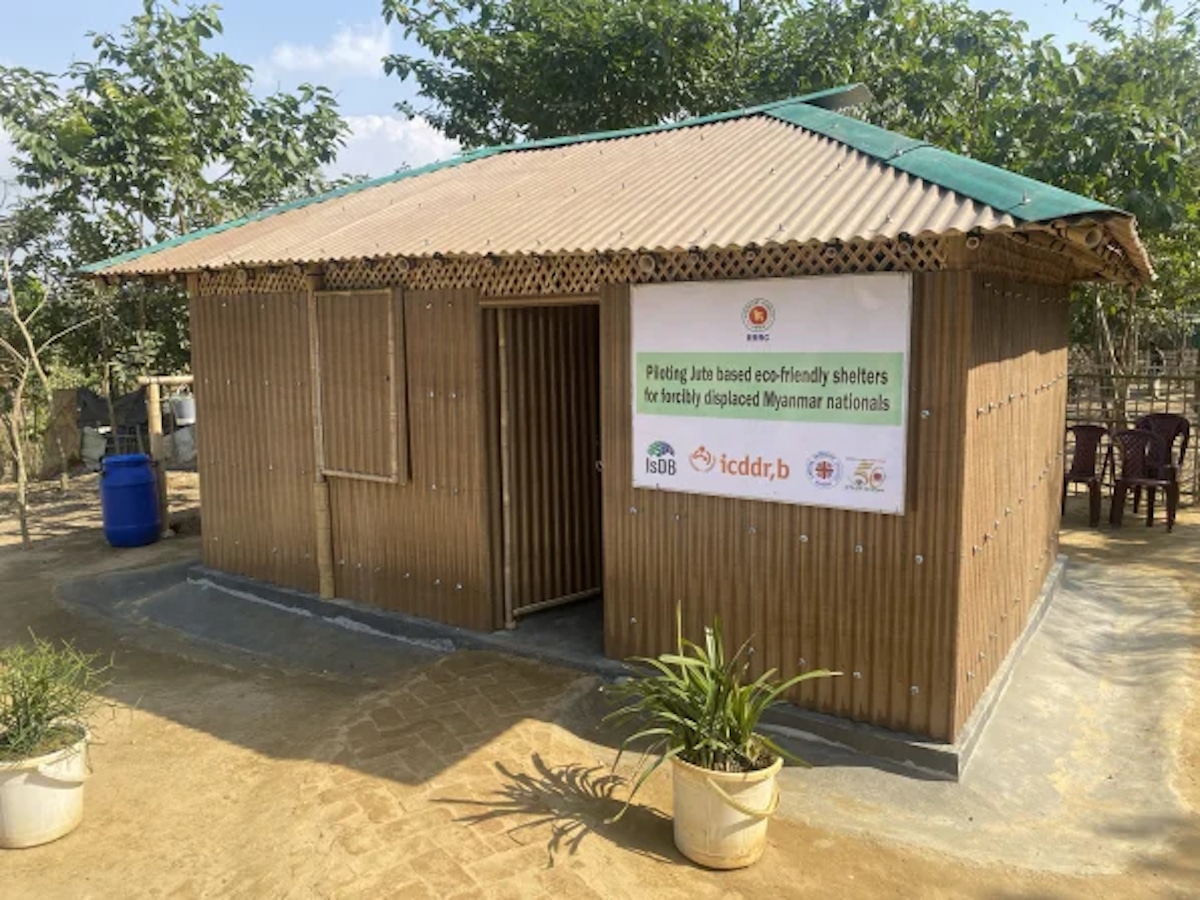
The photograph makes the application refreshingly literal. A corrugated roof, walls, a doorway, a window: the material is being asked to form a home. The practical questions extend beyond the composite itself. Can local workers assemble it? Can the structure withstand the weather? The attraction of this approach lies partly in using a locally familiar agricultural fiber for a purpose that asks more of it.
In 2025, Jutin reached the finalist stage of MIT Solve’s Global Climate Challenge, with Ardern listed as team leader. The project described building panels for communities facing coastal conditions and displacement. It also outlined proposed extensions involving floating modular housing and solar roofing. Those proposals give the work a direction; the deployed composite panels provide the existing starting point.
The title changes. The work keeps moving.
Applied Bioplastics won the Social & Culture category at SXSW Pitch in 2021, while Ardern was CEO. It was an apt category for a company whose materials work reached from industrial production to shelter. A competition can put a founder in front of an audience. The business still has to make the material useful when the audience goes home.
Incorporate the company.
Ardern’s CEO tenure ends; he continues as president and COO.
Jutin reaches the MIT Solve climate challenge finals.
Ardern’s CEO tenure ended on November 15, 2022. Blum became CEO; Ardern continued as president and COO. The two founders remained in the business under different titles. That transition puts an operating role at the center of Ardern’s later story, alongside a company whose public filings describe an Austin base and operations supported by subsidiaries in Bangladesh and India.
The international dimension was already present by May 2022, when a joint Austin speaking engagement described Ardern as having built a team of 16 across three countries. Their talk was called “A Journey from Charity to Industry.” The title captured the distance between the humanitarian starting point and the work of commercializing materials. It also kept both founders in the frame.
What leaves the factory
A recent marker comes from Ardern’s Frontier Summit 2026 biography. It describes more than 185,000 pounds of product delivered in the preceding year. The quantity is a reported business milestone, rather than a measure of what every product ultimately achieved. Still, shipped material gives an operating story something solid to examine: output that has moved beyond an explanation of how the technology might work.
Product delivered in the previous year.
Ardern’s public Wefunder biography expresses a desire to contribute to a more sustainable world. His chosen route involves industrial materials, with all the specifications and commercial negotiations that follow. The ambition is broad. The method keeps returning to practical details: what can be blended, what a factory can run, what a customer can buy, what a team can deliver.
That is where his story has its particular appeal. A housemate’s idea became an incorporated company, then products and trials across borders. Ardern moved from installing software to helping manufacturers consider a different input. The useful courtesy at the beginning of the pitch survives all of that distance. There is a new material to try. The machine can stay.