The first useful thing to know about Alex Blum is that he was good at selling software. Not passably good, or founder-biography good. In his second year selling network-monitoring software to large companies, he closed his entire annual quota in the first two months. The reward was a commission check big enough to make a 27-year-old reconsider the distance between earning and usefulness. Blum was debt-free. He gave his bonus to Austin charities anonymously. The gesture was generous, but it did not settle the argument in his head.
Then a college friend called about Bangladesh. Refugees were crossing the border from Myanmar at a scale that turned the word “crisis” into an inadequate little suitcase. Blum booked a flight. He arrived expecting to help and found himself facing a problem too large for his money. So the salesman changed the product. If he could not meaningfully alter the numbers alone, perhaps he could make people look at them.
He hired a director and an editing studio with his own funds. In three weeks, the group made a documentary in the Rohingya refugee camp. Blum wrote it, narrated it and served as sole producer. Blossoms from Ash later received festival awards, including a Special Jury Remi at WorldFest-Houston, and found distribution. The film was an act of witness. It was also the improbable corridor through which a technology salesman walked into materials science.
An inventor says no
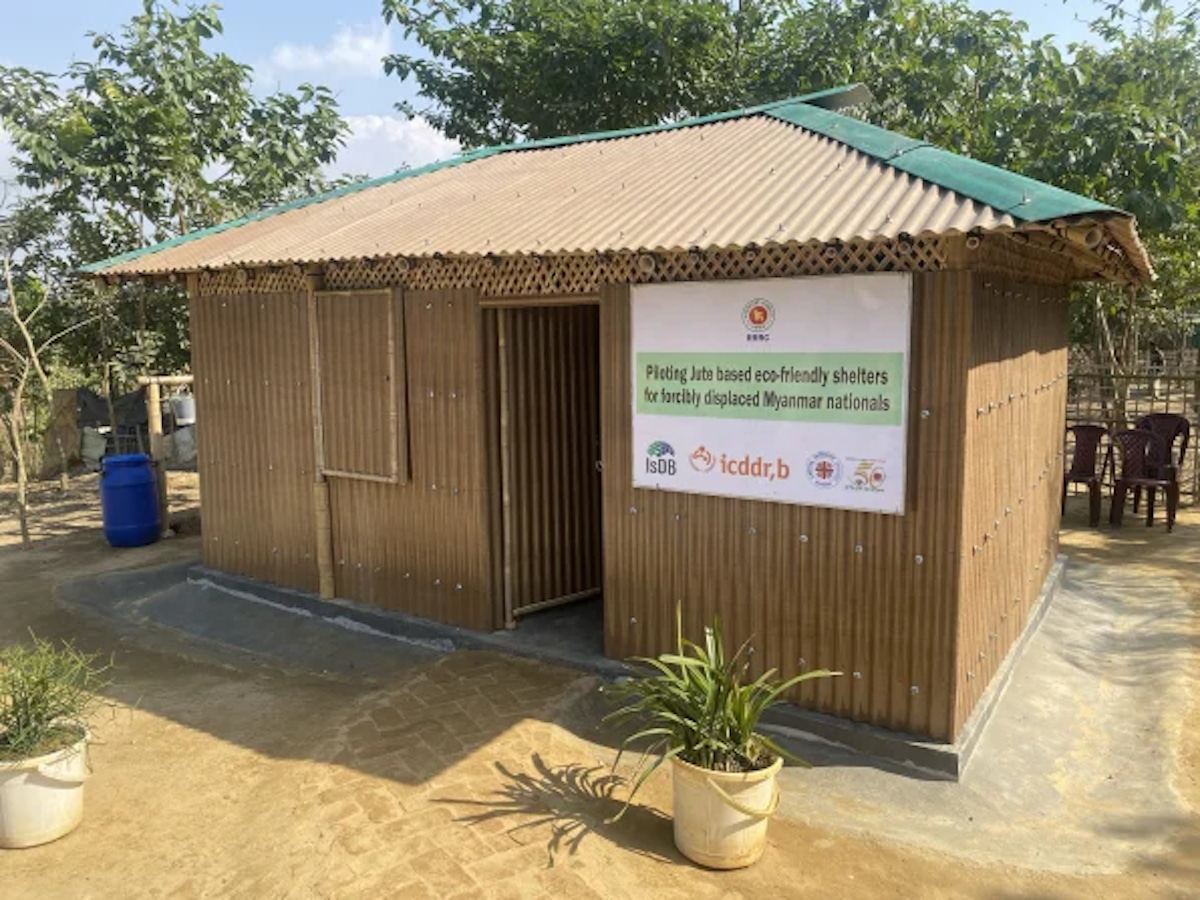
In Bangladesh, Blum met Mubarak Ahmad Khan, a senior scientist who had developed a way to combine jute with resin into panels for rudimentary housing. Jute has long belonged to the region’s agricultural and industrial life. Petrochemical sacks had weakened its old export market; Khan saw the fiber as a building material instead. His early method could produce shelter components without electricity, specialized tools or exquisitely trained labor. To Blum, the overlap was immediate: local crop, local work, better walls.
He offered to help commercialize it. Khan declined. Firmly. The invention was his baby. A neat founder legend would make the next handshake inevitable, but useful partnerships tend to require worse manners from time. Blum returned to Austin and remained unable to forget the housing idea. He brought it to Colin Ardern, then his housemate. They spoke with plastics experts, who saw a second possibility inside the first: the bonding approach might extend beyond panels into the much larger market for durable plastic.
“I want to be the transitionary housing of choice globally.”Alex Blum, on the ambition for the company’s building material
Blum stayed in touch with Khan. After roughly six months of negotiation, Blum and Ardern flew to Bangladesh to sign an intellectual-property transfer and an employment agreement. Work continued for two years. A pilot began in the refugee camp. In June 2019, after leaving their jobs to concentrate on the venture, Blum and Ardern incorporated Applied Bioplastics.
The machine already in the building
Applied Bioplastics now describes two related material families. BioFi is a thermoplastic feedstock that combines agricultural waste with standard, recycled or biobased polymers such as polypropylene and polyethylene. It is designed to be injection molded or extruded using industry-standard equipment. BTR Board is a thermoset composite intended to compete with familiar sheet materials; its Bangladesh-made, woven-jute version is called Jutin.
The commercial sentence hiding inside that chemistry is “no new equipment.” A plant manager can appreciate a lower-carbon resin and still refuse to replace a production line. Blum’s company aims to reduce the amount of virgin polymer in an object while preserving the manufacturer’s habitual motions. Dry the plant fiber. Treat it so it can bond with a polymer that naturally dislikes it. Compound the mixture into pellets. Feed those pellets into an ordinary process. Radical intentions, conservative plumbing.
The practical path from plant to part
Blum’s background becomes useful here. Scientists can make a material behave; buyers must decide to let it into a supply chain. He spent years at companies including WP Engine and ThousandEyes, collecting sales awards and learning where institutional enthusiasm goes to be refrigerated. A manufacturer’s environmental goal does not cancel its cost target, production schedule, qualification process or fear of interruption. The green material must still survive the purchasing department.
That reality corrected the founders’ early assumptions. Blum has described their first expectations as hilariously unrealistic. They imagined making an impressive material, seeing customers love it immediately and raising at least $10 million within a few years. Materials development preferred a longer joke. A 2024 podcast distilled the period into one line: “It was many years, and lots of money, but we got it done.”
A founder learns to distrust the easy money
Chemistry was not the only source of friction. Blum has recounted accepting an early venture term sheet that required exclusivity. The proposed investment was $4 million for roughly 40 percent of the company, but the promised money was to arrive in tranches and the full amount was not guaranteed. The exclusivity kept the company from freely pursuing other capital. Blum said the arrangement nearly put Applied Bioplastics out of business. He begged and borrowed to keep it alive.
His telling includes the right amount of embarrassment. Blum jokes that his father called him a natural scientist because, after failing the hard way, he would perform the experiment a second time just to be certain. This is not the burnished wisdom of a founder who claims every bruise was strategic. It is more useful: optimism is an asset until it signs a contract.
“Efficiency for efficiency’s sake is hollow.”Blum, on the purpose of a business and the people inside it
His public remarks on management carry the same anti-mechanical streak. A business makes money, certainly, but he has also described it as a place for opportunity, learning, friendship and respect. That is an appealing position from someone selling a new industrial material: machinery matters, and the humans standing beside it matter more.
The long middle starts moving
Awards arrived earlier than scale. Applied Bioplastics was a MassChallenge finalist in 2020 and won SXSW Pitch in 2021. Rice Alliance named it a most promising company in 2022. It won an advanced-materials competition in Berlin in 2023, followed by recognition at VERGE and Startup of the Year in 2024. Awards supply signal, photographs and encouraging evenings. Resin still has to ship.
The later numbers are less theatrical and more interesting. A public Austin startup profile records the company’s report of 10,000 pounds shipped in 2024 and 200,000 pounds in 2025. It also records a first deal with a 16 percent margin in late 2024, a first domestic sale in early 2025 and an automotive program targeting 2027 production. Those are company-reported milestones, not a victory lap. They show the particular shape of progress in materials: long stretches of qualification, then a scale-up measured in pallets.
Meanwhile, the original housing work remains present, which makes Applied Bioplastics an unusual two-front company. Its pellets court automotive, appliance, electronics, household and outdoor-equipment manufacturers. Its panels address shelter, humidity, fire resistance and the economics of jute. The same core idea travels in different clothes: put plant fiber to work inside durable material, and make the result economically legible.
The dual use produces tension. Commercial materials markets reward volume and repeatability. Humanitarian construction moves through governments, aid organizations, pilots and approvals, often at a pace that looks cruel beside urgent need. Several years into the project, Blum expressed frustration that the material had housed only six families. He also gave the frustration a vivid frame: climate change has no silver bullet; it requires “silver buckshot,” many partial answers moving at once.
The distance between a story and a system
Blum’s biography invites an easy cinematic cut: successful salesman sees suffering, flies across the world, discovers an invention and starts a climate company. His documentary instincts probably understand why that cut works. His operating experience explains why it is incomplete. Between discovery and a useful material sit contracts, experts, surface chemistry, testing, production partners, customer trials, financing mistakes, certifications and the graveyard hours of follow-up.
That is also what makes his route worth studying. He did not become a polymer scientist by proclamation. He built a team around science, kept the commercial problem in view and used the skill he already possessed: persuading institutions to consider changing what they buy. Applied Bioplastics is not asking society to fall out of love with a magical material overnight. It accepts that plastic is durable, cheap and deeply installed. Its wager is to alter the recipe and, over time, the footprint.
In Austin, that wager looks like feedstock and purchase orders. In Bangladesh, it looks like a corrugated jute panel fixed to a shelter. The two objects belong to the same company because Blum kept following a question after the charitable check failed to answer it: what would help look like if it had to survive outside the story?
The answer is still being manufactured. It arrives as a pellet, a board, a stubborn negotiation, a shipment twenty times larger than the year before. It is less tidy than a donation and slower than a documentary. It may also be the only pace at which a material becomes infrastructure.