The clue is in an old help document. Coffee, a sales prospecting platform, assigns one point to a dial and 30 to a booked demo. A manager can attach a meme to the result, add text and sound, and let the software choose among several celebrations. Somewhere between the phone call and the punchline sits a serious management question: how do you get a roomful of people to do difficult, repetitive work without making every next step another decision?
- The job: route leads and callbacks to outbound sales reps.
- The hook: points, live standings and team-made memes.
- The origin: built for Levitate, released to other teams in 2022.
01 The problem before the points
Jesse Lipson had already built ShareFile before starting Real Magic, the company behind Levitate. He understood outbound sales. But at Levitate, the mechanics were getting awkward. According to Coffee’s origin story, prospecting took too much manual work, and representatives were choosing the leads they preferred. Revenue operations wanted more control over which accounts received attention.
Lipson considered Outreach and Salesloft. His account says neither provided the fit he wanted with HubSpot and his team’s workflow. That is a description of one buyer’s search at the time. It explains the decision to build: the irritation was specific enough to become a specification.
The resulting tool first served Levitate’s own team. Interest from friends and former colleagues helped turn it into an external product. Real Magic announced Coffee on September 6, 2022. The product arrived carrying the assumptions of a working sales floor. There is a pleasing footnote to its name: in a contemporaneous interview, Lipson said he did not drink coffee. His morning choice was iced tea. The brand was built around the customer’s ritual rather than its creator’s.

02 Who chooses the next call?
Coffee’s basic proposition is lead serving. The rep receives an account with the context needed to act; managers influence what enters the queue. The launch announcement describes routing based on time zones and other factors, with follow-up and demo-confirmation calls appearing at the appropriate moment.
That changes a small relationship inside the sales organization. A CRM holds records. A managed queue also expresses priorities. In Coffee’s documented lead labels, an account can show that a demo is approaching, a follow-up is due or an outcome has not been recorded. A named blitz tells the rep which campaign produced the assignment.
The distinction matters to the buyer. Sales leaders want activity they can see. Revenue operations wants fewer ownership adjustments. Reps want enough context to place the call. Coffee brings those interests into the same workflow, making its natural audience outbound teams with repeatable prospecting work.
“I love that Coffee saves me time because I don’t have to manage and shuffle lead ownership.”
Jimmy Critcher · Sales Operations, REVGEN · 2022 launch
Even the timing advice gets specific. Coffee’s help center calls a historically favorable window for an area code the “Golden Hour.” It points to Levitate’s historical calling data to challenge the assumption that lunch is a bad time to reach someone. That is useful as a local finding: this team’s experience supplied a rule worth testing. Other sales teams would need to check their own audience.
03 Thirty points and a small celebration
The leaderboard supplies the visible part of the bargain. Coffee’s help center gives the scoring example: one point for a dial, 30 for a booked demo. Managers can make outcome-specific memes, including several that rotate. The celebration can sound like the team that created it.
Points in Coffee’s documented example. These are incentive weights, not conversion rates.
My reading of that ratio is straightforward: keep making attempts, but give the desired result much more weight. It also suggests a useful question for any manager borrowing the idea. Does the scoreboard reward the behavior the business actually wants? Points make priorities legible. They deserve the same care as any other instruction.
04 The testers who changed the default
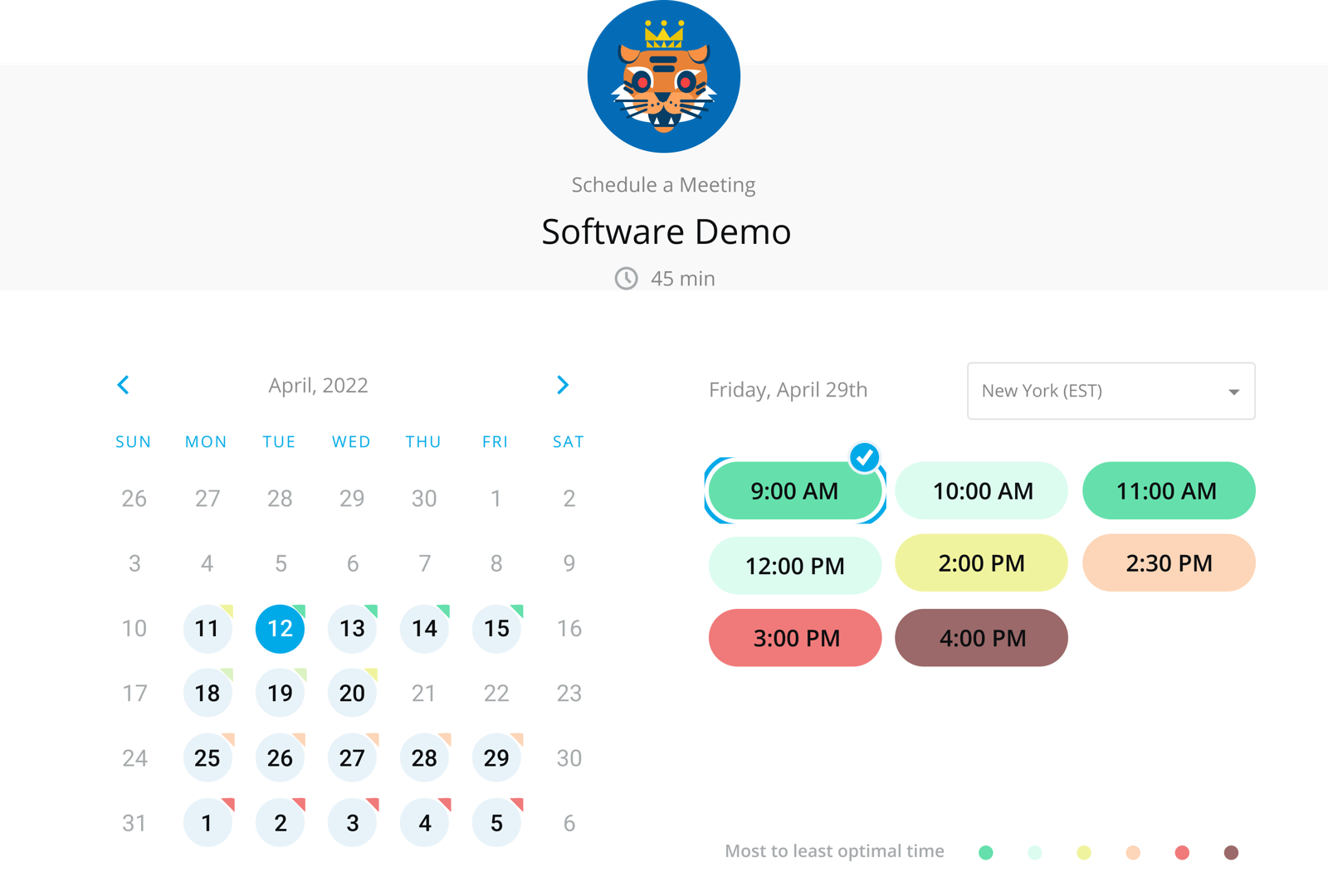
The quieter design work appears in follow-ups. Coffee’s instructions let a rep accept a recommended interval or choose a particular time. The time picker initially uses the lead’s time zone, so a request to call back at three need not become a mental arithmetic exercise.
Then comes a telling exception. The automatic-follow-up guide says that No Answer and GK Blocked outcomes do not automatically recommend a follow-up, a change credited to SDR beta testers. Users had pushed back on a default, and the product recorded the exception.
That is a small, copyable lesson in automation: start with a recommendation, preserve the override, and listen when people doing the work identify an unhelpful rule. The exception belongs in the product, where it can spare the next person the same correction.
05 The money sits outside the scoreboard
Coffee sells to businesses through a demo-led process. The commercial pitch combines workflow control with motivation: fewer lead-management chores, more visible activity and a prospecting experience designed to hold a rep’s attention.
Its launch coincided with a $6 million Levitate funding announcement, co-led by Bull City Venture Partners, Tippet Venture Partners and Lipson. That financing belongs to Levitate’s growth story. It should not be read as Coffee’s development budget or as a separate Coffee round. Buyers evaluating the product need a proposal covering software, implementation and their existing sales stack.
06 Fix the queue. Then ring the bell.
The practical lesson travels beyond this particular product. Decide which accounts deserve attention. Bring callbacks back into the workflow. Make progress visible. Give the team room to put its own humor into a repetitive day.
The limits are visible in Coffee’s documentation, too. Its REVGEN guide provides ways to skip leads with incorrect information or wrong time zones, and to remove duplicates or do-not-call records. A routing system still needs accurate inputs. A competition still needs sensible outcomes.
For a business built around a few bespoke relationships, my assessment is that a high-volume prospecting queue may offer little advantage. For a managed outbound team, the proposition is easier to grasp. Coffee takes a familiar daily question - who should I call now? - and gives the organization a way to answer it together.