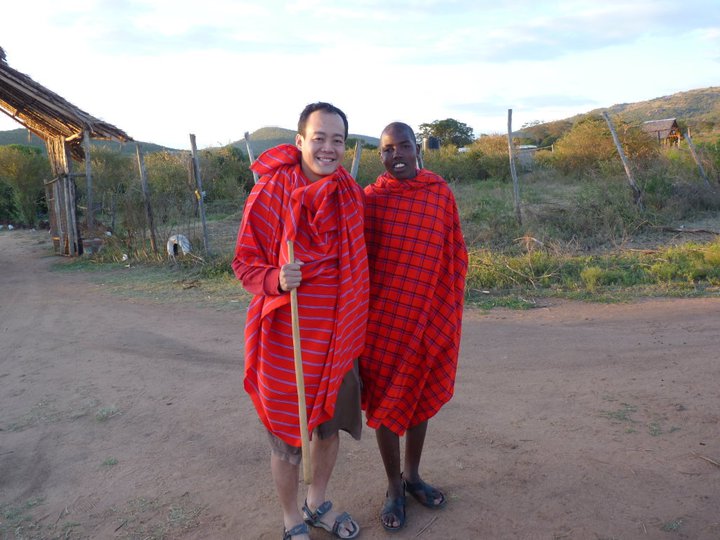
Clement Wong paid $20 to visit a Maasai village and then asked a question that spoiled the transaction. How much of his money would the village receive? He was in Kenya on business, had extended his stay for a safari, and thought the visit would help the local community. The answer, as he later recalled it, was $2. The driver kept the rest. Refuse the arrangement, a villager explained, and the driver could take the next visitors somewhere else.
There was plenty to see on that trip. What stayed with Wong was the route the money took. The person bringing in the customer controlled the transaction; the people providing the experience had little say. It was an awkward discovery for a tourist and a useful problem for someone who had spent his career studying how travel gets sold.
Wong's account of one visit in Kenya, not an industry-wide measure.
The researcher leaves the spreadsheet
Before he founded BeMyGuest, Wong worked on the less photographed side of tourism: research and strategy. At Euromonitor International, he led travel and tourism research for Europe, the Middle East and Africa. At Travelport, his work concerned distribution. He later headed research in Europe for Phocuswright. His clients' world included airlines, hotels, online travel agencies, tour operators and car-rental businesses.
That background matters to the kind of company he chose to build. A visitor sees an excursion. A distribution analyst sees the chain of businesses required to put that excursion in front of a visitor. Wong had spent years looking at the chain. Now he wanted to change who could join it.
He had graduated from the National University of Singapore with a Bachelor of Business Administration in 2003. In 2016, NUS Business School would recognise him with a Young Alumni Award. The distance between those two dates included a move from explaining other people's markets to being responsible for a business of his own. A forecast is considerably more comfortable when somebody else has to meet it.
A ticket onto somebody else's shelf
BeMyGuest began operations in March 2012. Its early proposition was practical: give local experience providers tools to put their products online and reach customers beyond the people who happened to walk past. A free content-management system helped turn a supplier's offering into something that could be listed, managed and sold through digital travel channels.
Wong was looking at a part of travel that had lagged behind flights and hotel rooms. In 2014, he described tours and activities as being roughly where airlines, hotels and car rentals had been 10 to 15 years earlier. Aggregation, standardisation and digitisation were still being worked out. A cooking class and an airline seat might both be bookable, but they did not arrive online with the same commercial machinery behind them.
The ambition was broader than persuading people to visit one more website. BeMyGuest could supply listings to other travel businesses. A small operator might reach a customer through an airline, a hotel or an online travel agency that already had the customer's attention. For Wong, the problem was access to those shelves.
- 01 Local operator
- 02 Digital inventory
- 03 Travel partners
- 04 Traveller
A simplified view of the distribution model developed during Wong's tenure.
The inventory could stretch beyond conventional sightseeing. Wong talked about bringing providers of prata-making classes, tea appreciation and parkour into the travel economy. These were people who had something to teach or show, even if they had never thought of themselves as travel suppliers. Software could make their offers legible to businesses accustomed to selling rooms and flights.
First, find people who will stay
The company's early difficulties were closer to home. Wong had to rebuild after original team members departed, twice. Differences over the venture's direction made agreement fragile. The idea survived; the original arrangements did not. It is a useful complication in a founder's story, where the opening insight can otherwise make everything that follows sound preordained.
He met Blanca Menchaca at a networking event. She joined as co-founder in 2013, bringing experience as Wego's global head of online marketing. Their meeting gave a concrete shape to advice Wong would later offer other founders: spend time with people, ask for help, and find colleagues who share the same goals and values. A contact list only becomes useful when someone on it is willing to build with you.
The business attracted S$500,000 in angel funding in 2013. In early 2014, it acquired Indiescapes, a business curating experiences in Southeast Asia. It also won Channel NewsAsia's Start-up Asia competition. These were separate steps: finding capital, adding experiences and persuading an audience that a difficult corner of travel deserved attention.
The holiday runs on unromantic details
In October 2015, Ctrip integrated BeMyGuest's activities API into its website and mobile app. The arrangement brought an inventory of more than 10,000 products across over 600 Asian destinations into a much larger shopping environment. Wong described an interface available in English and Mandarin, with dynamic pricing, geographic targeting and year-round customer support.
An API is a way for software systems to exchange information. Here, it let a travel seller display and sell experiences supplied through BeMyGuest. The traveller could stay within a familiar booking service. Behind that convenience sat work on prices, product descriptions and connections between systems. Nobody buys a holiday hoping to admire its data model. They notice quickly when it fails.
By 2016, BeMyGuest was concentrating on business customers. Its inclusion in Fast Company's innovation rankings recognised the supplier technology behind the experiences: translation, pricing and tools that helped smaller operators manage an online presence. It ranked fourth in the travel category. The glamour attached to the outing; much of the achievement belonged to the booking process.
“Listening even more to what our B2B partners need.”
Clement Wong, on changing the product strategy
Wong's own assessment was less polished than a prize announcement. Asked about product mistakes in 2017, he pointed to pursuing accommodation and activities simultaneously, building a large technology team rather than prioritising its quality, and hiring a technology lead who was insufficiently hands-on. He also cut consumer features that failed to justify their cost.
His answers made financial usefulness part of product judgment. The people he wanted to hire needed to think beyond travel and consider whether something made sense to build. In the first year, product work consumed most of his time because a working prototype could help attract investment. A presentation could explain the business; something that worked could give the explanation weight.
Enough scale to make the problem visible
In July 2017, BeMyGuest announced a Series A that brought total equity funding to S$11.5 million. Raffles Venture Partners and technology investor Koh Boon Hwee led the round. Participants included SPRING SEEDS Capital, Chan Brothers Group and travel-industry investors Meng Xiong Kuok and Leland Kwee.
The company then described a network of more than 500 distribution partnerships, over 4,500 suppliers and upwards of 25,000 activities, attractions, transfers and events across more than 900 destinations. Those numbers describe BeMyGuest at that stage. They also suggest how far Wong had travelled from a single uncomfortable conversation: the challenge now involved thousands of businesses with different products and systems.
In October 2018, BeMyGuest launched Xplore, a booking system and channel manager tailored to Asian operators. It supported online transactions, multiple currencies, promotions and electronic tickets across sales channels. The operator's own working day had become part of the product: taking payment, issuing tickets and dealing with different kinds of buyers.
On 28 November 2018, the company announced that Menchaca would become CEO and Wong would step down. She moved from chief operating officer into the role. The venture he had started in 2012 would continue under the co-founder he had met while trying to rebuild it.
Another market, then another question
Wong subsequently became CEO of Digital Goods at Lazada, serving from August 2019 to November 2020. He then founded and led Triber, a Philippine social-commerce business. His interests had moved toward the way people discover products through live selling and social connections. In 2022, he was exploring travel for that platform, too. He called travel his “first love.”
Later roles included chief growth officer at FCM Travel in Singapore, from September 2023 to April 2024, and group chief operating officer at GCL Global, which he joined in November 2024. The industries and job titles changed. The repeated subject was commercial growth: how an offer finds a buyer, and how a business organises itself to deliver it.
Today, i12ai names Wong as its managing director and co-founder alongside technology leader Dawid Makowski. The Singapore consultancy works on AI strategy, implementation, automation and training. The language is newer than the booking systems. The practical concern is familiar: where does technology change the workings of a business enough to earn its place?
At the NUS-ISS Learning Festival 2026, Wong is listed as facilitator of a workshop using the Business Model Canvas to examine AI transformation. Its questions concern what a business offers, whom it serves and how it earns revenue. That is a fitting place to find a former travel researcher. Before choosing the technology, follow the transaction. Wong's first memorable example cost him $20.