The useful thing about spending ten years inside banks is that you learn where good ideas go to wait. They wait for the risk committee. They wait for compliance. They wait for the person whose signature means the institution will still be able to explain itself to an auditor three years later. Clarisse Hagège learned that choreography from close range, then left it to build DFNS, a company meant to help new financial rails survive the old questions.
Her career began with a deliberately broad education: literature, history and geopolitics, applied economics, finance, and a graduate exchange year at New York University. The path reads less like a ladder than a well-stocked bookshelf. It eventually led through Goldman Sachs, Merrill Lynch, and Crédit Agricole CIB, where she moved from work supporting senior management in the Americas into corporate banking and global relationship management.
By the late 2010s, trade-finance experiments were giving her a practical look at blockchain's promise and its awkwardness. The technology could improve a process, yet banks were not equipped to operate it. Platforms that began with blockchain sometimes removed the blockchain simply to make the workflow usable. Hagège saw a chicken-and-egg problem with unusually expensive eggs: applications needed infrastructure, while infrastructure struggled to mature without applications.
The sabbatical that refused to end
In 2019, during a sabbatical, Hagège helped a company explore raising money through an initial coin offering. Institutional interest was there. The wallet machinery was not. Available products had largely been designed for investors buying and selling crypto, not for companies trying to build applications with secure custody tucked underneath. She resigned from banking and began assembling what became DFNS.
The transition included a wonderfully unceremonious technical apprenticeship. Hagège taught herself about cryptography and the sector through YouTube videos and specialist sites. Then came the slower education: finding people with whom she could build. She has said the co-founder search took eight to ten months. Christopher Grilhault des Fontaines, her partner, brought experience from earlier startups and joined the company; cryptographer Thibault de Mersan and engineer John Attlee followed as co-founders.
Building with a partner adds a domestic footnote to every strategic argument. Hagège and Grilhault des Fontaines have appeared together to explain DFNS's origins, with her banking experience meeting his background in consumer startups. He initially joined to help with operations and became fully involved as a co-founder. Their shared account makes the company sound less like a lightning strike than a long table covered in complementary problems: finance, product, security, and the daily work of turning specialist knowledge into a service.
The geography is similarly doubled. Hagège's public profile places her in Brooklyn, while DFNS is headquartered in Paris, and speaker biographies describe a life divided between New York and Paris with her partner and their two children. The arrangement suits the company she built. DFNS was incorporated in France but sells to an international financial system, one in which regulatory expectations remain local even when transactions cross borders in seconds.
Her education makes more sense in that context too. History and geopolitics teach that systems come with institutions attached. Economics puts incentives into the picture. Finance teaches what happens after the meeting, when someone reconciles the account. None of those degrees supplied an MPC protocol. Together, they help explain a founder who talks about cryptography through operations, incentives, and the people expected to trust it.
Their first big decision was expensive precisely because customers would never see it. DFNS could license an existing multi-party computation library and launch quickly, or build the cryptographic layer itself. MPC divides the work of producing a valid signature among multiple parties, avoiding a single private key that one person, device, or intruder can misuse. The team chose to build. The decision delayed the go-to-market by more than a year.
Startup folklore tends to treat delay as a character flaw. Security infrastructure makes the opposite case. A landing page can be rewritten on Friday. A root of trust deserves a rather longer lunch. Hagège later put the principle plainly: some parts of a business can develop by trial and error; the security foundation cannot.
Selling to the room behind the room
The banking years supplied another advantage. Hagège knew that an innovation team might sponsor a conversation without controlling the decision. Risk officers, compliance heads, and treasury teams could quietly determine whether the conversation continued. During crypto downturns, DFNS leaned into those buyers. It talked about audits, controls, regulatory alignment, and transaction governance while noisier companies sold the excitement of the market.
- Map the whole buying committee, including the people empowered to say no.
- Own the technical layer where failure would damage the customer's business.
- Translate the new system into workflows an institution already understands.
This is less about making blockchain resemble a bank than making responsibility legible. If several employees can initiate, approve, and execute a transaction, software must encode who can do what. If an employee leaves, access must change without placing funds in limbo. If a transaction violates policy, the system should stop it before anyone has to compose an apology. DFNS wrapped those concerns in APIs so a fintech could create wallets and move assets without inventing its own cryptography department.
The market eventually rewarded the patient approach. Hagège won VivaTech's Female Founder Challenge in 2021, a result she credits with bringing mentor Claire Calmejane, useful investor introductions, and credibility. DFNS announced a large seed round in 2022. In January 2025, it closed a $16 million Series A led by Further Ventures, with participation from Motive Ventures, Wintermute, Motier Ventures, and existing backers.
The wallet outgrows its name
By 2026, the company had decided that “wallet infrastructure” described too little. A modern institution may hold stablecoins, settle tokenized assets, run treasury policies, connect to trading venues, and reconcile movements across several chains. Holding or signing with a key is necessary, but it is a small portion of the operating problem. DFNS began calling itself a core banking platform for digital assets.
The layer between a balance sheet and a blockchain
banks · ERPs · treasury
wallets · tokens · settlement
The distinction matters because old and new rails are unlikely to conduct a duel at dawn. Hagège's thesis is coexistence. The same institution will operate both, under the gaze of the same board, regulators, auditors, and clients. The job is to give payments, custody, treasury, and settlement a common control plane without demanding that a bank tear out every system it already uses.
Recent product work follows that map. DFNS introduced encrypted transactions on Ethereum-compatible networks using Zama's fully homomorphic encryption technology, allowing contracts to compute over encrypted balances and amounts. It announced integrations and customers spanning cross-border stablecoin payments, institutional trading, settlement, and tokenized assets. In each case, the interesting object is not the coin. It is the operational sentence around the coin: who moved it, under which rule, between which systems, with what record left behind.
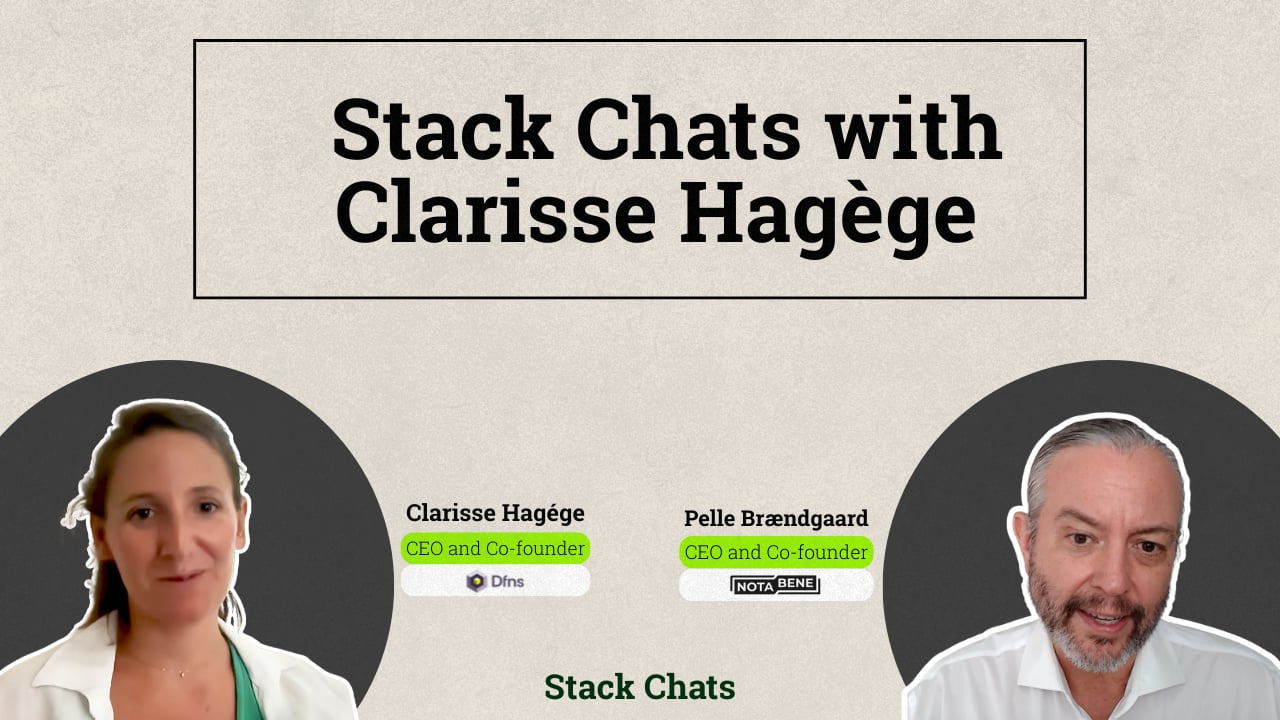
Watch: the custody idea behind DFNSFounder discussion · Video opens on YouTubeA second institution to rebuild
Hagège's interest in standards now extends beyond her company. In 2025 she became president of the MPC Alliance, after serving on its board and leading outreach. Her agenda included refreshed governance, an archive of research and use cases, shared code, engagement with bodies such as NIST and ISO, and a certification program. It is the same instinct at a different altitude: make a difficult technology easier for institutions to evaluate.
People who have worked with her publicly describe a leader who combines intellectual speed with empathy and an ability to make hard decisions. Her own writing is more revealing than the adjectives. She returns to control, first principles, and the specific humans inside institutional machinery. She is willing to defend a long technical investment, but she is equally interested in whether the product reduces the chance of human error.
That balance gives the DFNS story its shape. Hagège did not flee banking for a world without institutions. She left to make a new technical world answer the questions institutions ask when real money, real clients, and real accountability arrive. Crypto has produced plenty of theatre around freedom from intermediaries. Her work begins after the curtain, when somebody must decide who is allowed to press the button.
The aspiration is now larger than a safer wallet. Hagège wants the rails for fiat and digital assets to behave like one composable financial surface, with one operational discipline. It sounds sober because it is. Money has always depended on unromantic machinery. The people rebuilding it merely get to choose which mistakes the machinery will refuse to make.