The most important object in crypto is also the least photogenic: a private key, the long secret that proves you may move the money. Lose it and the assets can become unreachable. Expose it and somebody else may move them first. DFNS was built around a blunt observation that much of the young industry was handling this crown jewel with hardware gadgets, paper backups and more confidence than operational sense. The founders did not set out to make another coin or exchange. They set out to make the key someone else's well-engineered problem.
Clarisse Hagège and Christopher Grilhault des Fontaines incorporated DFNS in Paris in 2020. Hagège had looked for a technical co-founder before turning to des Fontaines, her partner in life as well as business. Their early proposition sounded narrow: Wallets-as-a-Service secured by multi-party computation, or MPC. Instead of keeping a complete private key in one place, the system divides signing authority across independent components. A transaction proceeds only when the required parties cooperate. There is no single secret sitting in a database waiting for one catastrophic leak.
The timing was both fortunate and miserable. Crypto markets were attracting users, money and attacks; Covid made building a deep-tech security company unusually awkward. The first thing to fail was not DFNS's cryptography. It was the assumption that the market would instantly understand why developer-oriented wallet infrastructure mattered. In 2020, the company says, Wallets-as-a-Service built on zero-trust architecture drew cautious optimism and outright skepticism. Infrastructure is hard to demonstrate because success looks like nothing happened.
01The wallet became a control room
DFNS now calls itself a core banking platform for digital assets. The change is revealing. A wallet sounds like a container. A core banking system sounds like the machinery that keeps accounts, processes transactions, applies approvals, reconciles balances and leaves evidence for auditors. That expanded description more closely matches what clients needed after the first secure wallet went live.
Through one API and dashboard, a customer can create wallets, manage keys, construct and broadcast transactions, monitor confirmations, sponsor network fees, enforce spending rules, automate treasury flows and interact with token contracts. The same policy layer can require multiple approvals, limit amounts, allow only known addresses or stop an action before it reaches the signer. DFNS connects to more than 100 networks at varying levels of support and offers TypeScript, Python and Go tooling alongside public solution blueprints.
That chain of events is the product. A consumer may see a fingerprint prompt and a balance. The fintech behind the screen sees identity, policy, key shares, nodes, fee logic and a transaction lifecycle. A regulated institution also sees a question that most crypto demos avoid: who can stop the system if the software provider itself is compromised? DFNS's 2026 Governance Engine and Validation Gate put a final customer-controlled checkpoint inside the client's environment.
02Who pays for invisible plumbing?
The customer list explains the market. Payment companies use DFNS to move stablecoins without asking every end user to understand gas. Neobanks embed self-controlled wallets behind familiar mobile interfaces. Custodians add new networks without rebuilding key infrastructure. Token issuers govern minting and redemption. Trading firms and brokers connect execution to settlement. DFNS publicly names organizations including IBM, Stripe, Circle, Kraken, MoonPay, Broadridge, Apex Group and Standard Chartered-backed Zodia Custody.
This is business-to-business software sold on subscription. DFNS's current public annual prices run from $800 for Starter to $8,000 for Basic and $35,000 for Pro, while Enterprise is negotiated. Plans bundle organizations, users, wallets, networks, policies and monthly signatures. The company says it does not charge a percentage of assets under management or transaction volume. That is a useful distinction for payment businesses: a vendor bill should not rise merely because the value of money moving through identical software went up.
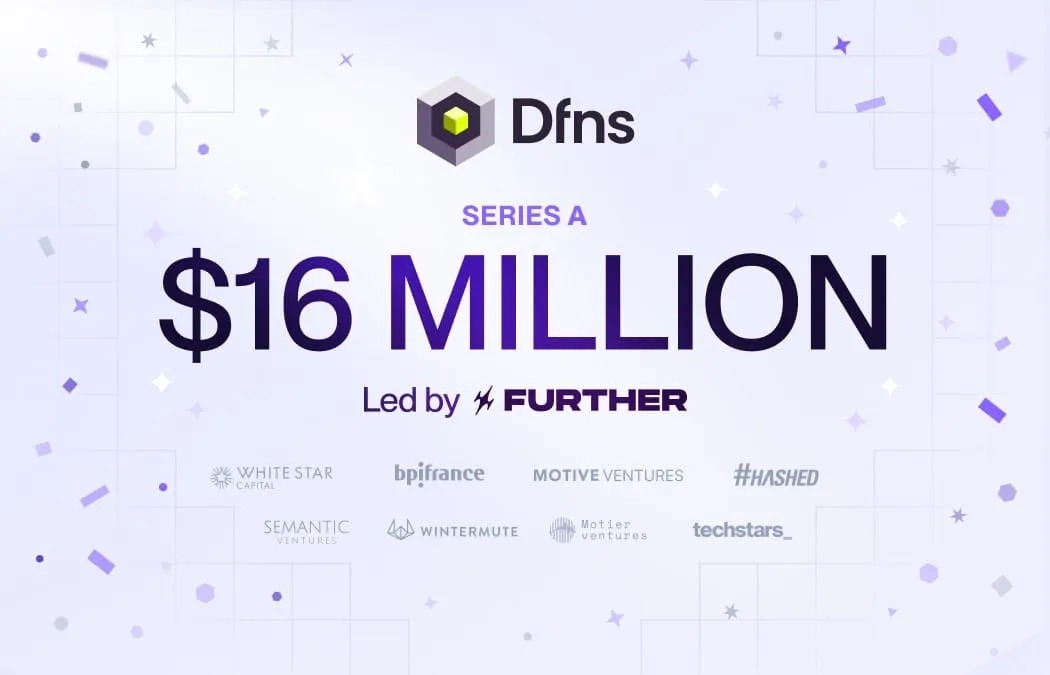
What did the company itself cost to build? Investors supplied the visible answer: a $13.5 million seed round led by White Star Capital in 2022, followed by a $16 million Series A led by Further Ventures, announced in January 2025. The less visible cost was time. DFNS waited about four years before opening general self-service access. Its 2025 launch included a trial and an inexpensive starter tier, a deliberate move after years spent hardening the product with demanding institutions.
03The useful reversal
DFNS's most instructive product decision was an admission that its original conviction had an edge. The company resisted private-key export because export creates a route around distributed security. If a complete key can leave, a carefully designed no-single-point-of-failure system has acquired a door. That was cryptographically coherent and commercially uncomfortable.
Customers pointed out that preventing export created another concentration risk: dependence on DFNS. A bank deciding whether to place critical infrastructure with a startup does not want a lifetime commitment disguised as a safety feature. The founders changed their minds and built controlled export. The trade-off did not vanish; it became explicit, governed and auditable.
The bit worth stealing
When customers reject your “safest” design, ask which risk they are pricing that you are not. Then make the trade-off controllable. DFNS did not abandon security; it widened the threat model to include vendor dependence.
The same pattern appears in DFNS's support for hardware security modules. MPC was the founding technology, but some banks already own certified IBM or Thales hardware and have rules about where keys may live. Instead of forcing one architecture, DFNS moved upward. Customers can use MPC, an HSM, a trusted execution environment or an offline signer while retaining the same APIs and policies above it. AWS CloudHSM support, added in July 2026, keeps signing keys inside a customer's own account and chosen region.
This is also where DFNS differs from lighter wallet developer kits. Passkey onboarding and friendly APIs matter, but the company is selling deployment choice, auditability and transaction operations to buyers with risk committees. Against broad enterprise rival Fireblocks, its pitch emphasizes a component-neutral control plane and predictable subscription pricing. Against Privy, Turnkey or an internal build, it emphasizes the breadth of the regulated operating stack. Competitors can match pieces; the contest is over how many pieces a buyer wants from one vendor.
04The IBM-sized signal
IBM's Digital Asset Haven, announced in October 2025, is DFNS's clearest institutional credential. Developed with DFNS, the platform is aimed at financial institutions, governments and regulated enterprises managing tokenized assets. The collaboration gives IBM wallet and orchestration capabilities while giving DFNS access to the sort of enterprise environments where procurement, sovereignty and hardware support decide whether software leaves the pilot stage.
Recent releases show the company following those workflows outward. A Wyden integration connects trading with wallet settlement. Schuman Financial uses DFNS beneath a MiCA-compliant euro stablecoin. Equisafe uses it for tokenized-asset wallets and restrictions. A transaction-screening feature looks for address-poisoning tricks before transfers. Robinhood Chain support gives builders the same control layer on a new network. This is not one killer application. It is an attempt to own the junction box.
05Copy the method, mind the conditions
Founders can borrow five moves. Begin with a primitive whose failure is existential. Wrap it in an API so customers can focus on their application. Let demanding early clients harden the product before opening self-service. Price the infrastructure in a way that does not punish customer success. Finally, follow the primitive into the operational work around it. DFNS did not leap randomly from wallets to treasury and tokenization; those jobs arrived whenever money moved through the wallet.
Where the playbook works
The primitive is painful, shared by many customers and costly to get wrong. Buyers value certification, reliability and integration more than owning every line of code.
Where it breaks
A hobby app only needs a simple wallet library, the buyer insists on total internal ownership, or regulation rejects any external control plane even in a hybrid or on-premises setup.
The risk for DFNS is the usual infrastructure paradox. Expanding the platform makes it more useful and more complicated. Serving a two-person startup and a global bank from the same API is a clean slogan; their support, procurement and failure tolerances remain radically different. Blockchain coverage can become table stakes. Banks can build. Large rivals can bundle. And crypto markets can still turn the word “onchain” from strategic priority into budget-line embarrassment.
Yet the company's positioning has matured in a way many crypto businesses have not. It no longer asks institutions to adopt a single ideology of custody. It offers choices, puts rules before signatures and treats escape routes as part of trust. The amusing part is that a company born to defend keys may win by making keys the least interesting thing it sells.