In the spring of 2021, Exodus had a problem that a beautiful chart could not solve. People were arriving faster than the company could answer their questions. Its cryptocurrency wallet was attracting users; its customer-service queue was attracting delays. In a shareholder update, the company admitted that response times had fallen below its own standards and said it was hiring support experts. The awkward detail is also the revealing one. Making finance look easy creates demand for somebody to explain the difficult bits.
- You keep the keys. Exodus supplies the interface; wallet users control their digital assets.
- The app is free. Transactions fund the business. Swap and fiat-service relationships supply revenue.
- The customer now includes other companies. XO Swap puts Exodus infrastructure inside partner products.
- The next test is everyday spending. Payments acquisitions and a new merchant checkout extend the wallet beyond investing.
Five years later, the problem has acquired a different shape. Exodus is buying payment infrastructure, issuing a merchant checkout product, and retiring its browser extension. The company that helped people hold crypto now wants to help them use it. That sounds like a small change of verb. It requires an appreciable change of business.
An engineer, a designer, and the geek requirement
JP Richardson and Daniel Castagnoli founded Exodus in 2015. Their division of labor helps explain the product: Richardson brought engineering; Castagnoli brought design. The company credits the latter with experience designing for brands including Apple and BMW. Its declared ambition was to remove the “geek requirement.” In a field rather fond of making newcomers feel underqualified, that was a sensible commercial instinct.

The engineering half of the founding pair.
The pixels have a proprietor.
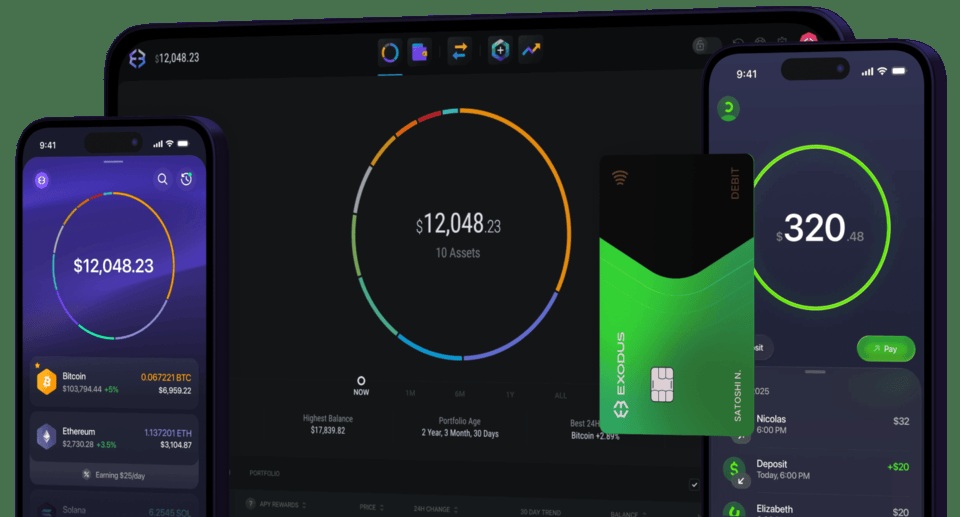
The resulting wallet brings balances, transfers, swaps, and eligible staking into desktop and mobile software. Users can inspect a portfolio without assembling several separate interfaces. Selected Ledger devices work with Exodus Mobile; Trezor integrates with Desktop. The useful promise is reduced effort: fewer places to look, fewer unfamiliar screens to negotiate, and support when the terminology becomes tiresome.
The distinction is custody. Exodus’s self-custodial wallet keeps private keys on the user’s device. Possession of those credentials confers control. A pleasant interface can make that arrangement less intimidating, but it cannot transfer the responsibility back to a help desk. The design problem is unusually delicate: make ownership approachable while leaving its consequences visible.
“Our goal is to remove the geek requirement”
Exodus, on the reason for its design
Free software, paid transactions
A wallet is a useful thing to give away if it becomes the place where people transact. Exodus connects users with third-party exchange and fiat-service providers and earns revenue from those relationships. The user receives a convenient route from one asset to another, or between cash and crypto. The company receives an economic reason to keep improving the route.
“Free” needs careful handling here. Exodus does not retain the network fee on an ordinary crypto transfer; that fee goes to the blockchain’s miners or validators. Swapping and buying have separate pricing. A quote may involve provider charges, a spread, and network costs. An attractive button cannot make all of those costs vanish. Users comparing alternatives need to compare the amount they receive, as well as the label on the button.
The model produced $121.6 million of revenue in 2025, against $116.3 million in 2024. Annual swap volume reached $6.89 billion. Those are different measures: the value exchanged is far larger than the revenue earned from facilitating it. Treating transaction volume as sales would make almost any payments company look splendid, and almost any analysis useless.
Full-year revenue in US dollars. Bars share a zero baseline.
Let somebody else own the screen
There is a second way to grow a wallet business: supply a service to people who already have a wallet. XO Swap packages Exodus’s exchange aggregation for partner platforms. Ledger announced the integration in September 2024. The product’s customer testimonials also name Magic Eden, Rango Exchange, Bifrost Wallet, and Zelcore.
This changes the sales pitch. A consumer wants an understandable app. A partner wants an integration that saves work and gives its users a reason to transact. Exodus can earn a place in that transaction without persuading the customer to move every balance into an Exodus-branded screen. Distribution becomes a technical relationship, not merely a contest for app downloads.
- 01Your walletChoose an asset pair and review the quote.
- 02Third-party providerAssets move to the provider executing the swap.
- 03Your wallet againThe resulting asset returns to your address.
Self-custody between transactions does not mean a provider never handles the funds.
The market is crowded. MetaMask, Phantom, and Trust Wallet also offer ways to manage and transact with digital assets. Exodus’s particular combination is its design emphasis, desktop and mobile software, hardware integrations, and an infrastructure business behind the consumer product. Whether that combination suits someone depends on the networks and services they actually need. A list of supported assets is a poor substitute for checking your own.
The bill for becoming a payments company
Payments broaden the ambition again. Exodus Pay launched in April 2026, integrating money sending and spending with the wallet. In May, Exodus completed acquisitions of Monavate and Baanx businesses. Card issuance and payment processing require capabilities quite different from displaying a Bitcoin balance. The purchases brought more of those capabilities into the company.
The price is not one tidy cash number. A July filing describes $76.2 million of loan netting for Monavate and Baanx.com, plus $30 million in installment consideration for Baanx US and specified assets. The quarterly filing also includes forgiveness of a $10 million note as purchase consideration and reports $29.5 million of acquisition-related costs for the first half. Financing settlements, purchase consideration, and deal expenses belong in separate columns.
The broader argument is intelligible: a company earning money when people swap crypto wants more reasons for people to transact. Paying for something ordinary offers a different habit from checking an investment portfolio. It is an interpretation of the strategy, not evidence that everyday payments have already insulated Exodus from the crypto cycle.
Nor did the expansion arrive without strain. In July 2026, Exodus announced a realignment affecting approximately a quarter of its global workforce. That is part of the company’s story alongside its published remote culture, open salaries, and Bitcoin payroll. Working anywhere does not exempt a business from deciding which work it can afford.
A television subscription is a useful test
On October 1, 2026, Exodus launched Checkout with DGO, DIRECTV’s streaming platform in Latin America. Eligible customers in Argentina can pay for subscriptions using dollar stablecoins; expansion to other markets is planned. The product supports one-time and recurring payments. A TV subscription is a revealing first use: familiar enough that the payment method must justify itself, rather than borrow excitement from the thing being purchased.
Monthly active wallet users
August 31, 2026. Active users are not paying customers.
The same month’s disclosed metrics show two distinct engines: $376.8 million of exchange-provider volume and $356.8 million of payment gross transaction volume in August. They measure different activity. The figures establish that Exodus now operates both businesses; they do not establish how profitable the combination will become.
The useful lesson for another builder is specific. Start with a job people already need done. Put monetization close to a useful transaction. Let partners distribute the part they can use. And staff the questions that adoption creates. Exodus’s 2021 support admission remains a better operating lesson than a vague injunction to obsess over customers.
The twelve words the interface cannot rescue
For a prospective user, the bargain has limits. Wallet recovery depends on safeguarding credentials such as the 12-word secret key; Exodus cannot retrieve a lost phrase. Hardware wallets add a separate layer of key protection. Some wallet components remain closed-source. Payment features and cards vary by location and may require verification. Convenience is a collection of arrangements, each with conditions attached.
The current product boundary matters too. Exodus ended browser-wallet support on October 1, 2026. Existing users can follow its instructions to recover assets through Exodus Mobile or a compatible wallet. Funds on a blockchain and a supported application are different things; the former can remain accessible after the latter closes its doors.
That is where the Exodus story gets interesting. The company can simplify screens, extend distribution, and buy payment infrastructure. What it has to prove now is whether those efforts make digital money useful often enough to become a habit. The next persuasive demonstration may involve something less theatrical than a crypto rally: a subscription paid, a transfer completed, and nobody needing to ask what a private key is.