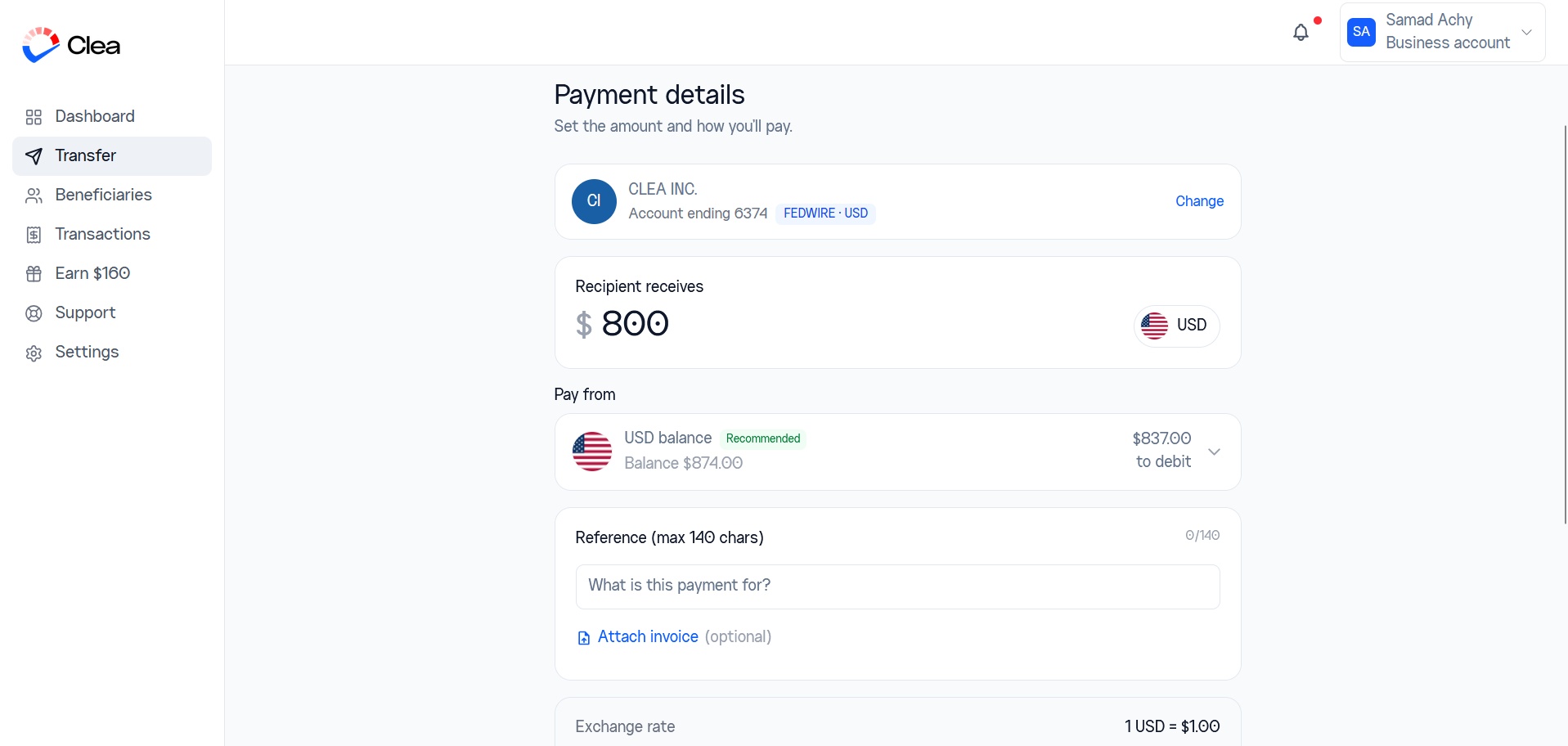
The payment failed because it had the wrong name. Nigerian car importers using Clea had legitimate orders and funds to pay for them. But an auction platform wanted the wire to arrive from the business on the buyer’s profile. Dollars sent by a helpful broker could still be unwelcome dollars. A fast transfer with the wrong identity merely delivers the problem sooner.
- HIFI connects stablecoins to accounts, banks and card networks.
- Clea’s named accounts tackled a specific supplier-payment failure.
- Developers get building blocks for moving and controlling money.
- Instant settlement makes upfront verification more consequential.
The name is part of the payment
HIFI’s September 2026 Clea case study reports supplier rejections falling from 60% to near zero. Its intervention combined dollar accounts in importers’ business names with verification adapted to local documentation. An established dealer might have no website; a utility bill might belong to the landlord. Clea also supplied invoices through the API. The work involved understanding the transaction’s context, as well as moving its value.
Company-published case study, September 2026. Near zero is an approximate result.
Here is the portable lesson: trace a payment until you find the first rule it violates. Fix that rule. Clea’s customer wanted a supplier paid, with the correct identity attached. The choice of settlement technology was important underneath. Above it, the useful result looked reassuringly ordinary.
One interface, several kinds of money
Founded in 2022 by CEO Zach Walsh and COO Mohamed Afifi, HIFI supplies infrastructure to businesses building financial products. A developer can use its APIs to accept funds, provision wallets, convert value and route payouts. Its customers include fintechs, exchanges, marketplaces and financial institutions. This is the layer a product team buys when it would rather spend its engineering time on the product.
The platform divides the work into inflows, controls and outflows. Incoming funds can come from banks, cards or wallets. Controls define approvals, limits and restrictions. Outgoing payments take the supported rail to their destination. Workflows join those pieces: split a payment among participants, separate operating funds from reserves, or release funds when a specified event occurs.
HIFI competes in the infrastructure territory occupied by Bridge, BVNK, Zero Hash and Coinflow. Its positioning emphasizes composable money movement, built-in controls and institutional settlement. The useful comparison is a customer’s actual workflow: which account names, jurisdictions, assets, permissions and destinations must an integration handle? A long list of supported rails answers only part of that question.

The boring work behind the buy button
Dapper Labs provides another angle. In HIFI’s account of the deployment, collectibles lived on Flow while payments settled on Polygon. Fans encountered a purchase button; engineers dealt with parallel systems, fees and eventual payouts. When individual transfers clogged reconciliation, the teams introduced batch transfers. The backlog cleared within a week, according to the case study.
“We were braced for calamity, and the whole thing was just boringly smooth.”Bart Bobnis, staff backend engineer, Dapper
That observation concerned the migration onto HIFI, coordinated over several days. It captures a peculiar standard of achievement in financial infrastructure. A successful launch can be an event nobody notices. The company’s expertise is visible in the engineering details: reconciliation, wallet operations, cross-chain liquidity and the cutover that lets customers carry on buying.
HIFI describes a team with experience at Uber Payments, Mastercard, Visa, Block, Google and Stanford Blockchain Research. Its public identity stresses technical builders. The customer stories add a less glamorous competence: working alongside another engineering team until a particular operational problem is resolved. A platform’s abstractions are tested by the awkward particulars of somebody else’s business.
Faster settlement moves the questions forward
The price of this convenience has several components. HIFI sells B2B infrastructure under commercial agreements; its Push to Card page describes flat fees. An integration also requires engineering, a supported route and customers who can satisfy verification. A sensible buyer would compare the complete journey: conversion, payout charges, liquidity arrangements and reconciliation work.
Circle’s HIFI case study puts numbers on the alternative. Establishing direct coverage through licensing, local entities and bank integrations could take up to two years and cost $500,000 to $2 million per market, it says. Through Circle Payments Network, HIFI could open a route in roughly three months. Those are partner-published comparisons of infrastructure buildout, rather than HIFI’s customer prices. They explain the attraction of buying access to an existing network: somebody has already done much of the expensive coordination.
Compliance introduces another cost: attention before execution. In a discussion published by HIFI, Arival Bank president Tom Hugh explains that instant, final settlement removes the pause once available for reviews. Knowing the business, its owners and its counterparties becomes work to finish earlier. That can mean more information at onboarding, even when subsequent transfers feel easier.
HIFI’s control tools reflect that sequence. Identity gates, transaction limits and approval rules evaluate whether an operation may proceed; structured events record decisions for review. The architecture matters when the destination cannot simply return the transfer. Faster settlement is useful only when the organization has decided what should settle.
Eligibility remains specific. Push to Card combines stablecoin settlement with Visa Direct for eligible US businesses and eligible Visa cards. A continuously operating blockchain does not make every recipient, bank route or jurisdiction continuously available. The useful promise is a supported end-to-end payment, under the conditions of that payment.
The same problem, wearing a suit
Institutional finance gives HIFI’s proposition a different setting. Onchain repo needs collateral and cash to settle together. HIFI supplies the cash-side connection to dollar liquidity and bank rails. Its private-transaction product uses Canton for confidential value movement, where institutions need controls over who can see amounts and counterparties.
On September 24, 2026, HIFI announced a $37 million Series A led by Left Lane Capital. Planned uses include additional licenses, hiring and expansion into cards and capital markets. The breadth is ambitious. The underlying sales argument remains practical: fewer separate systems to coordinate whenever money changes form or destination.
Clea offers the smaller, sharper test. Does the payment reach the supplier in an acceptable form? For a company promising programmable money, the answer may depend on something as old-fashioned as a name. Infrastructure earns its place when that detail stops being the customer’s problem.
Follow the money
Explore the platform, read the deployments, or hear the founder explain the thesis.