Imagine a financial institution with impeccable records, expensive security software, and a transaction it cannot authorize. The money is there. The network is running. The person with the right signing access is unavailable. This is a thought experiment, but it reveals a peculiar property of digital finance: ownership and usable authority are different things. MPCH has built a business around the space between them.
- Stronghold-KMS governs the keys that operate infrastructure.
- Stronghold-DR keeps recovery materials offline and under client-defined authorization.
- Consensys uses Stronghold; Blockdaemon pairs MPCH’s node controls with wallet security.
Its proposition is pleasingly unglamorous. Cryptography needs rules, hardware, and sometimes a locked room. MPCH combines those ingredients for institutions whose keys authorize more than a personal purchase. Banks, digital-asset businesses, enterprises, and government organizations are its intended audience. The interesting question is how to preserve their power to act without making that power easy to steal.
01 / The wallet was the beginning
Before MPCH, Miles Parry ran the institutional custody business Vo1t, acquired by Genesis in 2020. He encountered multi-party computation there. MPC lets participants perform a shared computation without disclosing their individual private inputs. For signing, the appeal is distributing trust rather than leaving a single operator in charge of one complete secret.
In a 2022 interview, Parry said that seeing pitfalls in the market persuaded him to build an architecture from scratch. He co-founded MPCH with Cat Le-Huy. Their original public pitch centered on MPC6, a proprietary engine, and Fraction, an institutional platform for managing digital assets, wallets, and workflow permissions. The ambition already extended beyond a nicer wallet interface.
Series A led by Liberty City Ventures
$50m total funding reported at the announcement
That money financed development; it was never a price tag for customers. Animoca Brands, Oak HC/FT, Polygon Studios, and QCP Capital were among the round’s backers. Today, the company’s product map emphasizes Stronghold signing and recovery, institutional network operations, and secure facilities. The movement is toward the machinery beneath an asset’s visible journey.
02 / A signature below the surface
A wallet key authorizes movement of assets. An infrastructure key may establish a node’s identity, protect confidential network state, or authorize administrative changes. Compromise at that level reaches the rules and machinery on which applications depend. MPCH’s Stronghold-KMS addresses this less photogenic category: authority keys.
Its stated design puts signing inside hardware security modules, with a policy engine controlling requests and approvals. Key management includes issuance, rotation, and revocation. Canton was its first deployment target; MPCH also describes applications in certificate authorities, software signing, and other infrastructure. These are proposed or supported uses, rather than evidence that every listed market has a named customer.
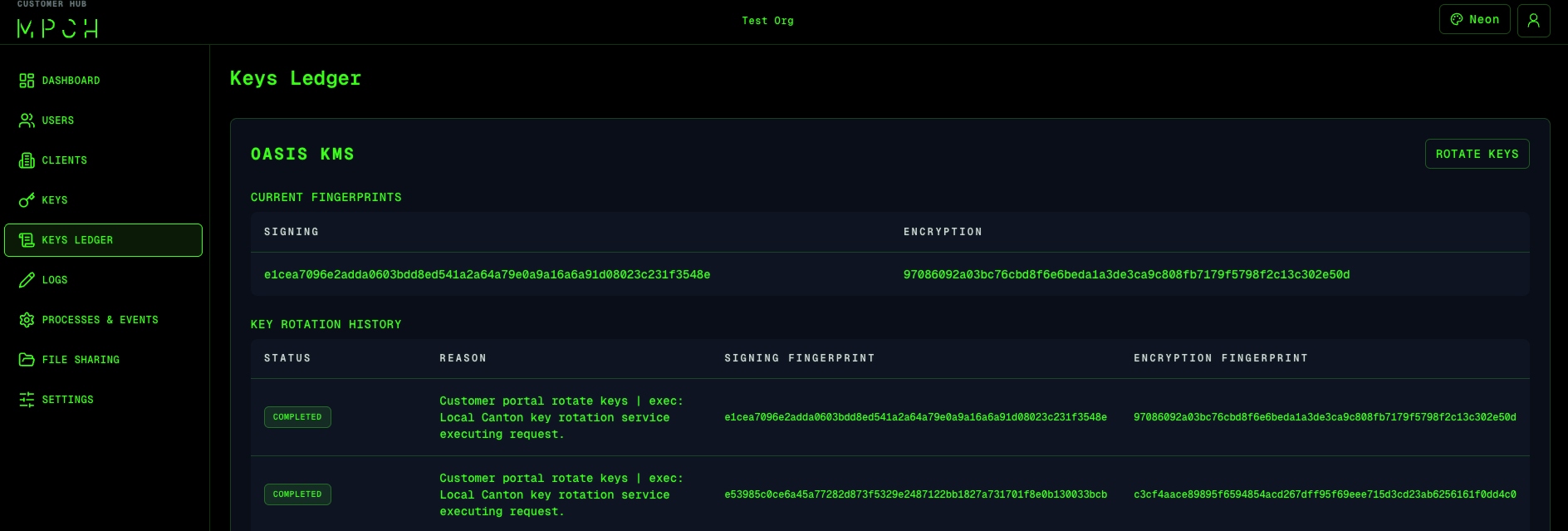
The distinction becomes concrete in its Blockdaemon partnership. MPCH manages Canton node keys; Blockdaemon’s wallet and transaction gateway manages asset and party-credential controls. Blockdaemon says the joint stack is securing production workloads. Institutions can choose managed service delivery or run the integrated stack in their own environment.
Different keys. Complementary controls.
That places MPCH beside institutional wallet providers as well as in competition with parts of their security stack. Its differentiation is the combination of facility operations, hardware, and software governance. A standalone HSM supplies key isolation. An institution still needs people and procedures to decide how that hardware gets used.
03 / The backup has a front door
Stronghold, launched in late 2024, brought another question into focus: what happens when normal access disappears? Stronghold-DR protects seeds, secrets, keys, and signing devices through offline storage and authorized recovery. MPCH describes geographically separated facilities, biometric entry controls, and air-gapped environments. The client retains control of the assets those materials can unlock.
In March 2025, MPCH announced that Consensys had implemented Stronghold for backup and recovery. This matters because a blockchain software company already understands self-custody. It bought an additional recovery layer. Its risk chief, Mark D. Young, included a useful qualification in his endorsement:
“While no security measures are absolute”Mark D. Young / Chief Risk Officer, Consensys
Recovery is a sequence of accountable acts. MPCH’s published process begins with enrollment and access rules, moves through storage configuration and documented transport, then establishes retrieval protocols and continuing reviews. The rather dull handoff record becomes consequential when the item being handed over can restore signing authority.
NCC Group reviewed both MPCH’s enterprise key-storage technology and its physical storage sites. The physical review used simulated real-world attacks to identify opportunities for improvement. There is an almost old-fashioned practicality here: ask someone capable to try getting through your defenses, then change the procedures where necessary.
04 / Permission before autonomy
MPCH’s institutional connections have widened. It joined the Global Synchronizer Foundation as a founding member in 2024, alongside financial-market and technology organizations governing Canton’s interoperability infrastructure. Its Canopius partnership also enabled customers to purchase additional custody insurance. Insurance is a separate contract, not an automatic consequence of storing a key.

The newer ATLAS and APEX products carry the authority argument into AI. MPCH describes ATLAS as a control plane for autonomous execution, applying policy checks and recording signed evidence. APEX specializes that approach for finance, including issuance and treasury authority. The logic is understandable: a machine’s intention to act needs an independently enforced permission to act.
The leadership reflects that mixture of disciplines. Parry’s background includes advising UK government bodies on secure systems. COO Kinga Bosse previously held senior roles at State Street and Lukka. CTO Rich Domikis brings experience from Boeing, ManTech, and Harris/Peraton. Those biographies explain the company’s vocabulary: financial operations on one side, high-assurance systems on the other. Its recruitment also includes remote software roles and a military-transition program through Ti22, its defense division.
There is a practical limit to the locked-room idea. Isolation can reduce network exposure, but an authorized request still needs a sound policy. Recovery also needs people who know the procedure. That is an operational inference from MPCH’s design: protection and availability must be planned together. A key nobody can steal is of limited use if nobody authorized can retrieve it.
MPCH sells enterprise infrastructure and managed operations through dedicated commercial teams. Buyers must consider integrations, approval policies, and recovery procedures together. For a simple personal wallet, that organizational apparatus may be excessive. For an institution, its usefulness depends on keeping permissions current and rehearsing what happens when ordinary access fails.
The lesson readers can copy is a matter of management: separate the requester from the approver, record the handoffs, and assign recovery authority before an emergency. MPCH makes those responsibilities tangible. A signature may take an instant. Keeping the right people able to make it is a continuing job.