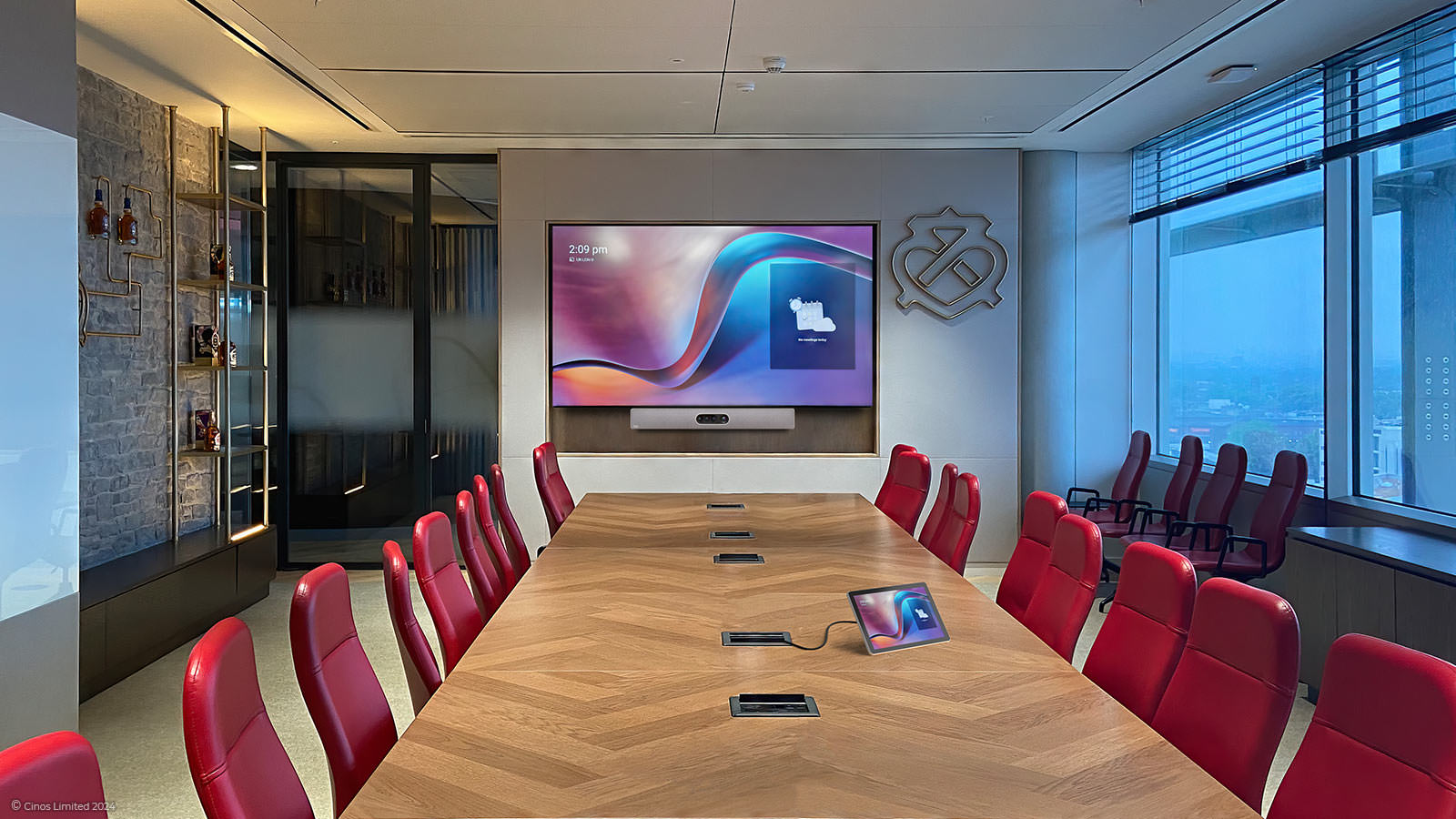
The Chivas boardroom has red chairs, a long table and a name that sounds better suited to the drinks trolley. At Pernod Ricard’s Chiswick office, however, the awkward part of a meeting had been the technology. Rooms frequently went offline. An elaborate audiovisual setup had become a recurring job for IT. Cinos, the British systems integrator brought in to simplify it, had to work out what was happening beneath the polished surfaces.
That is a useful introduction to a business whose output can be hard to photograph. The camera, screen and touch panel are visible. The network diagnosis, compatibility checks and decisions about what to keep are less so. Cinos sells that connective work to organisations whose technology comes from several manufacturers but must behave like one usable system.
The network gets first attention
At Pernod Ricard, Cinos’s networking team worked with the client’s IT staff to stabilise connectivity before the room rollout. It then localised the AV systems and deployed Cisco hardware running Microsoft Teams Rooms across 30 spaces, following trials of different options. Smaller rooms received Room Bars; larger and divisible spaces used Room Kit EQ systems.
The ceiling did not need a clean sweep. Existing Shure microphones and Biamp speakers were integrated into the larger-room installations. Cinos reports declining support tickets after the changes. The practical lesson is refreshingly specific: investigate shared dependencies before shopping for replacements, and assess installed equipment before writing it off. A new conferencing device still depends on the infrastructure around it.
The buyer moved. Cinos followed.
Founded in 2007, Cinos works across audiovisual systems, collaboration, connectivity, networks, security and infrastructure. Its Frimley base anchors operations with offices in the UK, Europe, North America and Asia. Customers buy room design and installation, communications services and the continuing work of supporting them. The company’s stated mission centres on delivering integrated technology worldwide.
A revealing change came in 2019, when Cinos folded Cinos Communications Services into its core business after four years of incubation. Managing director Johanna Guest estimated that IT now controlled about 85% of AV purchasing among its customers, compared with 50% three years earlier. The merger joined the sales and technical propositions around the people increasingly holding the budget.
“audio-visual assets are fast becoming IT assets”Johanna Guest, managing director, explaining the 2019 merger
That observation explains Cinos’s position better than a long equipment catalogue. The business sits between manufacturers and customers, with responsibility for making products cooperate. Kinly and AVI-SPL offer overlapping integration and managed services. Cinos’s case rests on the combination of room engineering, communications and network expertise demonstrated in its projects. A buyer should assess that combination against the particular job, rather than assume any one integrator owns the idea.
240 rooms, one familiar routine
The Government Property Agency project takes simplification beyond a single headquarters. Before defining AV Standards Version 3, the GPA researched users across departments and regions. Ease of use and interoperability emerged as priorities. Cinos tested the complete solution at its Customer Experience Centre; a pilot at London’s Old Admiralty Building preceded the broader deployment.
The reported rollout covered 240 meeting spaces across ten locations in four months. The user routine is simple: occupancy sensing wakes the system and its on-screen guide; a laptop connects through USB-C to use the room’s AV equipment. Sony displays, Logitech conferencing hardware, Lightware switching and Extron components sit behind the experience. The room powers down after inactivity.
The useful distinction here is between uniform equipment and a familiar routine. Different room sizes need different arrangements, yet people should not have to relearn the meeting every time they change buildings. The GPA’s approach gives the integrator a repeatable design and the user a predictable starting point.
Copying the cable alone would miss the work. A similar programme needs representative devices, room sizes and user needs tested before deployment. The lesson from the pilot is to discover exceptions while they are still cheap to address. Rolling an unresolved compatibility problem into hundreds of rooms merely gives the helpdesk a larger audience.
THE VISIBLE ROUTINE / GPA ROOM DESIGN
- 01Walk inSensor wakes the room and guide.
- 02ConnectLaptop uses the room through USB-C.
- 03MeetYour platform, the room’s audio and video.
- 04LeaveInactivity triggers power-down.
A control room cannot take the afternoon off
MSC Cruise Management UK brought a different constraint: its maritime control room operates around the clock. Operators needed to switch between information sources and view multiple dashboards more easily. The existing arrangement involved separate computers and limited connections to other rooms. Cinos’s account describes a facility supporting a fleet of 25 vessels at the time of the project.
The company installed VuWall’s TRx management platform while retaining the Samsung LED displays. An application server centralised browser access, encoders brought desktop content to the wall, and a ControlVu panel gave operators a common interface. Ten preset layouts made recurring display arrangements selectable. The president’s office and communications office were connected, too.
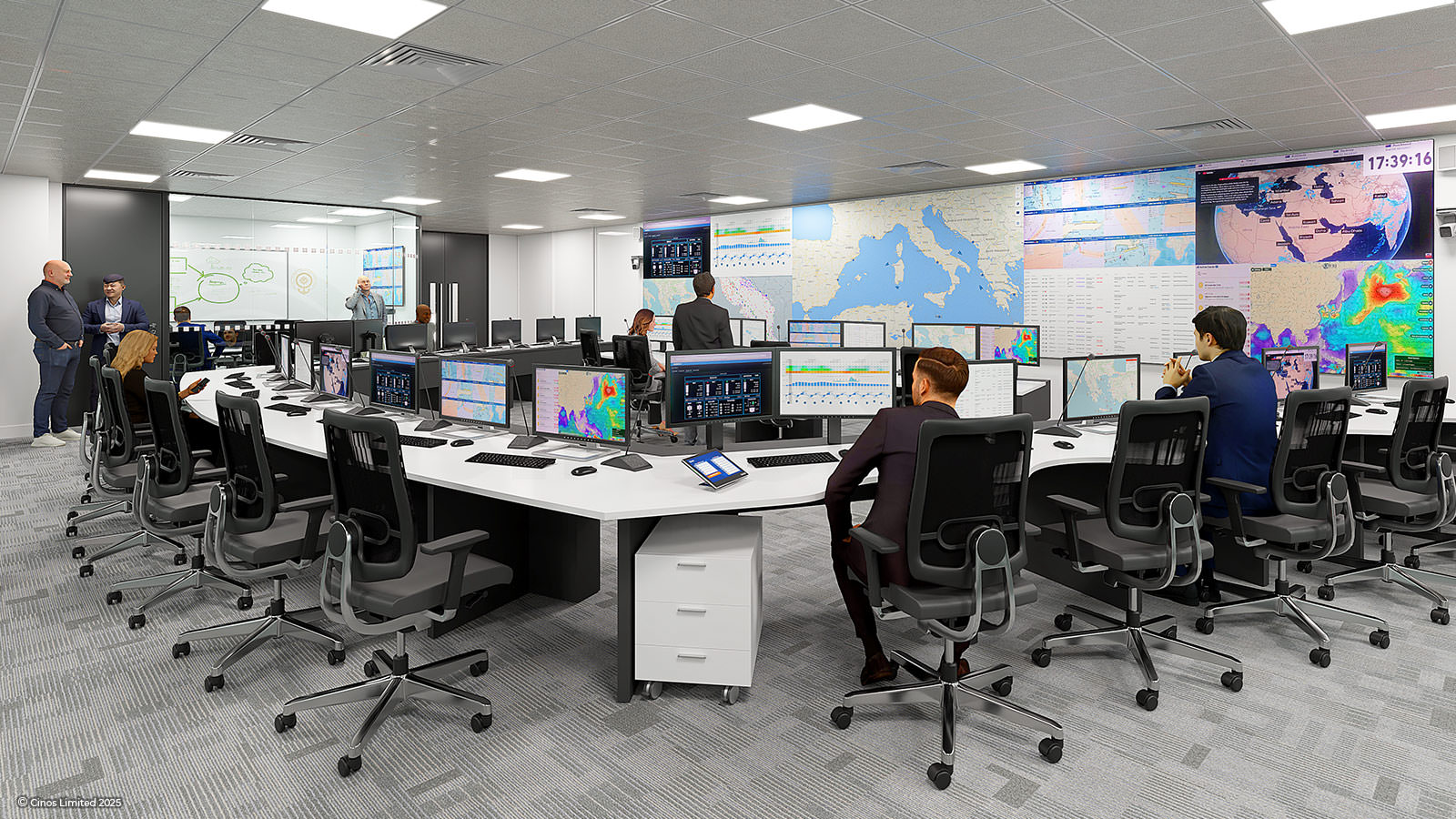
Cinos reports completing the project in four months during live operations, with near-zero downtime. Here, retaining equipment helped concentrate the change on access and control. The transferable idea is to organise the upgrade around operators’ recurring tasks. Display size attracts attention; being able to summon the right view is what makes the display useful.
There is a boundary to that lesson. Reuse depends on compatibility and the condition of existing equipment. Continuous operations also demand a migration plan that suits the site. A design that worked in this control room is evidence of an approach, not a ready-made specification for every emergency centre or industrial facility.
The price on the page, and the work around it
Cinos’s business mixes installation projects with ongoing services. Webex for Cinos Cloud makes the subscription part unusually easy to see: the company publishes per-seat monthly prices. Common Area Calling and Enhanced Calling are listed at £9, Webex Calling at £11.50, Webex Meetings at £15.50 and Webex Suite at £17, as checked in September 2026.
PUBLISHED WEBEX FOR CINOS CLOUD PRICING
The packages include weekday support from 09:00 to 17:30, with optional 24-hour coverage and service management. That distinction matters when comparing proposals: the operational promise is part of the purchase. A small office and a continuously staffed control centre do not have the same support requirement.
At the listed Enhanced Calling rate, 100 seats equate to £900 a month in subscription arithmetic. That illustration is not a quotation for migrating an organisation. Equipment, deployment requirements and support choices belong in the scoped proposal. For the room projects, the visible cost discipline is selective reuse: keep suitable ceiling audio at Pernod Ricard and suitable displays at MSC.
For buyers, the useful question is how the whole service will be delivered over its working life. Ask who handles faults that span the room and network, what the support hours cover, and how changes will be tested. Those details make competing offers comparable in ways that a list of screens and licence prices cannot.
A services business must organise itself, too
Cinos has had to address coordination inside its own operation. In a Simpro customer case study, the company describes putting project operations into Simpro while using Zendesk for ticketing. The account reports 75% faster job activation and a 50% increase in project managers’ workload capacity. Those are reported results from a vendor case study, rather than a forecast for another installer.
The organisational choice is instructive: give project delivery and support clearly defined systems, then make the processes usable. Integration companies face their own version of the customer’s problem. Information about labour, quotes and live jobs is valuable only when the people responsible can see and act on it.
There are other signs of a business built around delivery skills. Cinos entered the Sunday Times Virgin Atlantic Fast Track 100 in 2018. A late-2025 hiring announcement covered sales, installation, commissioning and support roles, and cited Investors in People Gold and Living Wage Employer recognition. Those credentials describe an emphasis on people and process; the customer still has to judge the team assigned to the actual contract.
The next brief is a public-service one
Cinos’s recent activity keeps it close to communications that have consequences beyond an awkward meeting. Its August 2026 announcement for the Emergency Tech Show outlined a planned September 16 session with Police Scotland about communications transformation. The company also updated its Cisco credentials in May to include Preferred Services Partner status, alongside Collaboration and Networks.
Its environmental reporting adds a less glossy operational detail. The May 2026 UK carbon plan resets the baseline after a methodology change and identifies purchased goods and services as the largest emissions contributor. For an integrator supplying equipment, procurement decisions reach beyond the installation bill. That makes the question of what to retain worth asking early.
The appeal of Cinos is clearest at the table: a civil servant connects a laptop, a cruise operator selects a view, a colleague joins a call. Each apparently modest action depends on decisions made earlier by people choosing, configuring and testing technology. Cinos’s business is to make those decisions hold together after the engineers have left the room.
Continue the conversation
Explore Cinos’s website, its project portfolio and company updates. Follow Cinos on LinkedIn or Twitter/X, and compare the Webex for Cinos Cloud packages.