Chuck Davis had a small request for Middlebury’s graduating class. He had never occupied the seat they were sitting in. Would they mind if he tried? On May 25, 2025, the commencement speaker stepped down from the stage, settled into an empty chair among the graduates, and stayed there for a few seconds. Then he returned to the podium. An honorary degree was coming his way that day. For a moment, though, he wanted the ordinary seat.
He had attended Middlebury for two years before transferring to the University of Vermont. His account of college includes two academic failures. The detour remained vivid enough for him to bring it into a ceremony more than half a century later. He told the graduates to expect failure and to learn from it. Sitting down was a rather good way to keep a commencement speech from floating above its audience.
The student and the scorecard
Today Davis is chairman and co-chief executive officer of Stone Point Capital, based in Greenwich, Connecticut. He chairs the investment committees of the Stone Point Funds. He shaped the firm’s Elephant Process and its partnerships with founders and owner-operators. It is a substantial set of responsibilities for someone who still introduces his younger self as a student who took a while to get going.
His education was proceeding on several tracks. At Vermont, he earned conference recognition in soccer in 1971, when the team finished 10-2 and shared the Yankee Conference title. He was also a tennis player, occupying the number-one singles position in every match in 1971 and 1972. In his final year, he captained the team and won the conference singles championship.
His coach, Hal Greig, remembered careful preparation for the final: Davis had worked out a way to beat the top seed from Massachusetts and executed it, winning in straight sets. Greig also remembered a player who worked hard and helped lead the team. Davis entered Vermont’s Athletic Hall of Fame in 2001. The athletic record supplies a useful correction to any account that makes his college years entirely a story of drifting.
When he later discussed his career with David Rubenstein at the Greenwich Economic Forum, Davis recalled the pleasures around competition: the bus, the locker room, the huddle. He had played soccer, basketball and tennis. As a child, he memorized baseball averages. When athletic eligibility ended and a professional contract failed to materialize, finance offered another setting in which numbers, teams and outcomes mattered.
UVM graduate. Tennis captain. Yankee Conference singles champion.
Homework with his father
Davis grew up in Burlington, Vermont. His father, Dudley Davis, ran Merchants Bank. While Chuck was still finding his way as a student, father and son read investment reports together each week. Accounting and banking became subjects he could get his hands around. He began advising his father on stocks and developed a close understanding of Vermont banks.
At a 2023 gathering of Governor’s Academy alumni, Davis described how that familiarity became a lesson in expertise. Pick something you can understand deeply. The territory could be small. A useful grasp of it could still have consequences. His early interest in banking had a teacher, a weekly routine, and businesses close enough to examine.
Columbia Business School brought a different opportunity. Davis saw the shortage of housing around its Upper West Side campus, studied the neighborhood, and joined investment partners, including a professor, in buying properties that were later sold to Columbia. Supply and demand had become something more tangible than a diagram on a classroom board. His MBA years included academic recognition through Beta Gamma Sigma. The student’s footing was improving.
“Life begins at the end of your comfort zone.”
Chuck Davis, speaking to Governor’s Academy alumni, 2023
A long apprenticeship in other people’s decisions
The first day at Columbia still gave him material for a joke. In his telling, students stood to introduce their colleges and subjects. When Davis announced physical education at the University of Vermont, the room laughed. He remembered them thinking he was kidding. The credential had made an entrance before the person had much chance to explain himself.
Goldman Sachs presented another difficult beginning. Davis said the person who recruited him soon began trying to have him dismissed. He acknowledged being poorly prepared. The story ended with the two becoming friends and working together for years. Davis’s recollection has the satisfying untidiness of a working relationship: an early judgment, time to improve, and a later accommodation.
He spent 23 years at Goldman, becoming a partner and head of Investment Banking Services Worldwide. His responsibilities also included leading the Financial Services Industry Group and co-leading the Americas Group. He described access to chief executives and consequential boardroom decisions as an education in itself. There was a great deal to observe before he began investing from the other side of the table.
In 1998, he joined MMC Capital, Stone Point’s predecessor. The firm became Stone Point Capital in 2005. His banking career had supplied contacts and transaction experience. Private equity would require choices about which businesses deserved capital and which opportunities to leave alone. A person accustomed to making transactions happen now had to decide whether they should happen.
The elephants require a memory
Stone Point organizes its financial-services investing around specialized sectors. Davis’s term for them is elephants. The name is easy to remember; the work underneath it is more demanding. Each subsector has its own vocabulary, competitors, gatherings and rules. Learning those differences takes time, and financial services supplies plenty of them.
In a 2022 explanation of the approach, Davis described studying 70 subsectors and building a list of companies the firm wanted to partner with. Its attention extended to service businesses that work with banks, insurers and other financial institutions. The question was how to become useful to the people already running those companies.
He described checking with customers before investing, introducing companies to prospective clients, and helping with recruitment, strategy, capital structure and acquisitions. The operating team remained central. He also emphasized managers investing their own money alongside the firm and its investors. Shared exposure gives a partnership practical weight: the people making decisions have capital at stake.
Study the sectorUnderstand companies, customers and regulation.
Find the operatorsIdentify businesses and people worth knowing.
Build the partnershipCombine capital with knowledge and connections.
The firm’s stated investment horizon runs from five to more than ten years, varying with the investment. It can hold minority or majority positions and generally targets equity investments of $100 million to $1 billion, with room for smaller and larger commitments. Those choices allow different kinds of relationships with owners. The common element is the industry knowledge brought to the discussion.
Patient capital still has to operate in a market. A specialist needs to recognize changing conditions, judge a business, and agree on terms with somebody who has reasons of their own for accepting or refusing. Davis’s approach puts a considerable amount of work before that conversation. Knowing an industry can make the meeting better informed; it does not conduct the negotiation for you.
More capital, the same assignment
In July 2025, Stone Point closed its tenth flagship fund, Trident X, with $11.5 billion in commitments. Its original target and hard cap had been $9 billion. The general partner and affiliated entities committed approximately $750 million. The fund began its investment period in May; its first completed investment was Ultimus Fund Solutions, a fund-administration business.
Davis’s comments at the closing emphasized continuing to identify owner-operators and help them build lasting business value. Jim Carey, his fellow co-CEO, pointed to continuity in the team and strategy. The fundraising total was large, but the assignment they described was familiar. More money needed businesses, managers and terms that justified putting it to work.
Stone Point’s 2025 review shows a broader institution around that work. Its credit business ended the year with more than $13.5 billion in assets under management. The firm welcomed 42 new colleagues and promoted three investment professionals to managing director. Expansion brings its own questions about transmitting knowledge and maintaining working relationships. Those are particularly relevant to a firm whose investing method depends on accumulated familiarity.
Vermont keeps its place
Greenwich became Davis’s professional base, but Vermont stayed in the biography. He served as a UVM trustee from 1996 to 2002 and helped fund the Dudley H. Davis Center, named for his father. He has also backed Vermont businesses, including electric-aircraft company Beta Technologies, where he serves as chairman.
He and his family spend time in Shelburne and remain involved with the Shelburne Museum and the Burlington community. The Chuck and Marna Davis Foundation supports organizations in Vermont. The place where his father taught him banking continues to receive his attention, through business, education and community institutions. His world widened without requiring him to forget the smaller one.
Notes for the next student
The Middlebury speech had an afterlife. Davis introduced MiddKit, a personal website of suggestions for graduates, and invited feedback and additions. There is career advice, a reading list and a collection of interviews. He favors biographies for the chance to follow someone through the rises and falls of a life. Apparently a balance sheet is allowed some company on the bookshelf.
The advice includes a memory of an early Goldman colleague who helped him without an obvious benefit to himself. Davis wants young people to offer that kind of help to others. His career notes also recall loving his first job in Bank of Boston’s trading room, then leaving it for an MBA after considering the work he wanted to do later. Enjoying the present job and planning beyond it could coexist.
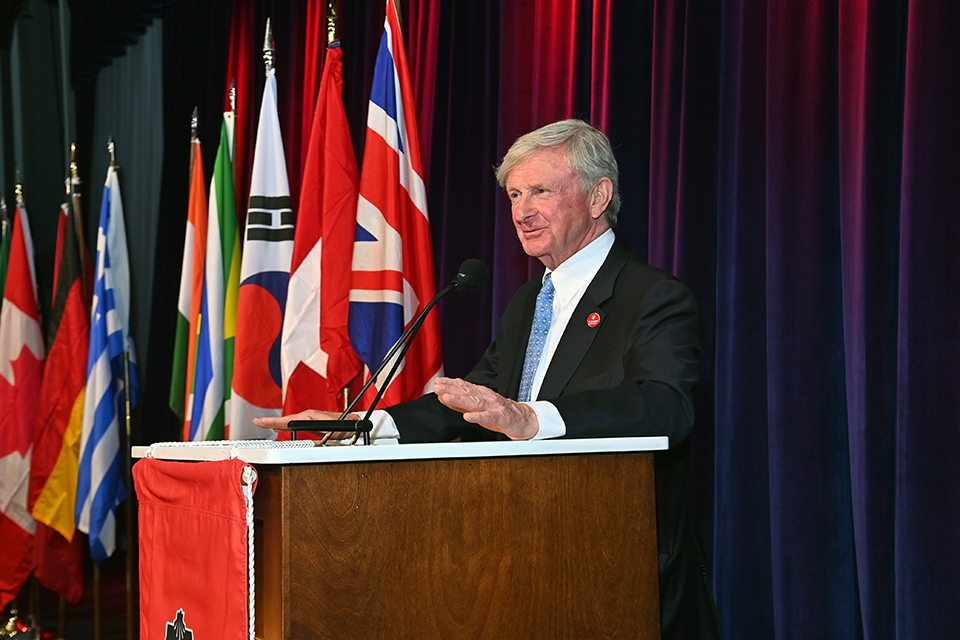
At St. John’s January 2026 dinner honoring him as the 2025 Insurance Leader of the Year, Davis again addressed people beginning their careers. The event raised $3.6 million for Greenberg School students and programs. He encouraged more young people to enter insurance and credited relationships built on respect and trust.
“Learn, earn, and return is a good mantra for life,” he told the room. Among the students was a Vermonter who sought him out, and the two connected over their home state. The executive with decades of experience had someone new to talk to. Davis’s education had taken its time. He was still making time for somebody else’s.