Before the chief executive’s title, before the earnings calls, before the photographs in which everybody appears to have been born wearing a suit, there was a friend who helped Harvey Schwartz get a job at Citibank. His career had not yet acquired the tidy upward slope that a corporate biography gives it. He had moved between jobs. He liked economics. Wall Street, and the range of work available there, had not been obvious to him.
Years later, he noticed Rutgers students struggling to get their own first opportunities in finance. His response was wonderfully practical: find a Rutgers graduate at different firms, gather them for dinner, and put the network to work. That effort helped launch Road to Wall Street, connecting students with alumni already inside the industry. A dinner invitation can be a small thing. Put the right people around the table and it becomes infrastructure.
Schwartz now runs Carlyle, the global investment firm, from New York. The distances involved have changed considerably. Yet the introduction remains a useful place to begin his story. Finance likes to measure capital in dollars. Schwartz’s career also invites a look at the capital contained in another person’s willingness to answer a question, make a call, or take a chance.
An economics degree, then an education in markets
Schwartz graduated from Rutgers in 1987 with a bachelor’s degree in economics. His early employers included J. B. Hanauer & Co. and First Interregional Equity Corporation. He joined Citigroup in 1989, entered its credit training program, and developed a specialty in structuring commodity derivatives. An executive MBA from Columbia followed in 1996. These are the bones of the résumé: a public university, several firms, and a growing familiarity with the machinery of markets.
Goldman Sachs hired him as a vice president in 1997. He became a managing director in 1999 and a partner in 2002. His responsibilities spread across financing, sales, and trading. By 2008, he was global co-head of the Securities Division; in 2013, he became chief financial officer. In January 2017, he took the role of president and co-chief operating officer.
The sequence matters because the work changed with each promotion. Selling and financing require attention to clients. Running a trading business adds exposure to positions and market movements. The chief financial officer has to examine the institution itself. A career can look like a ladder from a distance; up close, each rung asks a different question. Schwartz had spent years changing the questions he was responsible for answering.
Economics BA
Vice president
Chief financial officer
Chief executive
When the connections carried risk
In November 2018, Schwartz returned to Rutgers to discuss the financial crisis with more than 300 attendees. He had retired from Goldman earlier that year. The audience was largely made up of undergraduates in their twenties, people whose understanding of financial institutions had been shaped by the consequences of a crisis they were too young to have managed.
He described years of decisions that had left the world excessively indebted by 2007. After Lehman Brothers collapsed in September 2008, he said, regulators and market participants could see that the monitoring and reporting of exposures between financial institutions had been inadequate. Later, as CFO, he and his team worked with regulators on risk, capital, and liquidity management.
Here was the darker side of connection. The same industry that runs on relationships also contains obligations linking one institution to another. Knowing that a link exists is insufficient; somebody has to understand what it carries. In a lecture hall, the subject becomes less remote. A balance sheet belongs to a firm, but the consequences of its failure travel much farther.
Schwartz finished with advice of a more personal kind: “Don’t forget your school.” It was a compact ending to an evening about institutions and trust. The university was one institution to which he had kept returning.
“Don’t forget your school.”Harvey Schwartz, speaking at Rutgers, November 2018
The cost of getting through the door
Rutgers had provided Schwartz with financial aid as an undergraduate. In 2010, he endowed a $1 million scholarship through Goldman Gives to cover tuition and fees for four full-time School of Arts and Sciences students each year. When the university inducted him into its Hall of Distinguished Alumni in 2014, it recorded 25 recipients since the scholarship’s creation.
The sum is easier to grasp when stripped of the language of philanthropy. Tuition is a bill. Fees are another bill. Covering them changes the arithmetic of staying in college. A career talk can describe a possible future; a scholarship can help someone remain enrolled long enough to reach it. Schwartz supported both kinds of access.
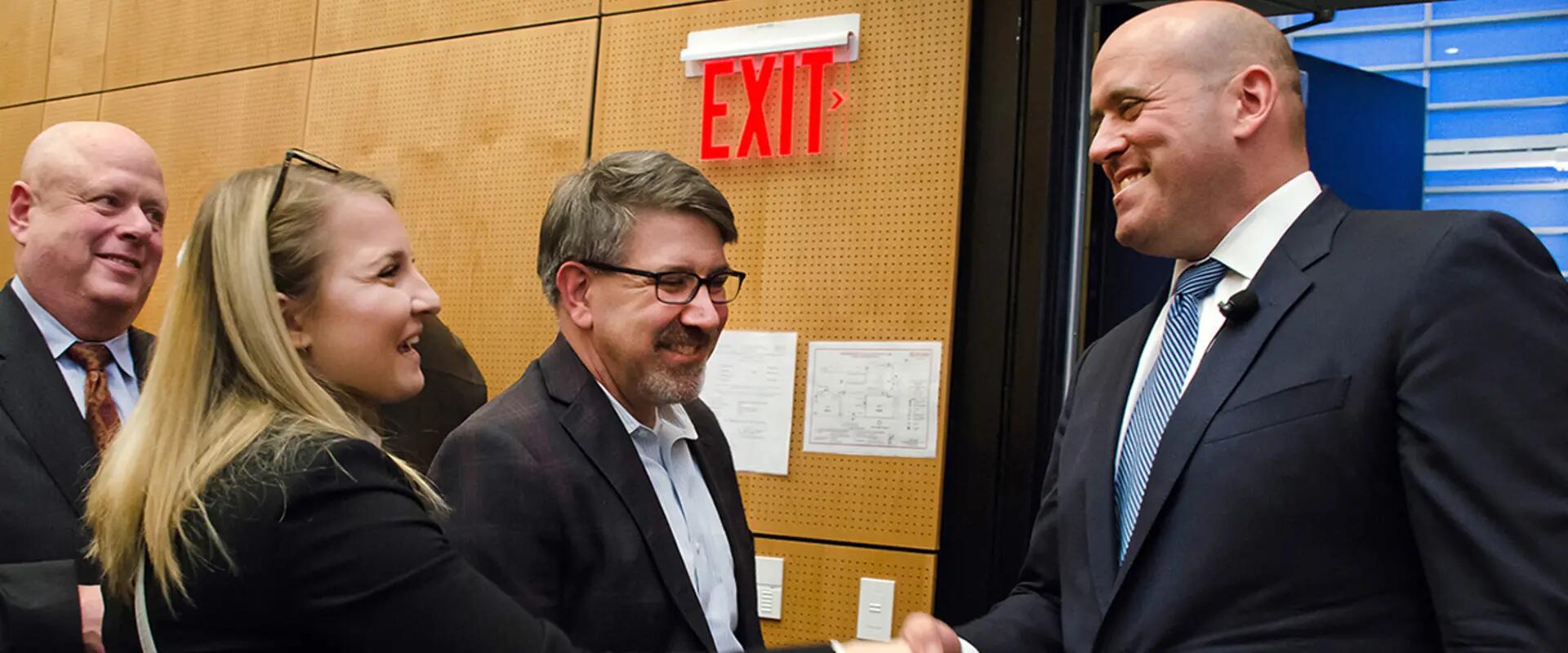
The mentoring effort also had identifiable results. Rutgers student Eric Lang credited Road to Wall Street with helping him land a summer internship at Citigroup. Through the program, he had dinner with Schwartz and visited trading floors. The internship ended with a job offer. For a student, the difference between hearing about an industry and being welcomed into it is considerable.
Schwartz continued showing up. In 2019, he gave the keynote address at the student-run Little Investment Bankers of Rutgers Finance Summit, held at Credit Suisse near Madison Square Park. More than 300 students, alumni, and faculty gathered there. The setting offered its own useful reversal: students were meeting the industry on its ground, surrounded by people who had once attended their university.
Five years without a master plan
Schwartz’s departure from Goldman took effect on April 20, 2018. David Solomon became the firm’s sole president and chief operating officer. After two decades at Goldman and a working life that had started well before that, Schwartz allowed himself a pause. Private investing, philanthropy, and projects that interested him filled the interval.
When Carlyle’s founders approached him, he already knew the firm as a Goldman client. His explanation for accepting the job was measured: he needed to feel confident he could make a difference. Familiarity with the industry helped. So did time spent with the founders. The opportunity eventually persuaded him to resume running a large institution.
Carlyle announced his appointment on February 6, 2023, with a start date of February 15. He joined the board as well. The assignment included advancing the firm’s diversification, identifying investment opportunities, and delivering for fund investors and shareholders. Those groups are connected, but their interests and clocks require separate attention. An investor waiting for a distribution experiences time differently from an executive building a business.
Schwartz was arriving at a firm founded by other people, with relationships and habits accumulated over decades. That creates a particular leadership problem: deciding what to preserve while taking responsibility for what comes next. The job offers authority immediately. Understanding has to be earned through the work.
A racing car enters the conversation
In September 2025, Carlyle became Oracle Red Bull Racing’s exclusive investment management partner through a multiyear global agreement. Carlyle branding would appear on the car, team kit, pit wall, and garage. The partnership also provided occasions to engage clients and partners around the Formula One calendar.
There is an obvious comic pleasure in an industry devoted to patient capital attaching its name to something built to go very fast. The commercial logic is less mysterious. Formula One brings a global audience, technology, data, and a highly visible team effort. Carlyle wanted to reach new audiences as interest in private markets expanded.
At Monaco in June 2026, Schwartz and Red Bull team principal Laurent Mekies discussed the relationship. Both emphasized attracting and supporting talented people. The car may receive most of the attention, but the conversation returned to the people around it. In a sport with a stopwatch, teamwork has unusually unforgiving feedback.
The number that has to come back
By June 30, 2026, Carlyle reported $485 billion in assets under management, more than 2,500 employees, and 28 offices across four continents. Its three business segments were Global Private Equity, Global Credit, and Carlyle AlpInvest. The scale helps explain how far Schwartz’s responsibilities now extend beyond his own office.
In the second-quarter results released on August 5, he highlighted nearly $7 billion distributed to clients during the quarter and $37 billion over the preceding year. The release also reported record fee related earnings and the highest distributable earnings in nearly four years. These were company results under his leadership, produced by teams across the firm.
Returning capital is an especially useful detail in a business often described by what it raises or manages. Money coming in can make an institution larger. Money going back to clients demonstrates another part of the relationship. An asset manager needs people to commit funds, but those people eventually expect the investment cycle to produce cash they can use elsewhere.
Schwartz’s comments about access have included a candid observation on liquidity. Discussing private investment vehicles with David Rubenstein, he suggested that some products described as semi-liquid might be better called “sometimes not liquid at all”. It is an unglamorous phrase, and a helpful one. An invitation into an investment ought to include an intelligible account of the exit.
Firm-level figures, not personal wealth. Distributions reported with Q2 2026 results.
Another dinner, another generation
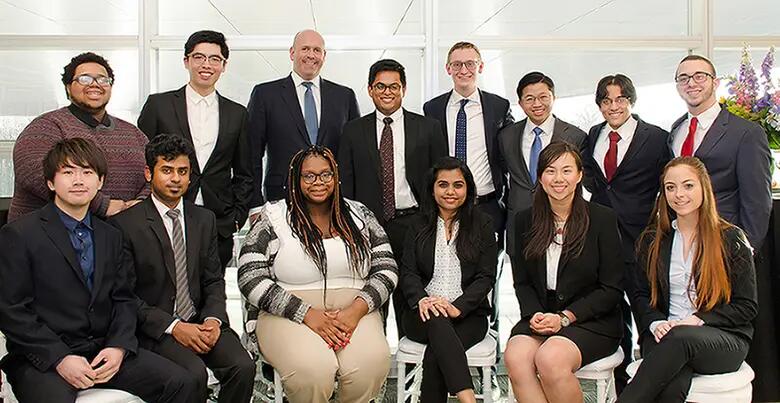
In a June 2026 post about an evening with Rutgers scholarship students, Schwartz reported that 57 students had participated in the scholarship program and 43 had graduated. Their careers included teaching, finance, communications, social work, and marketing. The range is telling: the assistance had produced lives beyond the industry that made the gift possible.
He described people believing in him before he had fully figured things out for himself. He also explained that the scholarship supported students whose financial needs extended beyond tuition and fees. That is a more demanding understanding of opportunity than simply offering admission. Getting someone through a door includes thinking about what lets them stay.
A dinner appears at both ends of this story. Earlier, it helped assemble a network of alumni for students seeking jobs. More recently, it brought Schwartz together with students whose education he had helped fund. Between those gatherings sit trading desks, a financial crisis, an executive office, and a return to leadership.
The corporate biography records the promotions. These smaller encounters give the promotions a human scale. Somebody once helped Schwartz find a foothold; he has spent part of his career creating footholds for others. For all the complexity of finance, that transaction remains easy to understand.