The sale that helped change Chris Cabrera’s career was a sale he could not make. He was working at Callidus Software, selling systems that helped companies calculate sales commissions. Steve Cakebread, then Salesforce’s chief financial officer, wanted a version delivered as a service. Cabrera’s employer sold software installed on the customer’s own infrastructure. The prospective buyer was asking for a different business.
It was an awkward request with useful information inside it. An executive could want the function and still reject the way it was packaged. That distinction mattered to Cabrera. Expensive software and the machinery needed to run it limited the customers who could afford to participate. A subscription could change the arithmetic, opening a market beyond the large enterprises able to absorb an installation.
Cabrera later recalled resistance to the cloud approach at his employer and being out of work at Christmas in 2004. By March 2005, he had founded Xactly. The rejected pitch had become the premise of a company. A salesperson is usually expected to overcome an objection. Cabrera’s next move was to build around it.
A family business education, with frozen turkeys
His first management classroom had been his father’s businesses. Cabrera grew up on a dairy farm in Massachusetts, the fourth of five children. He remembers a household where people could argue fiercely and then resume ordinary life. Dinner, in his telling, required a little competitive spirit. Later, he connected that upbringing with his willingness to hear employees challenge him.
His father was a serial entrepreneur, and Cabrera worked at his companies during summers. What stayed with him was the way the boss treated people: a janitor and a fellow chief executive received the same courtesy. Before Thanksgiving, father and son delivered frozen turkeys to employees. It is a rather literal version of bringing something to the table, and a memorable introduction to responsibility.
Cabrera also watched the difficulty of building businesses without outside funding. He pursued a business degree with an entrepreneurship emphasis at the University of Southern California, then an MBA at Santa Clara University. Formal study supplied a second education alongside the family one. The ambition to start something survived; he took time to acquire operating experience before acting on it.
At Silicon Graphics, he spent seven years in sales and sales management and served on the compensation committee. At Callidus, he ran sales and marketing and held a senior operations role. These were useful places to learn what happens when a business makes promises to its sellers, its customers, and its investors. Eventually, the promises themselves became his subject.
The peculiar honesty of a commission cheque
Sales compensation is an unusually candid corner of corporate life. An organisation can announce priorities in a meeting; the compensation plan assigns a price to them. Cabrera made a business out of that connection. Xactly’s early proposition was cloud software for calculating incentive compensation. Over time, the company expanded into the surrounding work of planning and managing sales performance.
He had already described that broader view in 2010: compensation belongs with territory management, analytics, modelling, and other tools that affect the sales team’s results. A commission calculation can be correct while the plan behind it sends people in an unhelpful direction. Software that merely settles the bill leaves the larger question waiting.
His 2014 book, Game the Plan: Every Sales Rep’s Dream; Every CFO’s Nightmare, treats employees’ efforts to maximise rewards as predictable behaviour. The manager’s task is to design the incentives so that pursuing the reward also advances the business. The title allows the sales representative a small victory before the finance department has even opened the book.
That argument gives his work a recognisable point of view. People will read the rules closely when their earnings depend on them. Leaders should read those rules just as closely before issuing them. A motivational speech may be forgotten by lunch; an incentive formula can keep directing decisions for months. Cabrera’s interest lies in making that influence deliberate.
Ten years to the bell, two years to a different owner
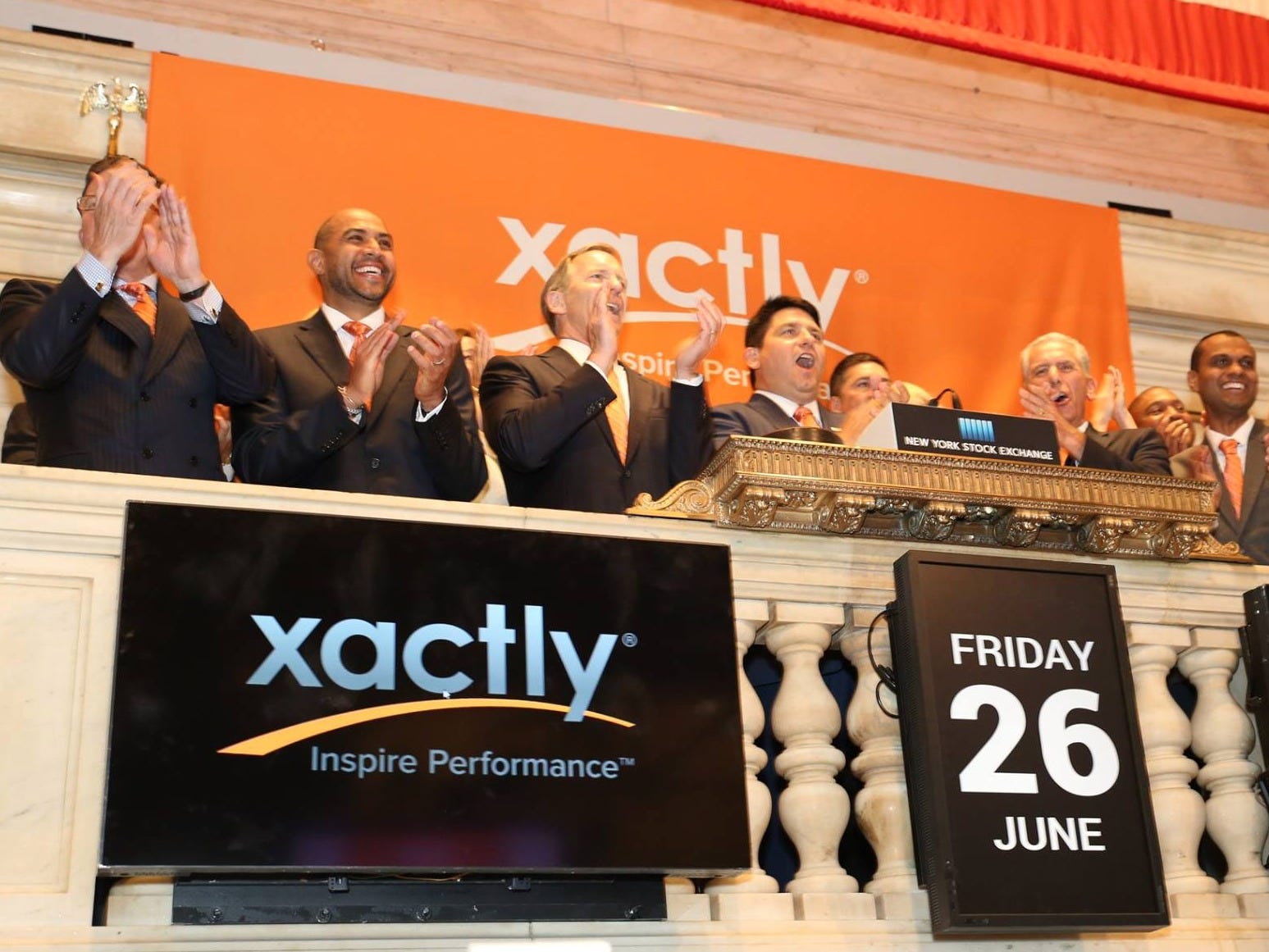
On June 26, 2015, Xactly went public on the New York Stock Exchange. The company Cabrera had founded a decade earlier now traded as XTLY. It had reported $61.1 million in revenue for fiscal 2015. The opening-bell photograph catches the familiar ceremony: suits, applause, an orange banner, and a business moment briefly made physical.
“The IPO roadshow was exciting and grueling,” Cabrera said at the time. It is a nicely balanced description of a ritual that requires a founder to repeat a story until strangers are willing to put a price on it. For someone trained in sales, the audience had changed again. The company’s ambitions were now being examined by public-market investors.
In 2017, Vista Equity Partners agreed to acquire Xactly for approximately $564 million. The company returned to private ownership, and Cabrera continued leading it. His message to customers and partners framed the transaction as another stage in the business, with Xactly remaining independent and its product commitments continuing. A sale of the company did not require a farewell from its founder.
The product range widened under Vista. Acquisitions brought capabilities around territories, planning, and forecasting into the business. That progression matters to Cabrera’s story because the original commission problem became a way into a larger set of decisions. Who should sell where? How much capacity is needed? What revenue is likely to arrive? Each question influences the others.
A unicorn with an accounting problem
Cabrera’s later writing turned the incentive question toward founders and investors. The Unicorn Fallacy, published in 2023, challenges the pursuit of billion-dollar valuations at the expense of an enduring business. It asks leaders to attend to profitability, durable revenue, and the alignment between employee behaviour and company goals. The author had by then operated under venture, public-market, and private-equity ownership.
“Balance is the ultimate competitive edge,” he writes. In the context of his career, the sentence has some weight. A valuation is an external verdict at a particular moment. Running a company requires decisions about spending, customers, product development, and hiring after that moment has passed. An impressive number cannot perform those jobs on its own.
There is a family resemblance between his two books. Game the Plan considers what sellers are encouraged to chase. The Unicorn Fallacy considers what company builders are encouraged to chase. Read together, they suggest a recurring concern: a target can be pursued energetically while the underlying business gets less attention than it needs. Enthusiasm benefits from a carefully chosen destination.
His relationships also extended beyond the company chart. In a 2022 conversation, Cabrera recalled forming a CEO group with Gainsight’s Nick Mehta when their businesses were each below $5 million in revenue. He described the pleasure of watching and helping each other grow. Even executives selling guidance to other executives have uses for a room where they can ask questions.
“Balance is the ultimate competitive edge.”
Chris Cabrera · The Unicorn Fallacy
The turkey lesson survives the spreadsheet
Xactly’s culture put some of those early family lessons into organisational form. Cabrera established XactlyOne alongside the company’s beginnings, giving employees a way to volunteer and support their communities. By 2020, the company reported more than 4,000 volunteer hours and nearly $160,000 donated. Those are dated milestones, but they show that the programme had become a working institution.
The public recognition included USC’s Alumni Entrepreneur of the Year award and a place among The Software Report’s Top 50 SaaS CEOs in 2020. Xactly also accumulated workplace awards during his tenure. Awards offer a snapshot. The more revealing continuity is the attention to how a business treats the people whose work produces its results.
Away from software, he has pursued Cabrera Cellars, a winemaking project discussed in his interviews. His LinkedIn profile lists a WSET Level 2 wine qualification. The cellar gives the profile a welcome change of scale: from sales organisations and revenue forecasts to something that eventually fits in a glass. Even a compensation specialist is allowed an interest without a quarterly quota.
Retirement takes a short detour
In September 2023, Cabrera announced his intention to retire as Xactly’s chief executive. The company announced Arnab Mishra as his successor in December, with Cabrera remaining on the board. Mishra had joined in 2017 and worked through product and operating leadership roles. The transition placed someone familiar with the business in charge of its next decisions.
Cabrera subsequently served as interim CEO at Provarity AI. Its problem was close to something he had encountered at Xactly: enterprise software evaluations could be difficult to track, making it harder to understand when a technical proof of concept would finish or why it succeeded. Provarity focused on giving presales teams a more repeatable process and clearer information.
In December 2024, Provarity announced a $7 million seed round led by Cheyenne Ventures. Cabrera’s explanation returned to a practical frustration from his previous job. The pattern was familiar. A process that senior managers needed to understand had remained frustratingly difficult to see. He had found another place where software might make the work more legible.
The next set of decisions happens on the road
On July 17, 2025, Lytx appointed Cabrera chief executive. The company works in video telematics and fleet operations, using cameras, data, and software to help organisations manage vehicles and drivers. His remit moved well beyond the sales department. The work still involves turning information about human activity into decisions an organisation can act on.
In a March 2026 interview, he discussed the move from front-facing cameras toward visibility around the entire vehicle, along with factory-installed equipment and AI’s role in interpreting the resulting data. His attention was on what fleets could learn and use. Collecting more footage makes sense only when someone can find the information needed for a decision.
At the May 2026 Lytx Protect conference, the company presented LytxOne alongside Lytx+, describing an approach that brings video safety, telematics, maintenance, compliance, and asset tracking together. In September, it launched its 360 Hub Kit for expanded camera coverage. These developments give Cabrera’s current chapter a concrete setting: vehicles, operational systems, and managers trying to see more clearly.
The industries have changed since that unsuccessful conversation with Salesforce’s finance chief. Cabrera’s questions remain recognisable. What is the customer asking for? What information is missing? Which behaviour does the system encourage? He built Xactly by taking a refusal seriously. At Lytx, he is still working on what a business can do once it sees the problem differently.