In 2001, Christophe Collet was doing his first internship at a BMW dealership when a salesman called Denis offered him a lesson. Selling someone a car was easy, Denis said. Selling that person another one was harder. Collet remembered the advice years later, along with its practical ingredients: a good product, service and the right price. It was a compact business education, delivered without a slide deck.
Collet would go on to build companies in mobile advertising, a trade full of numbers that can make almost anything look encouraging. Yet the dealership anecdote offers a useful way into his career. The first transaction gets applause. The next transaction asks whether the applause was deserved. For the founder and CEO of Locala, that question has followed the customer from the showroom to the smartphone and back to the street.
The trouble with taking somebody’s word for it
By 2010, Collet was running Adenyo’s French business. The company had emerged from the mobile marketing world in which he had already built Followcom. Adenyo was raising money, adopting a name intended to travel across languages, and looking toward further international expansion. Mobile advertising was attracting attention. Collet’s particular interest was what happened after attention had been purchased.
He spoke then about a market that still needed a credible way to measure mobile internet activity. The issue was practical for the people paying the bills: a new screen could command enthusiasm before it commanded confidence. An advertiser deciding where to spend had to understand what the technology actually delivered. The glamour of a device did very little to reconcile an invoice.
After Adenyo’s acquisition by Motricity in 2011, Collet started S4M with colleagues from the earlier business. His account of the opportunity was rooted in advertisers’ continued skepticism about mobile. Consumer habits were moving faster than advertising budgets. He wanted technology that could make those budgets easier to justify. Simply shrinking a desktop advertising system onto a phone would miss the differences between the two environments.
The difficulty with selling a new medium is that the customer has to buy two things at once: the campaign and the explanation of how it works. Collet’s approach addressed that second purchase. Better tools could give a cautious buyer a basis for deciding, and give the seller something more durable than enthusiasm to bring to the next meeting.
There is something appealingly unromantic about that origin. A founder notices that a buyer has reasons to hesitate, then builds around those reasons. The desired outcome is trust earned through evidence. It also explains why measurement kept occupying so much of Collet’s attention as the company expanded: reassurance had to survive contact with a real campaign.
A staircase before a world map
The early team photograph has everyone gathered on a staircase, with a miniature basketball hoop hanging from the rail. It is a pleasingly ordinary setting for a business that would later talk about advertising across continents. Before a company becomes a network of offices, it is people finding somewhere to stand for a photograph.
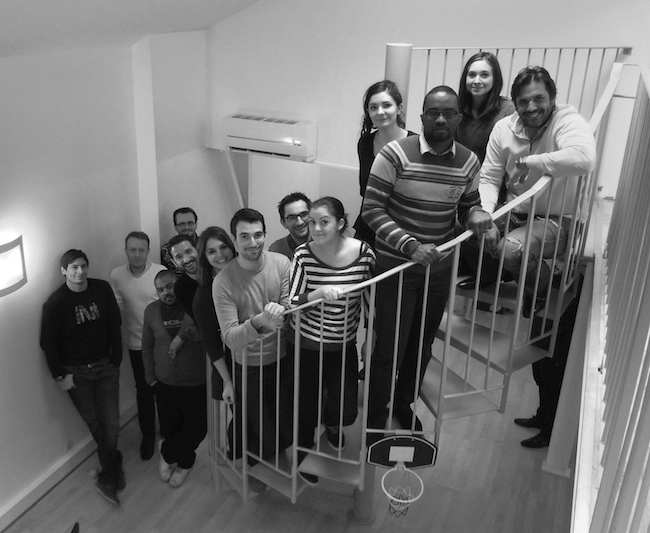
That continuity of people matters in Collet’s story. His professional biography describes colleagues from Adenyo accompanying him into S4M, forming a nucleus that stayed together as the business grew. The company began in 2011 with six employees. The enterprise that followed was international, but its origins were a group of people who had already worked together.
In a later conversation about leadership, Collet compared a company with a sports team. Trust and the ability to work together mattered more than everyone becoming friends. He named Good to Great as a favorite book and discussed the importance of profitability alongside growth. His answer about personal productivity was revealing, too: he assessed his own contribution through how well he helped other people achieve their objectives.
This is a more concrete portrait than a list of executive virtues. The person selling measurement tools also wants measures inside the business. The founder who speaks about teamwork describes his own effectiveness in terms of other people’s work. Ambition, in that account, requires an organization capable of carrying it.
The destination was always a real place
In May 2018, S4M announced a $12 million Series B led by Sofiouest, with Bpifrance and Entrepreneur Venture participating. It had launched FUSIO as a software platform that February. The funding supported further technology development and expansion in the United States. Store visits had become a central way of connecting digital advertising with the physical business it was supposed to support.
The company’s pitch had a particular appeal to retailers, restaurants and car dealers. Someone seeing an advertisement was one event; someone arriving at a location was another. The platform sought to connect them. Its catchment-area features considered travel distance and brand affinity, bringing the messiness of an actual journey into a business accustomed to describing people as audiences.
Stanislas Coignard, then the company’s Americas CEO, explained that outside measurement partners were used so the business would avoid judging its own campaign results. That concern fits the older problem Collet had identified. When the seller also supplies the verdict, the buyer has a reasonable interest in a second opinion.
By March 2022, the company had outgrown its mobile-centered name. S4M became Ask Locala. Collet brought in marketing executive Cameron Peebles for the rebrand, which involved the agency The Brand Terminal. The new identity put local commerce at the center while allowing the advertising to run across different kinds of media.
Collet put the company’s purpose in terms of bringing customers into physical stores. The idea is refreshingly easy to picture. A customer goes somewhere. A business has a chance to serve them. Behind that journey may sit considerable software, but the destination requires very little explanation.
“We exist to drive more customers to physical stores.”Christophe Collet · 2022
He also made a broader case for physical stores as part of community life. In that view, helping a shop succeed has consequences beyond a campaign report. The 2022 change of name gave that attachment a place in the company’s identity. A business born around one screen was declaring its interest in what lay beyond it.
Keeping the keys
In October 2024, Collet faced a different question about continuity. Existing investors wanted liquidity. He described two possible routes: sell the business, or arrange a management buyout. He chose the latter. Following the transaction, a group of roughly fifteen managers held more than 60 percent of Locala’s capital.
of Locala’s capital held by its management group following the 2024 buyout.
Trocadero Capital Partners joined the shareholder base, Zencap AM provided financing, and existing backers Sofiouest and Entrepreneur Invest supported the transaction. The financing included a sustainability-linked bond with environmental and social performance objectives. For Collet, the arrangement allowed management to regain control while continuing the company’s development.
The geography of that development had changed considerably. In the 2024 account, 80 percent of revenue came from outside France, with the United States contributing more than half of total revenue. Those figures put substance behind his earlier wish to establish an international business. They also made the ownership decision consequential: the team was taking control of a company whose commercial center of gravity extended well beyond its origins.
The dealership lesson offers a way to read the decision, although the comparison is an interpretation rather than Collet’s stated explanation. Maintaining a business means preserving the ability to make the next decision. A founder who has already sold one company chose a structure that let this management team continue steering its own.
A customer does not live in a dashboard
Locala entered the French Tech 120 class of 2025. That June, it launched Omni Planner, combining online engagement information with real-world consumer signals. Similarweb supplied digital data. The product extended Collet’s familiar concern with connected journeys into the planning stage, before a campaign had even started spending.
The practical problem was the work involved in making a plan for each market. A national brand can have a common identity while operating in places with different competitors and shopping patterns. Omni Planner offered a shared view of digital and physical engagement, competitive benchmarks, and localized plans. For the person making a budget decision, the promise was a more coherent starting point.
In April 2026, Locala introduced Planning Agents to help turn those insights into media strategies ready for activation. Sandrine Préfaut, its managing director for Europe, described this as a next step after learning to read market dynamics. The product direction followed a clear sequence: understand a place, make a plan, execute it and adjust.
Collet added Grant Gudgel as chief marketing officer in June 2026, as Locala sharpened its positioning around adaptive advertising. His stated aim was to help advertisers understand markets, connect media spending with business outcomes, and respond as customers changed their behavior. The vocabulary had acquired agents and AI. The commercial concern remained recognizable.
At Cannes that year, he discussed plans to establish a direct presence in Mexico, while explaining that Latin America should be approached through its different countries and cultures. These were expansion intentions. His emphasis was on proceeding step by step. Even a platform designed to operate across markets needed to acknowledge how unlike one another those markets could be.
The appeal of Collet’s story lies in that recurring attention to the particular. A country is made of different markets. A campaign is made of decisions that need checking. A company is made of people who must work together. And a customer, having bought once, remains free to choose differently next time. Denis’s second sale is still waiting.