Christian Nentwich once wanted to spend his research life making computer games look better. Instead, he spent much of his working life asking why two records of the same financial transaction disagreed. It is quite a career diversion. The dragon became a spreadsheet. The underlying attraction, however, survived: here was a difficult problem that software ought to be able to solve.
In March 2026, that attraction brought him back to the chief executive’s chair at Duco. He had handed the job to Michael Chin in January 2024, while staying involved with the board and product direction. Now, after two years close to the business, he was returning to lead its next phase of AI development. The unfinished work had acquired some new tools.
Founder returns can invite a familiar sort of theatre. Nentwich’s story is more interesting at desk level. He has spent years trying to reduce the distance between somebody who understands a financial process and the software needed to improve it. His latest ambition takes that argument further: let agents perform more of the tasks, and let the person decide what should happen.
The games researcher who took a different turn
Born and raised in Vienna, Nentwich taught himself programming as a child. By his teens, summer work included writing credit-card processing software. He moved to Britain to study computer science at University College London. There was an appealing possibility in software: a person with an idea could make something useful without first assembling a factory.
His academic interests initially ran towards real-time graphics. A conversation with professor Anthony Finkelstein redirected him towards software engineering and complex data validation. Nentwich later described academia as too slow for his temperament. “I’m very impatient,” he said. It is an entertaining confession from someone whose subsequent customers would include large financial institutions, organisations rarely accused of rushing a procurement process.
His doctoral thesis, submitted in November 2004, was called Managing the Consistency of Distributed Documents. The title contains much of the work that followed. Information lives in separate places; the relationships between those places matter; somebody has to notice when the pieces cease to fit. A bank supplied a commercial setting for an intellectual problem he already understood.
A student, a standard, and a very large textbook
In 2002, Nentwich helped establish Systemwire with Finkelstein and Wolfgang Emmerich to commercialise research. The validation engine was called xlinkit. By the 2004 ACCU conference, his biography listed him as Systemwire’s technical director and chairman of the validation working group for the Financial Products Markup Language, or FpML. His research had found a demanding audience.
The route into derivatives was remarkably direct. In his telling, a working-group opportunity arrived through Emmerich. Nentwich accepted, then bought Options, Futures, and Other Derivatives and read it quickly to understand the territory. There are quieter ways to learn a new industry than agreeing to help organise its electronic standards before mastering its vocabulary.
UCL’s research-impact record documents the working group’s creation in autumn 2003, with participation from banks including UBS, Barclays Capital and JP Morgan. It also records the use of the research’s constraint language to formulate consistency rules. These were practical questions about how trading information should fit together, rather than a software demonstration in search of applause.
Systemwire eventually became part of a sale to Message Automation. The experience introduced Nentwich to the economics of financial data: costly mistakes, complicated systems and customers who needed to keep operating while change happened around them. That last condition makes for rather exacting software buyers. The laboratory can stop an experiment. A bank would prefer to keep its accounts.
The problem hiding after the trade
Nentwich co-founded Duco with Michael Marconi. Its reconciliation service reached the market in 2013. Reconciliation sounds specialised until you consider an ordinary business checking that its accounts agree with its bank statement. Add more systems, products and formats, and agreement becomes a substantial daily occupation. A completed trade can leave a surprisingly long administrative afterlife.
Duco’s proposition was to put data preparation, validation and comparison within reach of business users through cloud software. An operations employee could configure a process without turning every change into a separate programming project. Nentwich chose work with three useful characteristics: it was compulsory, it cost money, and technology could simplify it. Glamour did not make the shortlist.
The commercial judgement matters as much as the engineering. A useful product needs a buyer with a reason to act. Reconciliation provided that reason, while leaving room for a platform that could handle different kinds of data. Cash and derivatives look different on a trading desk; both still require records that people can trust.
The company’s name means “I lead” in Latin. It is a concise name for a business that would have to persuade customers to change how they bought and used software. Selling a cloud service to institutions accustomed to installed systems required conviction. It also required the less photogenic skill of staying in business while conviction waited for a purchase order.
Thirty people, thirty clients, no breathing room
Duco’s first customer was a US hedge fund, reached through introductions involving its seed investors and a partner. Growth brought an awkward middle period: roughly 30 to 40 employees serving a similar number of customers. The clients were already demanding. The resources to step back and plan had yet to catch up. “We were living month by month,” Nentwich recalled.
His description is useful precisely because it lacks the tidiness of a growth chart. A larger customer list creates obligations before it creates organisational ease. Support, delivery and product decisions arrive together. Nentwich later thought Duco should have raised more money earlier. Surviving the stage took more than discovering a market; it meant learning how to run the company that market required.
The business also opened in New York while the team was still small. Its 2018 Series B raised $28 million. By 2021, Nordic Capital had agreed to buy a majority stake, with Nentwich remaining a shareholder and CEO. The deal closed that August. A founder could realise an exit and still face a very full calendar on Monday.
“exhilaration and complete existential terror”
Nentwich on building a global company, January 2024
When he handed over the CEO role, he used that phrase to describe company-building, adding that he would do it again. The humour has some bite because the work he describes includes the difficult middle, rather than merely the celebratory transaction. His public account leaves room for both satisfaction and the memory of how expensive mistakes can be.
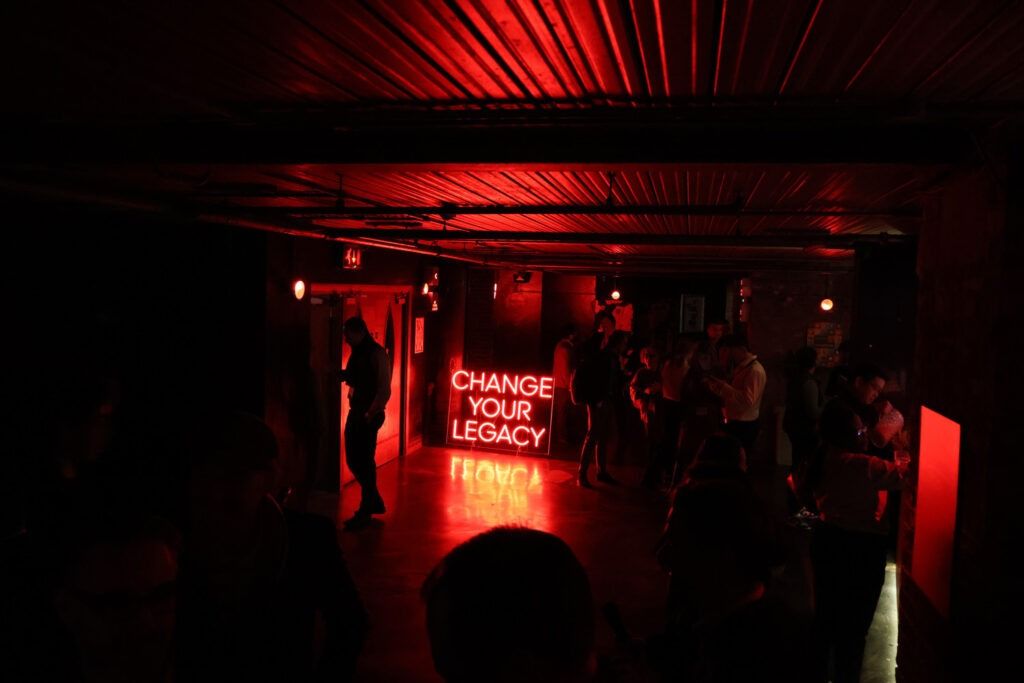
A nightclub, an ambition, and a return ticket
At Duco’s 2023 customer event at fabric, the London nightclub, Nentwich set out an ambition to reduce time spent on data work in finance and operations by 90%. The event’s invitation to change one’s legacy had acquired a literal neon sign. It was an unusually atmospheric setting for a conversation about what colleagues might stop doing every morning.
He was already describing a future in which an assistant handled tasks and an employee concentrated on decisions. A separate on-stage conversation with Santander’s José Muñoz at Sibos explored how operations teams could change processes themselves. These encounters put the product argument beside the people who had to make it work inside a bank.
His interests also extended beyond Duco. In February 2025, he became chairman of Vienna-based fiskaly and announced an investment in the company. Its business, fiscal compliance software, offered another setting where technical complexity meets mandatory work. For Nentwich, the appointment also brought a connection to the city he had left for university.
Then came the return to Duco’s CEO role on 16 March 2026. Chin moved into a senior advisory position. Nentwich’s stated priorities combined agentic AI with safe deployment and regulatory compliance. The combination fits a career spent on consistency: greater autonomy is useful only if customers can still understand and control what happens to their data.
Give the agent tools. Keep the evidence.
In May 2026, Duco launched its agentic operations platform. The design gave agents access to individual capabilities, including data preparation, reconciliation, exception management and audit trails, through Model Context Protocol. The established rules and matching engine remained part of the system. Agents could use those capabilities to carry out work, while people retained oversight.
There is an appealing continuity here. Early Duco helped a user express what needed doing without commissioning a bespoke software project. The new approach lets an agent take on more of that execution. The difficult question remains familiar: can a team show how it reached an answer, reproduce the process and intervene when something needs judgement?
Average reduction in overall manual reconciliation task time reported by Duco across 12 participating clients.
In September, Duco reported an average 76% reduction in manual reconciliation task time across 12 trial clients, including BBVA, Blackstone Credit & Insurance, and CIBC Mellon. That is a specific group’s result. It offers evidence for the direction Nentwich wants to take without resolving every question about how a department’s work will change.
By October, he was describing the opportunity as agents taking over much of the task work in financial institutions. The ambition asks something of the employer as well as the software supplier: decide where responsibility sits, equip people to supervise, and work out which decisions still require a person. Saving time creates its own management assignment.
Nentwich began with documents that needed to agree and found a career among people trying to make their systems cooperate. His return gives that long-running interest another form. The next test will happen where his earlier tests happened: inside an operations team, with real records to check, a deadline approaching, and somebody who needs to trust the answer.