Michael Chin expected New York to give him a piano and a precarious living. He had studied music at Carnegie Mellon, cared about the traffic between creativity and science, and wrote a final thesis around those two interests. The plan after graduation was candidly romantic: arrive in the city, become a musician and accept the hunger that came with it. Then arithmetic interrupted. Music might feed the soul, but rent had other appetites.
So Chin entered the J.P. Morgan training programme. He imagined a regiment of economics and finance graduates. Instead, the room held computer scientists, engineers, philosophers and historians. The discovery mattered. Markets, he learned, could use minds trained to see patterns from entirely different angles. Finance had more room for a musician than he had supposed, provided the musician could learn to trade.
He learned. Over 13 years, Chin traded across asset classes, ran businesses and moved through New York, Tokyo, Singapore and Hong Kong. This was the late 1980s and the 1990s, when much of the work was still stubbornly manual and electronic trading was advancing from novelty to inevitability. He began to look past the trade itself toward the machinery around it. The pianist's ear had found a different sort of timing problem.
Those postings made technology's uneven arrival impossible to miss. A process that looked settled in one market could appear improvised in another. Phones and paper still carried work that software might make faster, clearer and easier to control. Chin's interest grew from the trader's practical impatience rather than from fascination with technology for its own sake. The useful system was the one that removed friction without separating a trader from the information needed to make a decision.
“I wanted to be a concert pianist. For as long as I remember, that was my passion from the very beginning.”Michael Chin
The trader hears the machinery
At J.P. Morgan, Chin eventually led the investment management fixed-income trading group. Then, in 2001, he crossed the line separating a user of financial technology from a builder of it. At TradingScreen, a buy-side trading platform, he spent nine years in executive roles. He oversaw global sales, marketing and client services, served on the board, and helped grow a company designed around the new electronic life of markets.
The sequence that followed reads like a compact history of modern trading software. Chin became president and chief executive of Mantara, a specialist in low-latency trading technology. After the company filed for Chapter 11 in 2013, its technology assets passed to Deutsche Bank. He then entered Thomson Reuters, later Refinitiv, where his remit expanded across equities, fixed income, foreign exchange and commodities. He oversaw desktop tools, execution platforms, real-time data and analytics. In 2017, Institutional Investor placed him and co-head Neill Penney in its Trading Tech 40.
One career, five movements
Bars show career sequence, not a quantitative comparison.
Size, however, proved less attractive than proximity. Chin later said that plunging into a very large organisation reminded him how much he liked building smaller businesses. At a compact company, a customer complaint can travel to a product decision without acquiring a committee, a deck and a light coating of despair on the way.
Even inside the larger firm, he pressed for openness. Trading had become too broad and too fast for a single vendor to supply every useful idea. Under Chin and Penney, Thomson Reuters paired its own development with outside innovators, linking specialist capabilities into its trading ecosystem. The philosophy was commercial, but it also revealed a temperament. Chin did not need every good idea to originate inside the building. He needed the parts to work together for the customer.
Broadway Technology offered that return. Chin became chief executive and joined its board in 2021, taking charge of a firm known for high-performance fixed-income technology. In October 2023, Bloomberg acquired Broadway. Chin stayed briefly to help with integration, but another part of financial infrastructure had begun to interest him. He had spent years improving what happened around the front office. The neglected work after a trade was calling.
Forty conversations, one surprise
Duco appointed Chin chief executive in January 2024. Its software helps operations and finance teams ingest, transform, validate and reconcile data. The description sounds orderly. The reality inside many financial institutions was anything but. In his first month, Chin met roughly 40 customers and found highly trained people still spending their days on manual reconciliation, data entry and spreadsheets.
His response was less evangelical than practical: start with the product and the actual work. In February, Duco acquired the Antwerp company Metamaze, whose intelligent document-processing software could extract information from PDFs, emails, scans and other unstructured material. The combination was intended to carry data through more of its lifecycle without a human rekeying it between systems. By July, Duco had integrated unstructured-data processing into its reconciliation capability.
Chin framed the promise in human terms. One customer told him that automation could create the “workforce of the future.” Operations specialists could stop being custodians of repetitive steps and become investigators, designers and decision-makers. A no-code platform also placed some power in the hands of the people who understood the process, without requiring every change to queue at the door of an engineering team.
The distinction was important. Automation can be sold as a head-count equation, which is an accountant's way of making a human question sound tidy. Chin's version concentrated on unused ability. A person hired for judgment should not spend the day transferring figures between formats. Give that person a tool flexible enough to shape, and the organisation gains both efficiency and a source of ideas. The spreadsheet does not complain when relieved of duty. The analyst may even be grateful.
Innovation needs an appointment
Chin's idea of innovation is notably unsentimental. Companies must give it time. He has argued for labs, hackathons and protected intervals in which people can leave routine behind, exchange unusual ideas and see which ones survive contact with a real problem. Diversity matters because disagreement is productive when the room is well composed. That first surprise at J.P. Morgan, the philosophers sitting beside the engineers, became what he calls his North Star.
Customers remain the tuning fork. Chin prefers teams to sit beside them, watch the points of friction and listen before announcing a solution. He is wary of the clever project that exists mainly because someone inside the company finds it clever. Product-led leadership, in his telling, means making decisions from the market's needs rather than from the executive suite's appetite for novelty.
“The real ideas come when you're sitting there side by side and understanding and seeing what their pain points are.”Michael Chin
That attitude also changes once a challenger succeeds. Disruption is a phase, not a permanent personality. After customers adopt a new platform, the work becomes delivery: improve the partnership, execute faster and make the innovation dependable. It is a less glamorous verb than disrupt. It is also the one customers eventually pay for.
In 2024, TABBForum named Chin among its Top 40 Innovators in Financial Markets. He called himself a change maker, a phrase broad enough to cover trader, entrepreneur and hired operator. Yet the recognition came during a period when he was talking less about personal invention than about conditions: give people time, build teams with different backgrounds, listen closely and make the product useful.
The handover is part of the composition
By March 2026, Duco said it served more than 200 customers and processed over 14 billion transactions monthly. The company credited Chin's two years as chief executive with strengthening its operational structure, governance and commercial scalability. Then founder Christian Nentwich returned to the chief executive role to direct a new phase of AI product development.
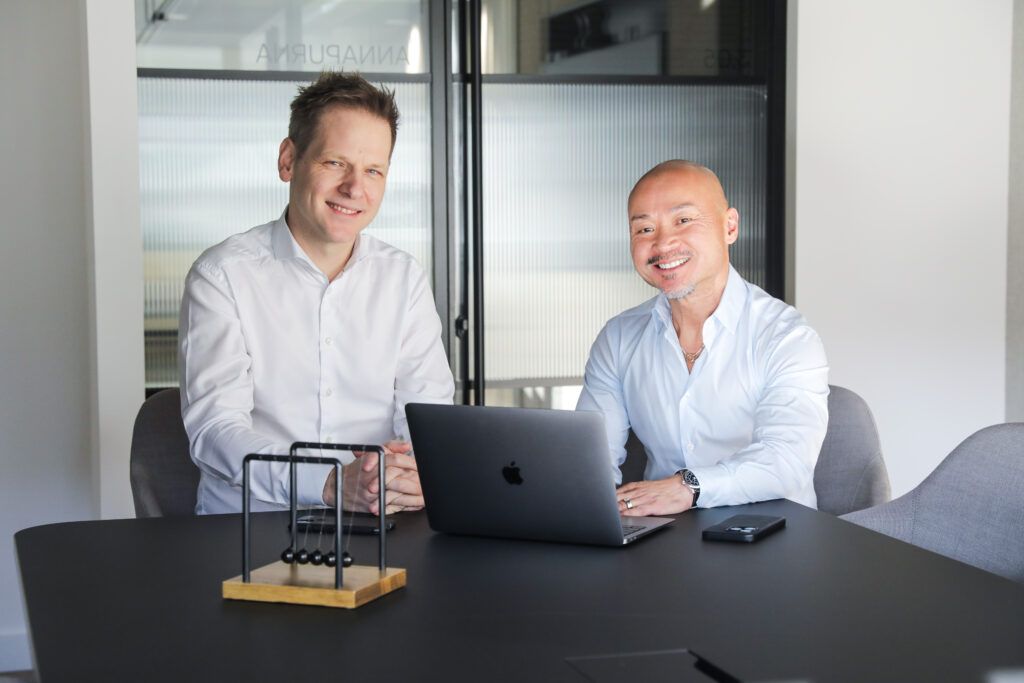
The transition was planned, and it preserved continuity. Chin moved into a senior-advisor role supporting Duco's board and leadership team and maintaining selected customer relationships. Nentwich described receiving a stronger engine. Chin described the moment as the right time to hand back the reins. Their office photograph from 2024 now looks almost compositional: founder and operator at the same table, a Newton's cradle between them, motion passed from one side to the other.
Chin's own career has repeated that motion. He has entered institutions, built commercial and product momentum, managed acquisitions, and moved when the work changed character. He has operated across continents and across the divide between trading and technology. He has also retained an unusually plain measure of progress: are talented people spending less time on tedious work and more time using their talent?
The piano remains the road not taken. Chin has admitted that he no longer makes enough time to play and finds that frustrating. But he does not regard the musical part of his mind as lost. Creativity, pattern, tempo, collaboration and the discipline of execution have followed him from Carnegie Mellon into every trading room and boardroom since.
A concert career would have demanded close listening, repeated practice and sensitivity to the ensemble. Financial technology asked for much the same, with worse acoustics and more spreadsheets. Chin changed instruments. The habits stayed.