On his first day in advertising, Christian Kunkel was handed a task with the crisp confidence of office tradition: go find a box of GRPs. He walked around asking colleagues where such a box might be kept. Gross rating points, he eventually learned, are a measurement, not an item available from the supply cupboard. The assignment was a prank. The confusion was real. Kunkel, newly arrived at Carat and not yet fluent in the dialect of media planning, kept asking anyway.
It is a fine origin story for a marketer whose later career would turn on making difficult things easier to grasp. It contains embarrassment, curiosity and the mild cruelty of colleagues with time on their hands. More importantly, it contains a choice: pretend to understand the language, or admit you do not and keep pulling at the thread. Kunkel chose the thread.
Today he is chief marketing officer at Fingercheck, a Brooklyn company that puts payroll, time tracking, scheduling, hiring and HR tools into one system for small and midsize businesses. Those are products with consequences. A vague claim may be annoying in most software. In payroll, vagueness can end with a crew wondering where its money is. The work rewards precision and punishes theater.
“I just like to find the simplest way of breaking something down in my head, just so I can understand the nuts and bolts.”Christian Kunkel
A history degree enters the ad business
Kunkel graduated from Southern Connecticut State University with a bachelor’s degree in history in 2010, after earlier history studies at the University of Connecticut. The route from archives to advertising is less crooked than it looks. Both ask what happened, why it happened and which version of events will survive. A history major learns quickly that a pile of facts is not yet an explanation. A marketer, at least a useful one, learns the same.
He began at Carat in 2013, working on media planning for Pfizer, then moved into client solutions at USA TODAY and GumGum. By 2016 he had joined Cuebiq, a location-intelligence company. He arrived as a marketing manager and rose through brand, content and demand-generation roles to vice president of marketing. He helped build the program from the ground up while the company had to explain a product that lived at the intersection of mobile signals, foot traffic, campaign measurement and consumer privacy.
One Cuebiq project still follows him: a comic book designed to teach the market about location data. It was the kind of concept liable to sound unserious right until it made a serious subject memorable. A former colleague later singled it out as evidence of his eye for creative work and his ability to carry an idea from conception through production. Kunkel himself is cheerfully realistic about the economics. The comic was not a magic revenue lever. Customers thought it was terrific. Not every useful object needs to pretend it changed civilization.
His time at Cuebiq also made him a public interpreter of data. He wrote about ways retailers could use location intelligence and discussed what foot-traffic patterns could, and could not, explain. He described himself then as a data-driven marketer with a passion for location, technology and storytelling. The order matters less than the combination. Data without a story is a spreadsheet awaiting company. A story without data is often just company.
The customer is hiding in the support queue
After Cuebiq came marketing leadership roles at the employee-benefits platform Nayya and the fraud-prevention company Sardine. In late 2022, Kunkel joined Fingercheck as head of marketing. He inherited a website that, in his description, suffered from high bounce rates and low conversion. Its value propositions, benefits and costs were not clear enough. The team reworked the messaging and design around a less ornamental question: what does a small-business owner need to understand quickly?
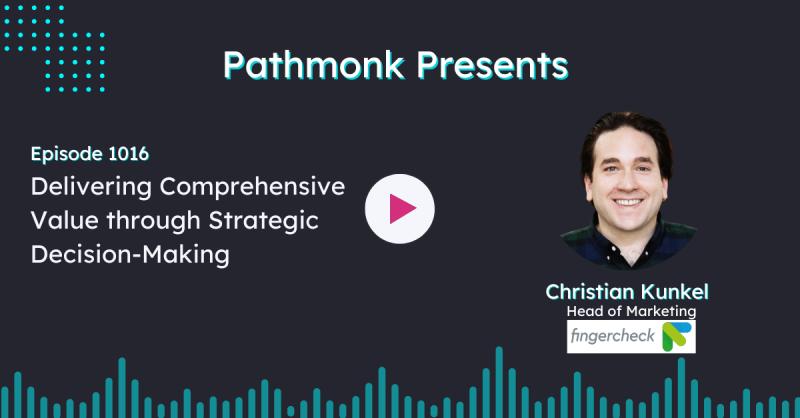
Kunkel’s answer begins unusually close to the ground. He listens to customer-support calls. Support conversations hold the sentences that polished research often sands away: what broke, what confused someone, which word the buyer uses when no marketer has supplied one. These calls are not a ceremonial tour of the front line. They are raw material. The customer is effectively dictating copy, objections and product context, though rarely in that order.
His definition of good marketing follows from that habit. The goal is to make customers feel smarter, not sold to. He favors useful, ungated material over trapping every answer behind a form. He also wants sales and marketing close enough that the buyer’s actual concerns can travel back into the work. In this view, trust is not a brand adjective. It is the residue left when a company helps before it asks.
The audience sharpens the discipline. Fingercheck serves businesses with hourly, mobile and deskless workers: construction crews, field-service technicians, healthcare staff, retail teams and others whose work does not take place in a neat row of laptops. Their employers may be CEO, payroll administrator and reluctant IT department in the same afternoon. They are not shopping for a rhapsody about transformation. They want time captured properly, people paid properly and fewer systems demanding attention.
A ruthless little question
Simplicity, for Kunkel, is not the absence of ambition. It is what remains after waste has been challenged. He has described an activity audit built around one sentence. It is short enough to fit on a sticky note and uncomfortable enough to clear a planning meeting.
“If we stopped doing this, would anyone notice?”
The question is useful because it removes the consolations of motion. A recurring report can be beautifully formatted and still be invisible. A campaign can generate internal excitement and external silence. A calendar full of activity is not proof of consequence. If nobody would notice the disappearance, the time can go toward something a customer might actually use.
That pragmatism does not exile creativity. It gives creativity a job. The comic book worked because it explained. The redesigned website mattered because it clarified. Content earns its keep when it reduces anxiety, answers a live question or gives someone language for a decision. Wit is welcome. Jargon must buy its own ticket.
There is also a management philosophy tucked inside the method. Former colleagues describe Kunkel as transparent, reliable and supportive, someone who offered room to stretch while keeping projects connected to measurable performance. Mentorship features prominently in how he tells his own career. He credits guidance with changing his trajectory and treats passing it along as part of the work, not an extracurricular virtue added after targets are met.
When the search box starts talking back
By 2025, Kunkel’s team had noticed customers finding Fingercheck through ChatGPT. The observation forced a rethink of discovery. Search marketing had long assumed a results page, a rank and a click. An answer engine can compress that journey into a conversation, presenting a synthesized account of a category before the vendor knows the buyer exists.
For a marketer fond of plain language, this is less a rupture than a stress test. Can the company explain itself consistently enough that machines, publishers, customers and employees arrive at the same basic picture? Are its useful facts available, or buried under slogans? Fingercheck eventually published a page built explicitly to state what the company is, whom it serves, what its product covers and who leads it. The format is new. The underlying demand is old: be intelligible when you are not in the room.
The timing matters. In October 2024, Fingercheck announced a $115 million growth investment led by Edison Partners, with StepStone Group and Columbus Capital participating. Dan Kazan joined as chief executive, and the company said the capital would support product, technology, hiring and go-to-market expansion. Growth gives a marketing organization more instruments. It also gives it more ways to make noise. Kunkel’s subtraction test becomes more valuable, not less, when budgets and expectations expand.
“We’re really in the business of making small business owners and their businesses stronger.”Christian Kunkel
The simple guy, properly complicated
Kunkel calls himself a simple guy passionate about a few things. Publicly, those things include his family, useful marketing and the New York Jets. His Fingercheck author bio calls him a “startup veteran by some miracle” and notes that he loves crafting stories almost as much as he loves rooting for a losing football team. It is an efficient biography: work, craft, loyalty, joke.
Asked about legacy, he put being a good father and husband ahead of the corporate nouns. A Jets Super Bowl in his lifetime would apparently settle the sporting account. He also describes himself as a homebody, an identity that sits pleasantly against the mythology of the networking executive forever photographed beside a conference lanyard. His wife is named Jennifer Lopez, though not the Jennifer Lopez. Even his domestic trivia arrives with a necessary act of brand differentiation.
The career, meanwhile, is broader than the self-description suggests. Media planning, publishing, advertising technology, location data, employee benefits, financial fraud and payroll each bring their own specialist vocabulary. Kunkel has moved among them by practicing a portable skill: translation without condescension. Make the machinery visible. Respect the audience’s time. Leave the reader more capable than you found them.
There will always be another box of GRPs in business: a phrase everyone repeats because everyone else appears to understand it. Kunkel’s advantage is not that he knows every acronym now. It is that he remembers what it felt like not to know, and still considers the person wandering the office brave enough to ask.