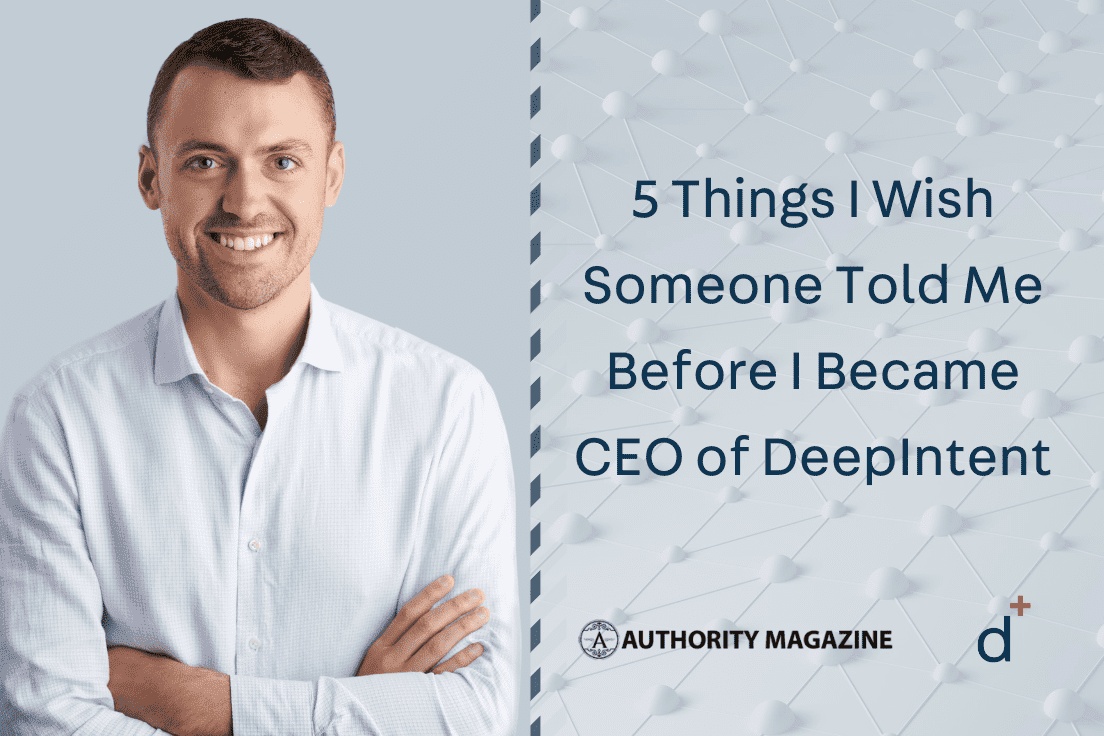
In 2017, Chris Paquette’s wife, Kelly, wrote him a check for $15,000. DeepIntent, the advertising technology company he had co-founded the year before, was struggling with cash flow. The money was meant for payroll and expenses. He never cashed it. Years later, he still remembered the gesture and wanted her contribution recognized. Startup histories tend to give the starring role to the person whose name appears beside CEO. Here was a reminder that the supporting cast had money on the table, too.
The founders had self-funded the business and expected early progress to attract venture capital. Instead, investor appetite for new demand-side platforms, the software advertisers use to buy digital media, had weakened. They eventually found corporate investors. Paquette’s verdict was plain: ‘cash flow is king.’ A promising product could still have an extremely unpromising bank balance.
Before the corner office, a research poster
There is an earlier glimpse of Paquette at Binghamton University in 2012. He was a senior in bioengineering, working with fellow student Joe Perez-Rogers and professor Walker Land. The two students had spent two years on a research project. While the university prepared its Research Days event, Paquette wanted other students to know what was happening around them. ‘We have some really cool projects,’ he said. The vocabulary was undergraduate; the impulse to explain technical work to a wider audience would prove useful.
He completed his bachelor’s degree in 2012. His first professional work included developing algorithmic bidding methods in advertising technology. That is a particular kind of apprenticeship: the software has to turn a prediction into a spending decision. Accuracy matters, but so do price, timing and the consequences of being wrong. The connection to his later career is straightforward. Before running a business that sold advertising software, he had worked on the machinery that decides what an advertisement is worth.
His LinkedIn project history includes BidSmart, dated December 2013, a set of predictive algorithms for advertiser and publisher pricing at adMarketplace. A résumé entry about bidding is less picturesque than a garage origin story. It is also more revealing about the work. Paquette came to entrepreneurship through models, prices and systems, with a practical understanding that a good calculation has to survive contact with a customer.
The founder has to change jobs
Paquette has called himself a ‘product CEO.’ He enjoyed technology and product work, and had participated in much of the company’s detail. Growth required him to hand decisions to a team and spend more time on strategy, marketing and hiring. The company was changing size; its founder had to change his job. For someone who likes making the thing, that can be an awkward promotion.
By May 2021, DeepIntent employed more than 110 people. The company had started with two. Its revenue had tripled in each of four consecutive years, according to its account at the time. Those figures make the delegation problem concrete. A two-person operation can run on shared memory and constant conversation. Once the staff crosses a hundred, knowing what everybody is doing becomes a substantial occupation of its own. There is a point at which the person who can answer every question begins to attract every question.
Rapid hiring also changes what a founder’s attention is worth. An hour spent adjusting a feature is an hour unavailable for finding the person who can own that feature for years. The trade becomes more consequential as the team grows. Paquette’s decision to move away from the detail is the interesting part of his leadership story: the skills that helped launch the company needed to become skills other people could exercise without waiting for him.
A company learns to say thank you
In October 2022, Paquette received PM360’s CEO of the Year award in its supplier, vendor or service-provider category. By then, the company employed more than 250 people. The accompanying account described an Employee Appreciation Day, an Employee Impact Week and an awards program. Such activities can sound like the soft furnishings of corporate life. At that scale, they also address a practical difficulty: colleagues can do useful work for months without the rest of the organization seeing it.
Another change was more telling. DeepIntent introduced a bidirectional annual review process that encouraged employees to identify where they wanted to grow. The word ‘bidirectional’ has the glamour of an office printer setting. The underlying idea deserves better: a review becomes a conversation about a person’s future, with room for the employee to help set the agenda. That fits a business whose founder was learning to share decision-making. Giving away responsibility works better when people have a chance to say which responsibilities they want.
The number gets larger. The job continues.
On September 9, 2025, DeepIntent announced a $637 million strategic investment from Vitruvian Partners. Vitruvian acquired a majority interest; DeepIntent said it would continue operating independently under Paquette. Its board would be reconstituted with industry leaders and specialists. For a founder who had once needed another route to capital, this was a very different conversation about money. The announcement paired the investment with plans for expansion, product development and generative AI.
The transaction put a large figure beside the business while leaving its founder with an operating job. That distinction matters. An investment announcement is a dated event; building software, hiring executives and delivering for clients remain recurring obligations. Paquette stayed to carry those plans forward. The check in the opening scene and the investment announced eight years later belong to different chapters of company finance. One was personal reassurance in a difficult year. The other changed ownership and the resources available for the years ahead.
By 2026, the changes were visible in the leadership team. DeepIntent appointed Ian Colley as chief marketing officer in May. Colley had previously been CMO at The Trade Desk and had spent more than 20 years at IBM. He would report to Paquette and lead global brand, marketing and communications. Bringing in an experienced executive gave a defined part of the company a leader whose work could extend beyond the founder’s own attention.
“Without money, it’s hard to be in business.”Chris Paquette, 2021
Still interested in the machinery
Paquette’s move into management has left a public trail of technical interests. A campaign-planning patent application filed in July 2019 names Christopher T. Paquette and Jennifer Werther Perlman as inventors. Its subject is integrating searches across media and non-media data. The useful detail here is the joint authorship and the problem being tackled: getting different kinds of information to work together inside an advertising planning process. His name appears in the engineering record as well as on the executive page.
The same appetite for explaining systems appears in his public discussions of privacy. In 2022, he spoke about the responsibility to educate a team as privacy rules change, linking that responsibility to how technology gets designed. It is an operational view of the subject. A rule has to travel from a document into people’s decisions and the software they build. For a founder selling technology, understanding that journey is part of knowing the product.
DeepIntent’s June 2026 launch of live sports and events advertising tools offered another engineering problem. A game concentrates demand into a narrow window. Lots of viewers can produce lots of simultaneous advertising opportunities, with little patience for machinery that cannot keep up. The company described dedicated infrastructure, verified live inventory and a delivery algorithm built for that timing. Paquette’s public response emphasized both the infrastructure investment and publisher partnerships. Even at this stage, he was discussing how the system worked.
The next interface is a conversation
In September 2026, DeepIntent introduced Cora. Paquette described conversational tools for research, strategy, planning, audience building and campaign execution, alongside shared project workspaces. These are the everyday verbs of agency and marketing work. Bringing them together expands the part of the working day the company wants its software to occupy. It also changes the product conversation: a client can ask about an entire process, with several people involved, rather than one isolated advertising purchase.
The plans return him to a familiar managerial question. If more work can be coordinated through one system, what should people spend their attention on? His own career offers a small, concrete version of that question. He began close to the individual calculation, took responsibility for a product and then built a team to carry more of the work. Cora is a new product chapter. The recurring interest in how separate decisions fit together is easier to recognize.
A life with room around the company
Paquette also appears on Binghamton’s data analytics advisory board, alongside people from finance, retail and business intelligence. The connection gives his university story a later chapter. The student explaining a research project now contributes industry perspective to a program that prepares other people for work with data. There is a useful continuity in that, without requiring a grand theory of his life. He studied there, built a career and remains connected to the institution.
He lives in Rye, New York, with Kelly, their daughter Sloane and their dog Hanalei. His public biography describes running, travel and an enthusiasm for the outdoors. These details put ordinary dimensions around the job title: a town, a family, interests that do not require an advertising dashboard. They are also a fitting place to leave a story that began with a gesture from his wife. The company’s history contains investors, employees and new products. His account of the early years makes room for someone who believed in him before the balance sheet became easier to admire.
- DeepIntent / Company website ↗
- Chris Paquette / LinkedIn ↗
- Five things he wishes he knew before becoming CEO ↗
- Listen / THINK Business with Jon Dwoskin ↗
- Watch / Chris Paquette in conversation with Rajeev Goel ↗
- DeepIntent / News and product announcements ↗
- Binghamton / The data analytics advisory board ↗