A marketing department can count almost everything: visits, clicks, names, forms, impressions. Chris Golec has spent much of his working life asking a less comfortable question. How much of it comes from anyone who might actually buy?
It is the sort of question that can spoil a perfectly cheerful presentation. The traffic is up. The chart is green. Then someone asks whether those visitors belong to businesses the sales team can serve, and the room has to reconsider its applause. Golec built Demandbase around that mismatch. With Channel99, the company he launched in 2022, he is examining the spending behind it.
There is a pleasing stubbornness to this career. The products change, the acronyms accumulate, and artificial intelligence enters the discussion. The underlying concern remains recognizable: a business should be able to tell the difference between movement and progress. Golec came to that concern through chemical engineering, industrial sales, and a software company that preceded the one most people associate with his name.
The engineer finds a different kind of waste
He graduated from Michigan State University in 1987, trained as a chemical engineer, and later earned an MBA at Boston University. His early career included DuPont and GE, with responsibilities across engineering, sales, and marketing. Before there were website visitors to identify, there were industrial customers and their actual requirements.
That background matters because account-based selling was already ordinary work in those settings. A salesperson could have a defined group of businesses to look after. Success depended on understanding the account and keeping the relationship productive. The account came with a name and a commercial reason to pay attention. A larger pile of unrelated names would hardly have improved the job.
In 1995, Golec and colleagues he had met at GE started Supplybase. The company helped large enterprises manage their global supplier base, bringing software to a problem familiar from their industrial careers. In March 2000, i2 Technologies acquired it. Golec’s later biography puts the transaction at $380 million. It was a substantial exit, though the number describes the deal rather than the founder’s personal proceeds.
Supplybase also gave him experience on the buying side of marketing technology. Selling business software exposed the limitations of the tools available to reach other businesses. After the acquisition, he developed a consulting practice helping companies organize demand generation. That work evolved into Demandbase, founded in 2006.
An account list becomes a business
Demandbase’s proposition began with a practical distinction. Consumer marketing could describe people by demographic characteristics. A business selling to another business needed to understand the company behind the interest: its industry, its scale, its suitability. The question of who was visiting a website could be commercially useful before the visitor filled in a form.
The company developed technology connecting internet addresses with business identities. By 2012, Golec was discussing company-targeted advertising as an extension of that capability. Identification could help a marketer decide where to advertise, how to adapt a website, and when to bring sales into the conversation. The account became a connecting thread across systems that otherwise kept their own records.
This was an engineering problem with a sales consequence. A company could buy a great deal of exposure and receive remarkably little attention from the businesses it wanted. Golec’s approach gave customers a way to work from a chosen set of accounts. It also gave marketing and sales something specific to agree on before either side began congratulating itself.
“All marketing is better when you know whom you’re talking to.”
Chris Golec
In his 2016 explanation of account-based marketing, he emphasized alignment across the customer lifecycle. The work extended from attracting an account to developing an existing customer. Shared measures such as opportunities, deal size, and close rates mattered because they connected both teams to the same commercial outcome. Counting leads alone left too much room for an argument over whose definition of success should win.
A category needs a meeting place
Building an account-based marketing platform also required explaining how customers should use it. A category needs a vocabulary, examples, and people who can compare experiences without spending the first twenty minutes defining the subject. Demandbase’s events helped provide that meeting place.
By its fifth annual ABM Innovation Summit in 2018, attendance had grown from a little over 100 at the earlier gathering to more than 1,000. Agencies and consultancies were building practices around the approach. A discussion that once needed to establish the case for ABM could spend more time on implementation. The audience’s questions were changing alongside the software.
In 2019, Golec joined Demandbase colleagues Peter Isaacson and Jessica Fewless to publish Account-Based Marketing: How to Target and Engage the Companies That Will Grow Your Revenue. The book addressed selecting accounts, aligning teams, and measuring programs. These were working decisions. Even an excellent advertising system needs somebody to decide which businesses deserve to be on the list.
The book’s appearance placed Golec in another role: explaining a method that customers had to carry into their own organizations. Software could support the work, but a shared plan still needed human agreement. A sales team’s priorities and a marketing team’s budget had to meet somewhere more useful than the quarterly postmortem.
The room called Journey
Golec’s account of leaving Demandbase contains a detail that would never make it into a product specification. The headquarters had a conference room called Journey, named after his first concert. In January 2021, a photograph taken outside that room accompanied his farewell as an employee. After fifteen years, even the meeting-room names had acquired a backstory.
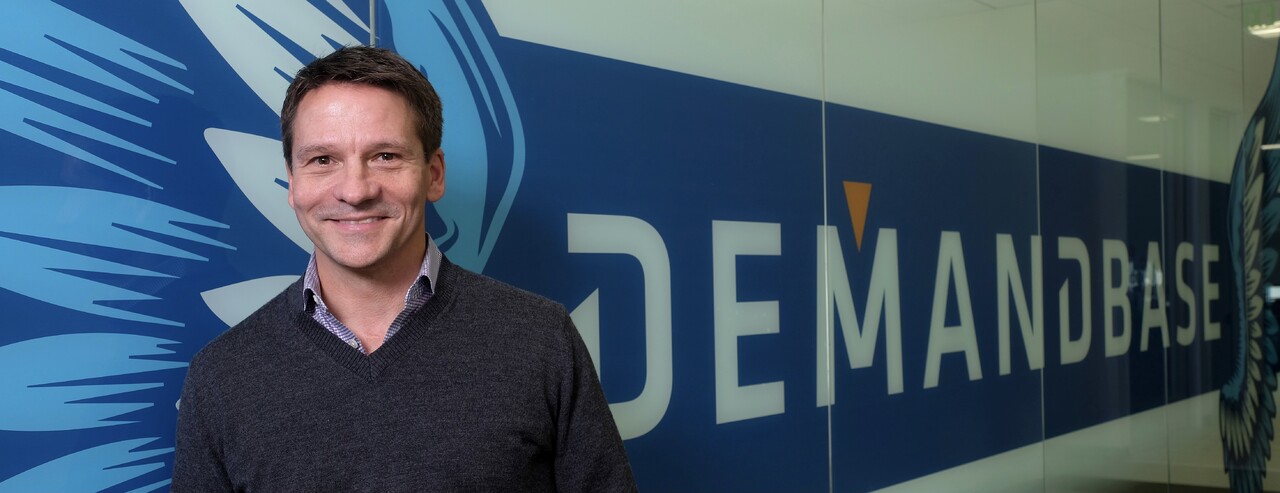
He had already handed the CEO role to Gabe Rogol in November 2019, moving into the chief strategy officer position. Demandbase was approaching $100 million in annual revenue. Golec said the change would let him concentrate on product innovation and customers. A founder’s job had become a choice about where he could contribute next.
His farewell also recalled a less conventional customer gathering: nearly 1,000 people packing 100,000 meals for Rise Against Hunger at the company’s 2015 conference in San Francisco’s baseball stadium. They wore hairnets. As conference souvenirs go, it offered rather more to remember than a branded pen.
That sort of activity gave the company’s culture a visible form. Golec has described an early Demandbase commitment to attracting and keeping talented people, made when the team numbered roughly twenty-five. Listening, transparency, and inclusion were part of his explanation of how to make the promise credible. Demandbase subsequently placed tenth in Glassdoor’s 2016 ranking for smaller companies.
His employee departure left room for continued involvement as a board member, advice to other businesses, and another venture. The existing company had its next leader. The founder still had a question he wanted to pursue.
The idea that waited
Channel99 made its public debut on November 30, 2022. Its initial offering included a free mobile app for examining the quality of B2B website traffic across channels such as search, social, email, and display advertising. Adding spending data was intended to make the comparison financially useful: which channels brought attention from companies in the customer’s market?
For Golec, this was a return. He has described the measurement mission as part of Demandbase’s original vision, before the market was ready for it. The intervening years produced an account-based marketing business. They also left an unresolved question about how a marketer should choose the next investment.
“It was just way too early. The market wasn’t ready for it.”
Chris Golec, on the earlier measurement vision
There is a difference between showing where a visit came from and explaining which activity helped create demand. Someone may see an advertisement, remember the company, and arrive later through another route. The easiest interaction to record can receive more credit than its role deserves. Golec has publicly challenged that reliance on the last touch.
Channel99’s stated ambition brings finance into the same discussion. A channel’s activity needs to be understood alongside its cost and its connection to pipeline. The product’s use of AI sits inside that aim. The point of the recommendation is to help a person decide where money should go, with enough context to defend the decision.
A budget should be able to explain itself
In January 2026, Channel99 announced Paid Search Optimization. It applied the account lens to keywords and ad groups, aiming to show the cost of engaging suitable businesses rather than simply generating traffic. The release extended Golec’s long interest in the quality hidden inside an apparently satisfactory total.
The work remains recognizably connected to his earlier career. Supplybase addressed how enterprises dealt with suppliers. Demandbase addressed how they found and engaged customers. Channel99 addresses how they judge investments in reaching those customers. Each company sits beside a business decision that becomes harder when the information is fragmented.
Golec’s story has the large transactions and leadership changes expected of a software founder’s biography. Its more distinctive feature is the question that keeps following him into the next company. When a report says something worked, what exactly does it mean?
It is an awkward question for a room enjoying its green chart. After three companies, he is still willing to ask it.
Continue the conversation
Golec’s companies, writing, and conversations.
Channel99 Current company ↗Demandbase Company profile ↗Chris Golec on LinkedIn Profile & writing ↗Chris Golec on X @cgolec ↗My Last Week of a 15 Year Journey His 2021 farewell ↗The apprenticeship question Watch on YouTube ↗Back at Michigan State Innovate State conversation ↗AI, people, and marketing investment Sales Pipeline Radio ↗Taking the account lens to paid search January 2026 announcement ↗