Chris Burry started and sold his first company while he was still in college. It is a pleasantly inconvenient detail in the biography of someone who now helps other people learn entrepreneurship. Before the workshops, the international programmes, and the discussions about founder capability, there was a student who had already tried the business of making a business.
He later helped found technology companies, worked on enterprise systems, and became part of Avanade’s founding team. Since late 2010, his work with US Market Access Center has brought him into the company of founders trying to grow beyond their home countries. The recurring question has become larger than where to find an investor. What must a person learn to build an organisation that can survive its own growth?
That question gives his career its shape. Burry has spent time on both sides of the classroom: building and operating businesses, then helping others prepare for decisions they have yet to encounter. He brings the background of someone who has worked on complicated systems to a job concerned with people who must make complicated choices.
A political science degree, then the plumbing
His undergraduate degree was in political science at Swarthmore College, with honors. The later résumé takes a technical turn: senior technology consulting at Electronic Data Systems, executive work at Andersen Consulting, and the founding team of Avanade, the Microsoft and Andersen Consulting venture established in 2000.
At Avanade, his responsibilities included infrastructure leadership and the role of Technology Fellow. This was the practical end of computing, where a system has to work after the presentation finishes. An organisation can admire an elegant design and still require someone to make it run across offices, users, and competing demands.
In December 2002, Burry put the customer’s concern plainly: “Reducing and controlling IT management costs is high on most CIOs’ lists today.” It is a sentence with very little appetite for glamour. Customers had costs to control and systems to manage. Useful technology had to address those realities.
He also wrote about operating systems and infrastructure for ComputerWorld and advised IDC’s research division on cloud computing and technology’s future. Explaining technology became part of the job alongside delivering it. His international project experience included the United Kingdom, France, Germany, and Australia. By the time founder education became his focus, working across borders was already part of his professional life.
An airline ticket is a modest beginning
US Market Access Center gave that experience a different destination. Burry is its Co-founder and Co-CEO, alongside Alfredo Coppola. The organisation works with international technology companies and with institutions trying to develop entrepreneurial activity. Its name is wonderfully literal. Market access sounds administrative until you are the founder who needs it.
A new market contains customers, partners, investors, and people who can explain how business is done there. Reaching the place is the easy part to describe. Understanding it requires more than a flight booking and a presentation translated into English. The founder has to learn which conversations matter and how to make those conversations useful.
In Malaysia in 2018, Burry spoke at Sunway iLabs about corporate innovation and strategy. He was also discussing A3 Global Collider, an accelerator initiative linking Silicon Valley and Sunway. His explanation of market entry began with people: “Ultimately, it is people that make up the markets.”
The talk considered the difference between making something new and finding a commercial use for it. Burry emphasised adoption, customer value, and the willingness of established companies to work with outside innovators. The invention may be clever. Someone still has to decide to use it. That small, stubborn transaction gives the larger discussion its purpose.
The mentor needs a few scars
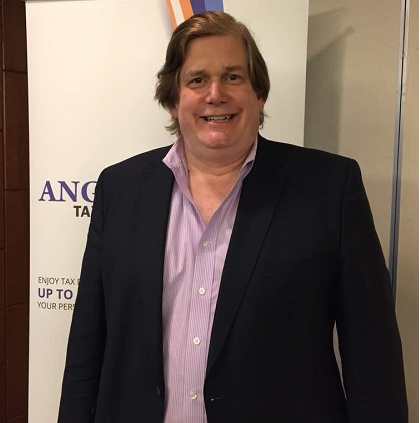
At Stanford in April 2017, Burry presented his view of Asian startups seeking international growth. He organised the problem around access to markets, people, finance, and support networks. The distinction he kept making concerned experience: who had actually taken a company through growth?
His emphasis on mentors who had built businesses matters because the founder’s next problem rarely arrives as a tidy lesson. A senior title can indicate responsibility without revealing whether someone has faced the particular uncertainty of starting and scaling a company. Burry wanted founders to have access to people familiar with that journey.
The argument is practical. Experience gives an adviser something to compare a new situation with. It does not make every answer transferable. A founder in a different country, industry, or stage of development still needs to decide what applies. The useful mentor helps with that sorting, rather than handing over a biography as proof that every recommendation must be correct.
Four connected needs, rather than a ranking or a promise of success.
A classroom that crosses borders
Berkeley became an institutional home for this work. Burry joined the entrepreneurship faculty at the Sutardja Center for Entrepreneurship and Technology in 2013. Its current fellows directory lists him as a Global Ambassador. The connection puts his operator background alongside an organisation devoted to teaching entrepreneurship.
The collaboration has taken him beyond California. In August 2022, Berkeley announced plans for a September bootcamp in Georgia with the European Innovation Academy. Burry was named among the collaborators who would teach students, alongside Ken Singer, David Law, Gail Gannon, Moor Xu, and Stephen Torres. The planned curriculum covered innovation, entrepreneurship, leadership, and storytelling.
That combination is revealing. Building a company requires people to explain what they are doing, bring others into the work, and make choices together. A technical idea has to become something colleagues and customers can understand. The classroom offers a place to practise before those conversations carry the full weight of a business.
Japan is another part of his public working map. The DATERISE! 2025 programme in Sendai listed him as a pitch-contest judge, identifying his USMAC, Dojo, and Berkeley roles. Judging a presentation is a brief encounter with a founder’s thinking. Training gives that encounter a longer horizon: time for questions, revision, and another attempt.
The product builder’s next job
Burry’s international teaching has also carried a warning about timing. In a 2022 programme for European startups, he argued that founders should think about global markets early, even before entering them. A business can begin locally while still considering how its choices will affect expansion later.
The distinction has consequences. Decisions made for one market can become expensive to revisit. Thinking ahead does not require a young company to sell everywhere immediately. It requires the founder to ask which assumptions are local, which might travel, and which will need testing again. Ambition becomes more useful when it produces questions that can be acted on.
Another transition appears in the Dojo’s account of USMAC’s 2016 Lazaridis Scaleup work: the move from building a product to building a company. The account describes scale readiness as a change in skills and mindset after product-market fit. The founder’s work expands as the organisation grows around the product.
It is easy to see why that transition interests someone with Burry’s background. Getting a thing to function and getting an organisation to function are related tasks with different demands. A founder who can solve the first problem has earned the opportunity to confront the second. Success has a habit of assigning homework.
The founder’s work expands as the organisation grows around the product.
An observation on Burry’s scale-readiness work
Global Innovation Dojo emerged from Burry’s collaboration with Berkeley entrepreneurship educators, including Ken Singer. It combines USMAC’s international work with teaching methods developed at SCET. Its purpose is founder development: helping people improve the judgment they bring to unfamiliar situations.
The organisation describes its work in terms of decisions under uncertainty, learning, and the increasing complexity of a growing business. Those are less photogenic measures than a crowded event. They are also closer to what a founder has to do when the visitors have left and the next difficult choice is waiting.
More hands in the room
The Dojo’s project list includes Founder Dojo Imo in Nigeria in 2025. Its history places the programme in Owerri, Imo State. A Startup Grind Owerri session paired Burry with Singer to discuss founder development and the programme’s vision. The geography extends a long-running concern: how people outside established startup centres gain access to experience.
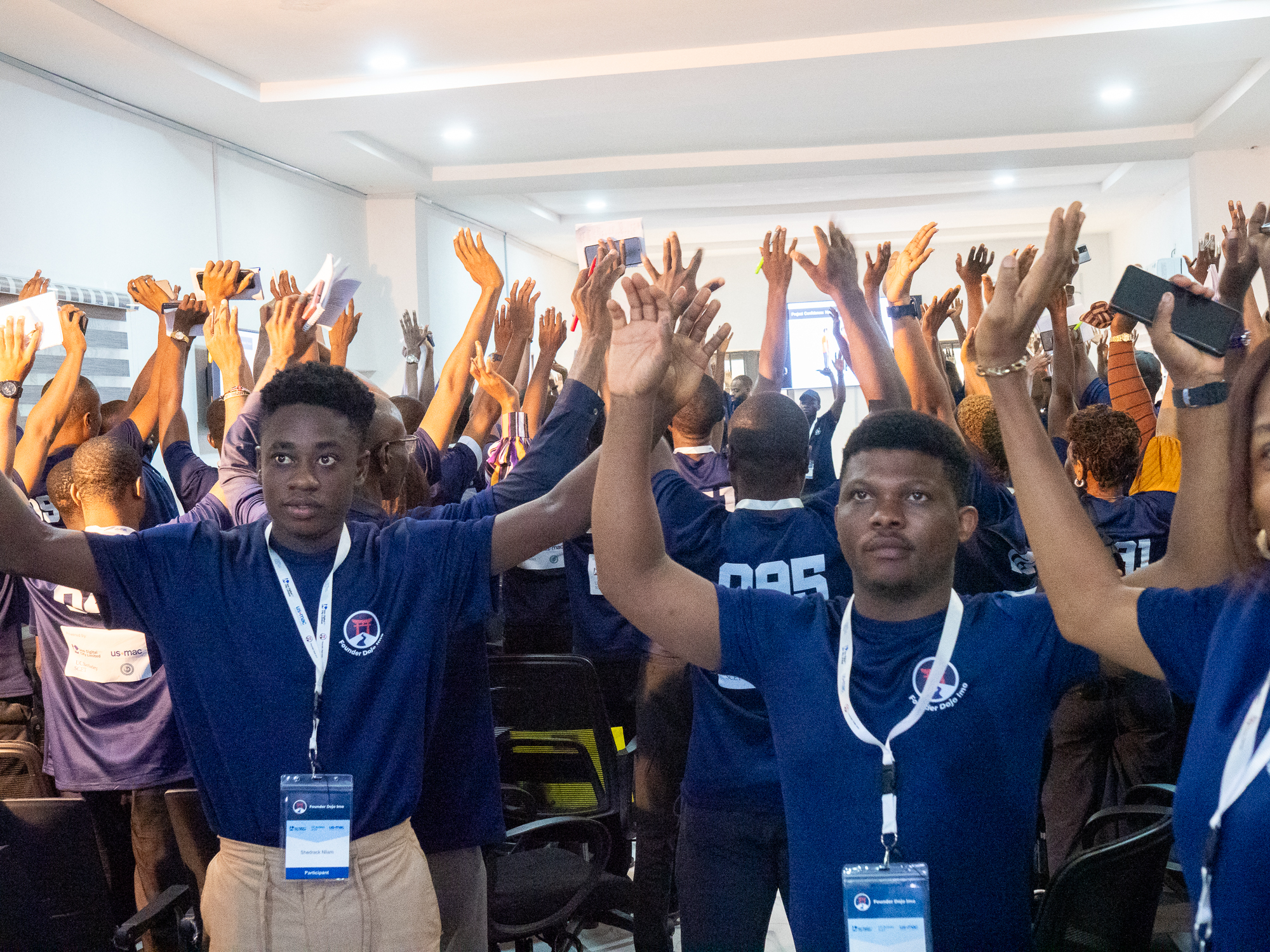
The programme photograph shows a room full of raised hands. It is a useful image for work that depends on participation. A founder has to test an idea, hear an objection, and decide what to do next. The exchange can be uncomfortable. It can also make a future decision less lonely.
Burry’s stated motivation is that innovators exist around the world while access to knowledge, capital, markets, and networks is uneven. That belief has taken his career from enterprise projects to classrooms and founder programmes. He is interested in the people capable of using an opportunity when it arrives, and in helping them become better prepared.
The student who sold a company eventually made other founders’ development part of his working life. There is continuity in the change. An idea needs someone to build it. A growing company asks that person to keep learning. Burry’s work follows the distance between the two, one decision at a time.
Follow the work
- US Market Access Center
- Global Innovation Dojo
- Chris Burry on LinkedIn
- Berkeley SCET fellows
- Stanford presentation, April 2017
- Malaysia: innovation and market access
- European market-discovery training
- Georgia bootcamp announcement
- Dojo blog