Sehat Sutardja had a radio repair license long before he had a doctorate. He earned it at 13, in Indonesia. Decades later, after helping build a semiconductor company, he still liked showing it to people. His wife, Weili Dai, carried the document in her purse. A company could acquire offices, customers and shareholders; the license remained conveniently portable proof that he knew how to fix something.
The fascination began on a childhood visit to Singapore. His younger brother, Pantas, had electronics books and magazines. Together they built a Van de Graaff generator. Back in Jakarta, Sehat made a smaller device using parts scavenged from his parents’ auto parts business. Mechanical contacts kept oxidizing. Transistors offered a way around the problem. One troublesome contraption had given him a reason to learn an entire field.
There is a practical joke somewhere near the beginning of this story: he wanted a little machine that could give people a shock. The more consequential surprise was his own. Electronics gave him something to investigate, improve and investigate again. Repair work suited that appetite. A radio had a fault; finding it required attention. An impressive opinion about the radio was unlikely to make it play.
The road went through Iowa
Sutardja moved to the United States in 1980. His first stop, the University of San Francisco, proved an awkward fit for someone intent on electrical engineering. He transferred to Iowa State, where he completed his bachelor’s degree in 1983. The geography of his career can look inevitable when compressed into a biography. At the time, it included a change of university and a substantial detour through Ames.
Berkeley came next: a master’s degree in 1985 and a doctorate in 1988, both in electrical engineering and computer sciences. Pantas also studied there. The brothers who had once experimented with hobby electronics now had access to the mathematical tools and laboratories behind professional chip design. Their shared curiosity had acquired considerably more expensive equipment.
At Berkeley, Sutardja’s work included analog-to-digital conversion. Stephen Lewis, his graduate-school office mate, remembered a designer who kept revisiting details after a circuit already worked. Sutardja found a way to use two identical capacitors where the conventional arrangement used differently sized ones. Small departures from the usual design could improve performance. He was interested in the space between acceptable and better, a space that can be difficult to explain to anyone waiting for you to finish.
Three founders, one kitchen table
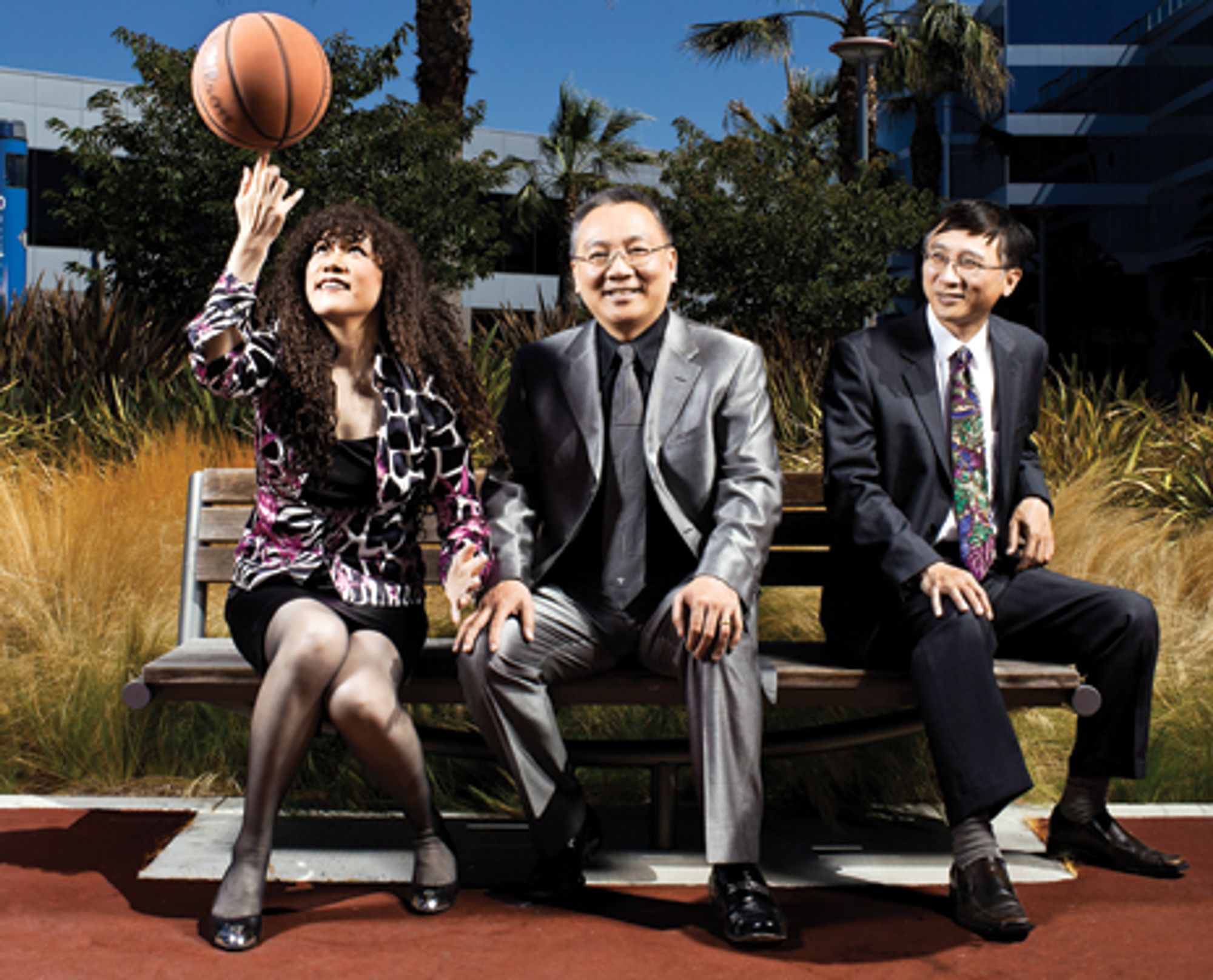
In 1995, Sutardja, Dai and Pantas founded Marvell around a kitchen table. The relationships were unusually close: a husband and wife, and a brother. The company name expressed their intention to make marvelous devices. The actual first assignment was less theatrical than the name. They wanted to build a better read channel for hard drives.
A read channel deals with a delicate translation. A disk stores information magnetically; the electronics must recover usable digital data from the signal picked up by the drive’s head. Speed matters, but so do power consumption and manufacturing cost. Marvell’s opening product used CMOS circuitry, taking an approach that established assumptions treated skeptically. It turned a specialized engineering decision into a business opportunity.
The division of labor mattered. Pantas worked on architecture and digital circuitry; Sehat concentrated on analog design. Dai worked to bring the technology to customers. A family business still needed someone to answer the least romantic question in invention: who would buy it? A chip on a workbench could demonstrate ingenuity. A customer willing to put it into a product could give the company a future.
Marvell went public in 2000. The kitchen table was now the beginning of a public-company history, with all the expectations that accompany it. The origin is appealing because it is domestic and specific. Its lesson requires more care. Three people being related does not explain a working semiconductor. Their different contributions do.
The gadget he preferred was unfinished
For someone whose work helped supply consumer electronics, Sutardja had a pleasingly inconvenient relationship with gadgets. In a 2011 interview, he described himself as “not really a gadget person.” He owned smartphones and tablets. Ownership simply was not the part that most interested him. He preferred the work that happened before a customer opened the box.
“My enjoyment comes from being able to develop these products,” he said. That preference helps explain why the technical work remained central to his identity. A finished device is a collection of settled choices. Designing it means confronting those choices while they are still open: what can fit, what can run faster, what can use less energy, what can be made economically.
He also saw technology as something that crossed national borders. A useful device in the United States could be useful in Japan, China or Indonesia. For an engineer whose own education had crossed an ocean, that was a concrete way to think about reach. The satisfaction lay in other people finding the technology useful. He did not need to be its most enthusiastic shopper.
“I only see things in terms of electronics.”Sehat Sutardja, 2010
When the chip became too big a bet
By the middle of the next decade, Sutardja was concerned about the economics of chip design. Complexity meant expensive tools, validation and verification, along with long development schedules. In a January 2016 interview, he described the difficulty of predicting what a customer would need several years ahead. A mistake could require another costly version of the silicon.
His proposed answer was modularity. Instead of making every function part of a single large design, engineers could connect smaller functional pieces. He compared the idea to LEGO. The comparison was friendly; the underlying requirements were exacting. Connections needed to work reliably, and the system needed to remain usable as individual components changed.
At the 2015 International Solid-State Circuits Conference, he presented MoChi, a modular chip platform. This work belongs in the history of his interest in chiplets: smaller semiconductor blocks combined into a larger system. It also broadens the portrait of him. His attention could move from the details inside a circuit to the rules that allowed separate circuits to work together.
In April 2016, Marvell’s board ended Sutardja’s tenure as CEO and Dai’s tenure as president. Its announcement called for a new leadership direction; both initially remained directors, with Sutardja continuing as chairman. The break belongs in the story. Building a company and continuing to run it are separate chapters, especially once the company has a board, public shareholders and an agenda larger than its founders’ workshop.
Memory
Input / output
A second life for the building blocks
Sutardja and Dai continued working in semiconductors after their management departure. In 2021, they joined BJ Han to found Silicon Box in Singapore. Han brought a background in semiconductor packaging. The new company addressed a practical question raised by modular design: how do you integrate the pieces efficiently enough to manufacture useful products?
Design and packaging meet at that question. A drawing can arrange functional blocks neatly. Production must connect physical devices, manage their behavior and deliver them consistently. Silicon Box’s role was to provide advanced integration and packaging services. It gave the modular vision a manufacturing counterpart, and gave Sutardja another setting in which to work with partners whose expertise complemented his own.
He and Dai also led Expedera’s $18 million Series A financing in December 2021. Expedera developed deep-learning accelerator intellectual property that chipmakers could license. Here was another route for a smaller company’s engineering to reach larger systems. His later career included backing other builders as well as founding companies himself.
In October 2026, Silicon Box reported that its Singapore factory had shipped more than one billion units. The company projected two billion by year-end; that remained a target. The reported milestone gives the later chapter a measurable continuation. Sutardja’s own dates are 1961-2024. Work he helped set in motion continues through the engineers, investors and manufacturing teams who carry it forward.
- 2015MoChi presented at ISSCC
- 2021Silicon Box founded in Singapore
- 2023Singapore factory opens
- 2026Company reports 1 billion units shipped
A place for other people to make things
Some of that continuation is visible on the Berkeley campus. Sutardja Dai Hall was dedicated in February 2009, recognizing the support of the three Marvell founders. The building houses the headquarters of CITRIS and the Banatao Institute, along with research spaces and the Marvell Nanofabrication Laboratory. Its name brings the family partnership back into the university where so much of their education took place.
At 141,000 square feet, the hall is a different kind of engineering contribution from a chip. It provides rooms, equipment and places for researchers to meet. Laboratories need a physical home before anyone can produce a result worth celebrating. The building makes that practical requirement visible. It is difficult to invent the future while looking for somewhere to put the experiment.
Sutardja served on Berkeley Engineering’s advisory board from 2006 and supported its new Engineering Center. He also advocated more efficient consumer electronics: Marvell supported the Smart Electronics Act introduced in 2010. Faster and more numerous devices brought questions about their combined energy use. He was willing to follow the implications of his field beyond the boundaries of an individual product.
Still willing to stop and talk
The inventor’s record included more than 440 patents as inventor or co-inventor, IEEE fellowship, and the 2013 Dr. Morris Chang Exemplary Leadership Award shared with Dai. Those distinctions measure recognition. A smaller recollection shows something about how he treated people. Journalist Junko Yoshida remembered calling a question to him while they passed on opposite escalators at CES. He waited upstairs and gave her a short interview.
Yoshida also remembered his continued interest in ideas and the startups he and Dai supported. The image is useful precisely because it is ordinary. A busy executive could have kept walking. Sutardja made time for the question. Curiosity can become a private obsession; in that encounter, it was something another person could join.
His story moves from repairing radios to designing circuits, founding companies, funding builders and helping furnish a university with space to work. The scale changes. The attraction is recognizable throughout: a device can be understood, a design can be revised, a useful idea can find its next collaborator. There is something rather agreeable about a career that still leaves room for the old repair license. It records an early pleasure that success never quite displaced.
Follow the circuits
Talks, profiles and the companies that continue the work.