A bad restaurant review has one advantage over a business plan: someone has actually eaten the food. In April 1996, Aaron Kennedy received the sort of verdict that makes a founder wish the newspaper had lost its delivery trucks. His noodle restaurant in Madison, Wisconsin, had an appealing premise. The meals were letting it down. The idea and the bowl had parted company.
Kennedy had opened his first Noodles & Company in Denver the previous October. Now, with two restaurants and a precarious business, he had to decide how much of his own creation he was willing to question. He called together his team, including founding chef Ross Kamens and college friend Tom Weigand, and sent them looking at noodle shops in Chicago. They returned to examine their operation. Dinner had become homework.
The useful part of this story begins here. Kennedy kept the broad ambition: bring noodle dishes from different cuisines onto one menu. He let the particulars go up for inspection. Food, pricing, service, surroundings. A founder can be passionately attached to a premise and still have terrible lighting. A restaurant gives customers ample opportunity to notice both.
The world was already eating his idea
The original inspiration arrived in New York in 1993. Kennedy encountered an Asian noodle shop in Greenwich Village and saw a possibility beyond the dishes in front of him. Pasta and noodles belonged to households across the world. Why should a hurried customer have to choose a restaurant by country before choosing dinner?
That was the attraction of the proposed global noodle shop. Italian pasta, Asian noodles and American macaroni and cheese could share an address. The familiarity of the food made the range less forbidding. There was room for the person seeking something new and the companion who would prefer that nothing exciting happen to their supper.
He began developing recipes in 1994 with Kamens and Joe Serafin, using his mother-in-law's kitchen. The first location opened in Denver's Cherry Creek neighborhood in October 1995; Madison followed in March 1996. His friendship with Weigand connected the venture to Wisconsin. Two early shops in widely separated cities made a fairly stern test of whether the concept could travel.
Kennedy brought experience in consumer research and brand management, acquired at Oscar Mayer and Pepsi, as well as work in brand design. Yet a restaurant requires its promises to arrive on a plate, several times an hour. His marketing background could help explain what the business should mean. Cooking and serving dinner introduced a different examination.
One Denver restaurant. A menu that put several culinary traditions under the same roof.
Fifteen things between an idea and dinner
The early operation used steam trays. Kennedy and Kamens later identified fifteen things that needed changing, including cooking each dish to order. The change brought a practical answer to the gap between a good concept and a disappointing meal. A diner paying for freshly prepared pasta had reason to expect the preparation to matter.
The reconsideration extended into the room itself. The team found the atmosphere sterile and the prices too low. Kamens revised recipes; the kitchen was restructured for hot sauté preparation. New managers brought experience in food service. By the fall of 1996, the Madison restaurant had become profitable. A second Madison location followed in May 1997.
These are ordinary restaurant decisions, which gives them their force. The team improved the things a customer could taste, see or encounter while placing an order. None required the public to admire a founder's courage before enjoying lunch. Kennedy's broad idea survived because the business around it was allowed to change.
There is also an unglamorous scene from those early Wisconsin days: Kennedy and colleagues bailing water out of a flooded basement. Years later, it remained among the memories he revisited. The entrepreneurial experience had supplied a metaphor and then, with rather excessive thoroughness, supplied the actual basement.
A brand manager with a reporter's degree
Kennedy graduated from Augustana College in 1985, having studied English and journalism. He earned his MBA at the University of Wisconsin-Madison in 1989. The combination helps explain a career in which understanding an audience and presenting an idea repeatedly sit next to each other. Before the restaurant came years spent learning how people respond to products.
At Kraft's Oscar Mayer division, he conducted consumer research for the development and launch of Lunchables. At Pepsi, he worked on research, national advertising and promotions. His design work involved brands including Coca-Cola, Burger King, Swiss Army Products and the Denver Broncos. Those assignments offered experience in making an identity recognizable across different settings.
His partnership with Weigand had an earlier, less corporate history. After college, the friends shared apartments in Galena, Illinois, and later Madison. In Galena, Kennedy was a sports editor and Weigand was city manager. The future restaurant partners had already practiced staying in one another's orbit before there was a noodle business to organize.
A college friendship is an agreeable detail in a company history because it precedes the company. Neither party needs a pitch deck to explain why they know the other. In Kennedy's case, the relationship supplied continuity across journalism, graduate school, marketing and eventually restaurants.
Macaroni on the floor, management in the room
As Noodles grew, Kennedy used a weekly email called Noodle News to keep restaurant teams connected. It carried sales information, growth updates and recognition for staff and stores. He also attended restaurant openings and worked when he was there during service. The executive visit could include the executive carrying dirty dishes.
“Everyone in this company carries dirty dishes, picks up mac and cheese off the floor.”
Aaron Kennedy, 2003
That sentence sets an unusually concrete standard for corporate culture. Macaroni has no interest in an organizational chart. The person available to pick it up is the person who can improve the room. Kennedy's willingness to join the work gave employees something observable alongside the emails and speeches.
By 2001, he was also looking closely at his own job. Brand development, menu evolution, culture and broad strategy suited him. Building teams, formal procedures and real estate strategy called for other strengths. He made a list of what the president's role required and considered where he fitted it. Growth had made the boundaries of his expertise consequential.
The company eventually brought in Kevin Reddy, whose background included Chipotle. Kennedy's move away from day-to-day leadership took place in stages. The person who had needed to reconsider the first restaurants now needed to reconsider his own place in the organization. Both decisions required letting evidence interfere with attachment.
The uncomfortable arithmetic of more restaurants
Franchising presented another question about control. By 2003, the company had reached $68 million in annual sales. Outside operators offered a way to expand, but they would also carry the brand into places Kennedy could not personally supervise. He had seen difficult manufacturer-bottler relationships during his Pepsi years and worried about inconsistent customer experiences.
The approach included experienced operators and a corporate mentor called a Noodles Buddy. Real estate, design and construction support helped turn the relationship into something more substantial than a manual. Training was part of the proposition. An agreement could permit a new restaurant; an operating relationship had to help make it work.
By the January 2007 account of that effort, managers spent three months learning in an existing restaurant. The chain had 142 locations, including 22 franchises, and annual revenue of $120 million. Those historical figures mark the distance from the uncertain opening period. They also show why consistency had become a daily problem at a different scale.
- 1995Cherry Creek opens
- 1996Madison prompts a rethink
- 2007142 locations reported
- 2019Startup mentoring in Green Bay
Milestones, not a continuous growth series. Restaurant count is historical.
Colorado becomes the client
In 2012, Governor John Hickenlooper recruited Kennedy as Colorado's first chief marketing officer. The assignment widened the audience considerably. A state contains residents, visitors, employers and people considering a move. Mountains are an appealing starting point; agreeing on what else belongs in the picture takes more conversation.
The Making Colorado initiative invited public input and brought together creative and business participants. It sought a shared identity that could support tourism, economic development and the attraction of talent. Kennedy described the intended result as a parent brand with applications for different purposes. The challenge was to make separate efforts recognizably related.
The official identity took inspiration from the state's green-and-white license plate. Even the familiar state flag raised a question: the public already owned and used it freely. Official agencies needed a coherent way to present themselves. A subsequent licensing program let Colorado businesses identify their products with the state brand, extending the work beyond government stationery.
It was a fitting assignment for someone whose career had moved from researching a packaged lunch to designing a restaurant experience. The object changed; the audience still needed to understand what was being offered. Here, that audience could answer back through the public process.
A second audience, a different kind of return
In April 2019, UW-Green Bay and the University of Wisconsin System named Kennedy TitletownTech's first entrepreneur-in-residence. The venture firm grew from a Green Bay Packers and Microsoft partnership. His appointment connected emerging companies with university expertise and put an experienced founder within reach of students and entrepreneurs.
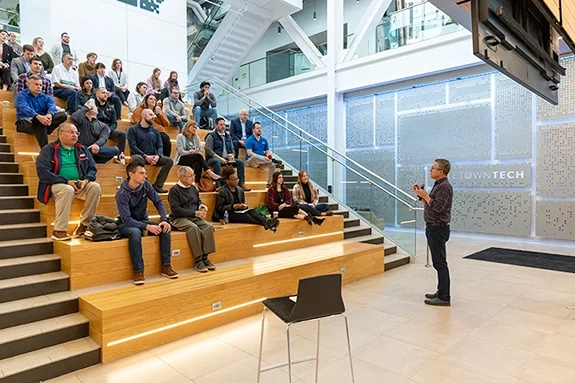
Kennedy completed that four-year commitment in March 2023. The appeal of his presence is easy to understand: he could discuss the interval between a promising idea and a functioning operation from experience. For someone starting out, a founder whose early restaurants needed substantial correction has useful company to offer.
His influence also appears in a smaller story. Augustana alumna Vallory Farrasso McCormack remembered hearing Kennedy speak in an entrepreneurship class. His account of early struggles and later growth helped convince her to pursue the restaurant industry. She went on to become a senior marketing manager at Portillo's. A guest lecture can have a surprisingly long working life.
By October 2026, Noodles was celebrating its thirty-first birthday and acknowledging Kennedy among its inaugural Legacy Award recipients. The company also credited him with the drawings it affectionately calls noodle doodles. The founder's traces include the obvious institution and the small marks around its edges.
His career offers a practical portrait of ambition: an idea worth pursuing, particulars worth correcting, colleagues worth bringing closer, and a role worth handing on. Somewhere in the middle, there are dirty dishes. Kennedy's story improves considerably when they stay in the picture.