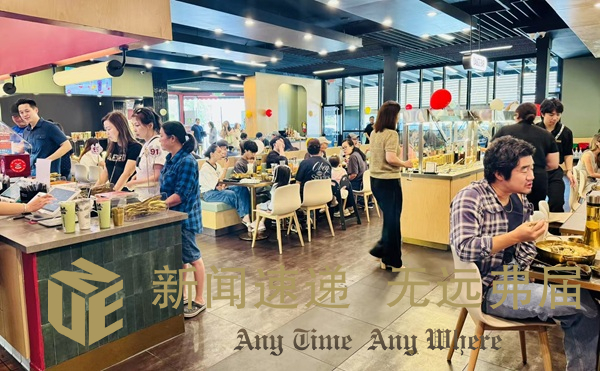
The first choice at Big Way Hot Pot is not a broth. It is a bowl: round, gold and empty. The emptiness is the point. Along a chilled wall sit vegetables, mushrooms, noodles, tofu, seafood, meat and fish balls. A guest fills the bowl, carries it to a scale, chooses a flavor, pays and waits while the kitchen turns that private pile into dinner. Friends can sit together without negotiating a common spice level. A solo diner needs no tabletop burner. Appetite becomes authorship.
Christiana Luo, the Vancouver-based co-founder and brand executive behind Big Way, has spent the past several years explaining why that sequence travels. Her answer is usually some version of choice. “People like me like customisation,” she told the South China Morning Post. In another interview, she compared the impulse to ordering a personalized drink at Starbucks. Familiar behavior, applied to a meal with a long communal history.
This is a founder story built less around a secret recipe than a precise edit. Luo and co-founder Jack Yao kept the abundance and occasion of hot pot. They changed who controls the pot, moved the cooking into the kitchen and made weight the bridge between appetite and price. The result fits inside fast casual without looking like another salad line.
An old ritual, edited carefully
Luo and Yao came to the idea with operating experience. Public accounts say they grew up in Jiaxing, China, became a couple in high school and married in 2009. Both studied business. Before Canada, they ran Gloria Jean’s Coffees franchises in Melbourne, Australia. Coffee is a useful apprenticeship for what came next: a daily product, a repeatable service line and customers trained to specify exactly what they want.
Big Way dates its founding to 2021, with the first restaurant opening near Metrotown in Burnaby in 2022. The timing sharpened the concept. A shared pot had become harder to sell during the pandemic. The founders did not abandon hot pot’s social energy. They separated togetherness from uniformity. Everyone could still gather at one table, while each bowl carried its owner’s decisions.
That distinction sounds obvious after someone makes it. Most good format innovations do. The restaurant offers a series of physical instructions that teach themselves. Pick up the bowl. Walk the ingredient wall. Stop at the scale. Choose from the broths and dry mixes. Let the kitchen cook. The customer understands the product by moving through it.
The four-move meal
The scale is part cashier, part theatre
Pay-by-weight pricing gives choice a visible consequence. A diner can control portion and, with some care, budget. Yet the scale also creates suspense. Vancouver customers began making a game of predicting the price before their bowls were weighed. The detail is funny because every ingredient suddenly acquires mass in the imagination. Corn, tofu and crab can become tiny financial dumbbells.
Luo noticed the behavior and described a “Guess the Price” promotion for the California opening: land within ten cents and the meal was free; within twenty cents brought a discount, with another discount at thirty. It is marketing that grows directly out of the product. The campaign does not interrupt dinner with a foreign idea. It gives an existing pause a scoreboard.
Watch where customers naturally hesitate, laugh or pull out a phone. That moment may already contain the campaign.
This instinct appears elsewhere in Big Way’s brand. A free ice cream cone gives the meal a clean ending. Bubble tea extends customization into the cup. Bright rooms and gold bowls make ordinary table shots legible on a phone screen. The slogan, “Your Pot, Your Way,” works because it is also a literal description of the service. The words do not have to carry more weight than the experience.
Making the format travel
By late 2024, Big Way had moved beyond its early Vancouver cluster and was preparing for the United States. In 2025, the company entered Greater Toronto and opened its first American restaurant in Rowland Heights, east of Los Angeles. Luo became a steady public interpreter of the expansion, speaking as Chief Marketing Officer or Chief Brand Officer depending on the outlet.
Her pitch was concrete. Canadian stores offered more than 100 ingredients; the early American assortment had more than 80. Guests could choose seafood heavily or avoid it. Broths and dry mixes offered vegan versions. The kitchen simmered soup bases for hours and delivered every bowl cooked. In a trade interview, Luo put a typical US check around $20 to $25. The point was not one prescribed version of authenticity. It was an accessible system for making a version that belonged to the diner.
California added another lesson: consistency does not require blindness. At the Monterey Park opening in October 2025, Luo described a customer base spanning different backgrounds and a preference among some local guests for stronger flavors. Big Way brought back a classic mala option with a deeper profile. The operating spine stayed fixed while the menu listened.
That is the difficult balance in geographic growth. A format needs rituals people recognize across cities: the gold bowl, the abundant wall, the scale, the personal broth. But a restaurant also has to taste the place it enters. Luo’s public comments tend to move between those levels, from store counts and square footage to broth strength and the number of seats. Brand and operations arrive in the same sentence.
A restaurant with more than one occasion
The format also stretches across different reasons to eat. Some Big Way locations stay open until 4 a.m. on weekends. A personal bowl can be a quick weekday dinner, a late-night stop or the center of a group outing. The free ice cream cone at the end gives each occasion the same small punctuation mark. The restaurant is flexible without becoming vague because the ordering ritual stays recognizable.
Menu range does similar work. A cautious first-time guest can identify vegetables, noodles and a tomato broth. A practiced hot pot diner can reach for frog legs, crayfish, fish balls or a spicy dry mix. Vegan versions widen the set again. Everyone moves through the same line, but fluency is optional. That matters when a Chinese dining format enters neighborhoods where customers arrive with very different reference points.
Luo’s framing rarely asks those diners to master a cultural lecture before ordering. She starts with a universal preference: getting what you want. The ingredient wall supplies discovery after the invitation. A guest might begin with the familiar and add one unfamiliar thing, then return with a slightly different bowl. Choice becomes a gentle teacher.
There is an operational advantage hidden inside that hospitality. A group with conflicting diets or spice preferences does not require several restaurant concepts. The variation happens inside a common system. Big Way can welcome difference without writing a separate script for every table. For a growing chain, that is both a brand position and a practical piece of design.
Choice becomes company value
The growth attracted a large strategic partner. In early 2026, Chinese restaurant group Jiumaojiu deepened an existing investment in Big Way through a US$43 million transaction. Regulatory filings say the deal raised Jiumaojiu’s economic interest in Big Way Group from 10 percent to 49 percent. Big Way gained a partner with experience operating hundreds of restaurants and multiple Chinese dining brands.
The investment put a large number beside a simple consumer observation: people enjoy composing dinner. But money changes the scale of the test. What felt charming in one restaurant must remain legible across supply chains, training systems and new markets. The wall has to look abundant without becoming wasteful. The broth must carry identity while responding to local preference. The surprise at the scale must feel like agency, not confusion.
Luo’s role sits at that junction. Marketing is not merely getting more people through the door. For a format-led company, the product choreography is the message. The ingredient count, pricing logic, bowl color, promotion calendar and late-night hours all tell customers what sort of place they have entered. Each decision has to survive repetition.
The discipline inside “your way”
Choice can be a lazy promise. Hand someone a giant menu and call it freedom. Big Way’s version is more structured. One decision follows another, and the kitchen absorbs the hardest work. Customers can improvise without cooking at the table. They see ingredients before committing. Price arrives through a single measurement. The bowl feels personal because the process is constrained well.
This may be Luo’s most useful contribution to the modern restaurant conversation. Customization does not have to mean endless operational variation. It can mean designing a stable frame in which customers vary the contents. The company keeps control of the sequence while the guest keeps control of dinner.
In August 2026, EY named Luo and Yao Pacific finalists in its Entrepreneur Of The Year program, under brand-driven growth. The category fits. Big Way has expanded by making its proposition visible before a customer tastes anything. The empty bowl is invitation, menu and brand asset at once.
A good restaurant leaves a memory of flavor. Big Way also leaves a memory of selection: the ingredient passed over, the mushroom added at the last second, the number on the scale, the friend whose bowl came out entirely different. Luo helped turn those little decisions into a business that could cross a continent. The company’s future will depend on whether that sense of ownership can remain intact as the number of bowls multiplies.