Michael Dalzell has spent much of his career selling products that have to perform before they can persuade. A mountain cannot fake its pitch. A rain jacket eventually meets rain. A bollard is either properly specified for the place it protects or it is not. The useful part of his story is what happens after function has earned the right to speak: he looks for the identity, emotion and sense of belonging that turns a competent product into something people choose.
Today, Dalzell is chief marketing officer at Reliance Foundry, a Surrey, British Columbia, supplier of architectural site furnishings, traffic-management products and industrial castings. Its catalog includes bollards, bike racks and wheels, objects so physically plain in their purpose that most people pass them without a second thought. The company sells to people who cannot afford to be casual: architects, engineers, contractors, municipal teams and facilities managers. Dimensions matter. Materials matter. Mounting systems and performance standards matter.
Yet these products also sit in the middle of ordinary human life. They mark the edge of a sidewalk, protect a storefront, give a cyclist somewhere to lock up and quietly organize movement through a public square. Reliance Foundry says its mission is to make places people want to be. Dalzell's job is to connect the technical object to that larger promise without losing credibility with the person reading the specification sheet.
The mountain was the message
Long before industrial streetscapes, there was Kicking Horse Mountain Resort. Dalzell served as director of sales and marketing from 2004 to 2010, part of more than 15 years he spent in senior resort-management roles. Kicking Horse was a product with an unmistakable personality: steep, exposed and prized by serious skiers. The strategic argument around the resort was whether that difficulty should be softened to reach a wider market.
Dalzell believed the sharper truth had more pull. Speaking years later about the resort's early positioning, he described the goal as making its big-mountain experience something a broad audience wanted to associate with. The expert skier could validate the place while the aspiring skier supplied the larger market. It was a nuanced distinction. A brand can invite families without pretending its most memorable terrain is gentle.
“You only have one opportunity to launch a resort and make a big impact.”Michael Dalzell on Kicking Horse
That episode contains a practical positioning lesson: a wider audience does not always require a blander product. Sometimes the edge is the invitation. The marketer's work is to make a defining trait legible to people who admire it, even if they will never use the product at its limit.
The resort years also offered a communications problem no classroom exercise could improve. In 2006, Boo, a resident grizzly, escaped his enclosure twice. On the second escape, the bear broke a roughly 400-pound steel door from its bolts, damaged an electrical box, crossed electric fencing and cleared another barrier. Dalzell, acting as resort spokesman, was left to explain an event that the resort believed was impossible. His quote compared it to breaking out of Fort Knox. The story traveled widely because the facts were already more vivid than any campaign.
There is a small operating truth inside the spectacle. Marketing leadership includes launches and positioning decks, but it also includes standing in front of a fast-moving fact pattern, saying what happened and resisting the urge to make uncertainty sound tidy.
Performance, translated
Dalzell later became marketing director for The North Face, moving from the experience of the outdoors to products designed for it. In 2017, Stormtech hired him as vice president of marketing, with responsibility for global marketing strategy and retail operations. The company made technical outerwear and performance apparel, another category in which a claim eventually encounters weather.
His advice to distributors was appropriately tactile. If a jacket promises waterproof and breathable construction, examine the seams, zippers and inside finish. He framed rugged apparel around choice rather than obligation: work gear people want to wear, not merely gear they have to wear. The feature list still mattered, but it became part of an employee's daily experience and a company's visible identity.
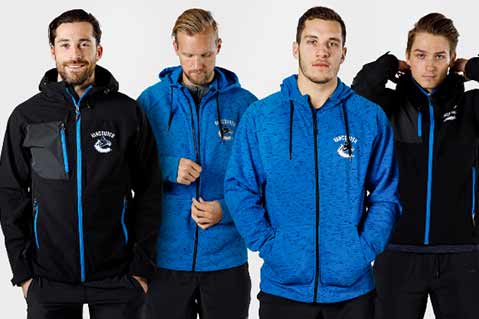
Stormtech's partnership with the Vancouver Canucks made the same idea concrete. Staff uniforms and a retail collection put one product system on employees and supporters. Dalzell called the partnership a natural fit. It linked a Vancouver performance brand, a Vancouver hockey organization and the social signal of wearing team colors.
At SAXX Underwear, where he became vice president of brand, the assignment shifted again. SAXX had a distinctive technical product and growing cultural identity. In 2019, as the company prepared a larger United States push with McCann Canada, Dalzell talked about building meaningful relationships with customers and supporting a community of men stepping outside their comfort zones. The strategic tension was familiar: explain the innovation, then build demand beyond the feature.
Kicking Horse Mountain Resort - sales, marketing and real-estate leadership.
The North Face - marketing leadership in a global outdoor brand.
Stormtech - global marketing strategy and retail operations.
SAXX - brand leadership during a North American growth push.
AlgaeCal - ecommerce and growth as chief marketing officer.
Reliance Foundry - chief marketing officer.
A consumer lens enters the foundry
Between apparel and Reliance Foundry, Dalzell served as chief marketing officer at AlgaeCal, a direct-to-consumer ecommerce company. In 2022, he publicly celebrated the launch of a rebuilt website, emphasizing speed, navigation, user experience and the information presented across the customer journey. He also made a point of naming the cross-functional team and external partner behind the work.
That combination of customer attention and operating detail helps explain the move to Reliance Foundry in September 2023. Consumer ecommerce and specification-driven B2B are different systems. The first can move from ad to checkout in minutes. The second can run through research, drawings, approvals, quotations, procurement and installation. But both punish a broken journey. Both need the right information at the right moment. Both depend on clean handoffs between marketing, technology and sales.
Reliance Foundry reached its centennial in 2025. The anniversary arrived with a refreshed identity, a campaign highlighting 100 bollard installations and a program to plant one tree for every bollard sold through a partnership with Veritree. The company set an initial target of 10,000 trees. It is an easy idea to repeat because the unit is tangible: one purchased object, one planted tree.
Start with the terrain, construction, fit or specification that can survive scrutiny.
Show the identity or lived experience that the functional product makes possible.
Connect content, ecommerce, CRM, sales and partners so the promise can be delivered.
The initiative also echoes Dalzell's outdoor background. A tree program would be decorative if it floated free of the business. Tying it to each bollard makes the customer part of the mechanism. The purchase becomes participation, while the company's public reporting can provide the accountability.
The org chart is a tool
Dalzell's recent public writing has become more operational. He described replacing a full-time performance-marketing position with an independent specialist who ran a small agency. He reported improved paid-marketing performance, greater confidence in the work and lower cost. When a lifecycle-marketing manager moved on, he considered another specialist model rather than automatically recreating the old role.
The details make the experiment more interesting than a generic argument about contractors. Reliance Foundry needs marketing-automation architecture, nurture sequences, lead scoring, email segmentation, CRM hygiene, reporting and a clean handoff to sales. Its sales cycle is long and specification-led. Flexibility only works if ownership stays clear.
This is where Dalzell's career looks less like a collection of category jumps and more like a consistent operator's habit. He preserves the core problem, then changes the structure around it. At Kicking Horse, the core was a mountain's difficult appeal. At Stormtech and SAXX, it was technical product credibility married to social identity. At AlgaeCal, it was a digital customer journey. At Reliance Foundry, it is the connection between product data, a demanding buyer and a better public place.
His public record also shows an interest in teams beyond formal employment. Dalzell served as president of the Kicking Horse Country Chamber of Commerce from 2009 to 2011; his professional profile credits the organization with 10 percent membership growth during that period. A former colleague later described him as approachable and emphasized the way he connected team dynamics with business strategy. Those are not flashy credentials. They are clues about how the work gets done.
The category changes. The durable work is understanding the customer, protecting the product truth and organizing people around both.
There is also a personal note in the way Dalzell talks publicly. In a recent post, he celebrated his daughter Ainslee's book-community project, which began in her room during the pandemic and grew into a sizable subscriber audience, a Patreon partnership and a Times Square billboard. His tone was simply that of a proud father, amazed by what a small experiment had become. For a marketer preoccupied with communities and organic growth, the example was close to home.
What the bollard teaches
A bollard is a useful final object for this career because it resists abstraction. It occupies space. It has a job. It creates a boundary while helping people move. Good industrial marketing should feel similarly grounded. The story can widen the frame, but it cannot make the steel less real.
Dalzell's path suggests that the distinction between consumer and B2B marketing is sometimes overdrawn. A procurement process may be rationalized through standards, budgets and approvals, yet it is still navigated by people trying to make a responsible choice. They want clarity. They want confidence. They want to see how the part fits the whole. Consumer experience helps when it sharpens those needs rather than dressing them up.
The lesson available to steal is modest and portable. Respect the product enough to learn what makes it true. Respect the customer enough to understand the life around the transaction. Then build a team and a path capable of joining the two. Dalzell has applied that sequence to a mountain, apparel, ecommerce and cast metal. The objects could hardly be more different. The underlying work is recognizably the same.