The first thing Big Way Hot Pot hands you is a golden bowl. It is not subtle. Neither is the refrigerated wall that follows: curls of beef, prawns, frog legs, tofu, greens, noodles, fish balls and mushrooms, an edible personality test arranged under bright light. You take what you want. A scale turns your appetite into a price. The kitchen adds one of the broths or dry mixes, cooks the lot and brings it to your table. No group vote. No raw shrimp hovering over a tabletop burner. No friend quietly monopolizing the last fish ball.
This is hot pot recast as fast casual, and Big Way's founders, Jack Yao and Christiana Luo, have made the format travel. The company dates its founding to 2021; the first restaurant opened near Metrotown in Burnaby in 2022. By spring 2026, it had 22 locations across British Columbia, Ontario and California and about 1,400 employees. A Chinese restaurant operator, Jiumaojiu, liked the result enough to deepen an earlier investment with a US$43 million deal that brought its total holding to roughly 49 percent.
The product is permission
Big Way solves an ordinary dinner problem: people sharing a table rarely want the same dinner. One person wants a numbing mala broth; another wants tomato. One is vegan; another is building a small reef from shellfish. Traditional hot pot makes those preferences a negotiation. Big Way makes them SKUs.
Customers assemble an individual pot from roughly 100 ingredients in Canada, fewer at the first US restaurants while the supply chain develops. They can choose broth - collagen bone, tomato, tom yum and signature mala are recurring options - or ask for a dry preparation. Sauces add another layer. Milk tea, fruit tea and boba lift the ticket. A complimentary mini soft-serve cone gives everyone the same tidy ending, even when every bowl before it was different.
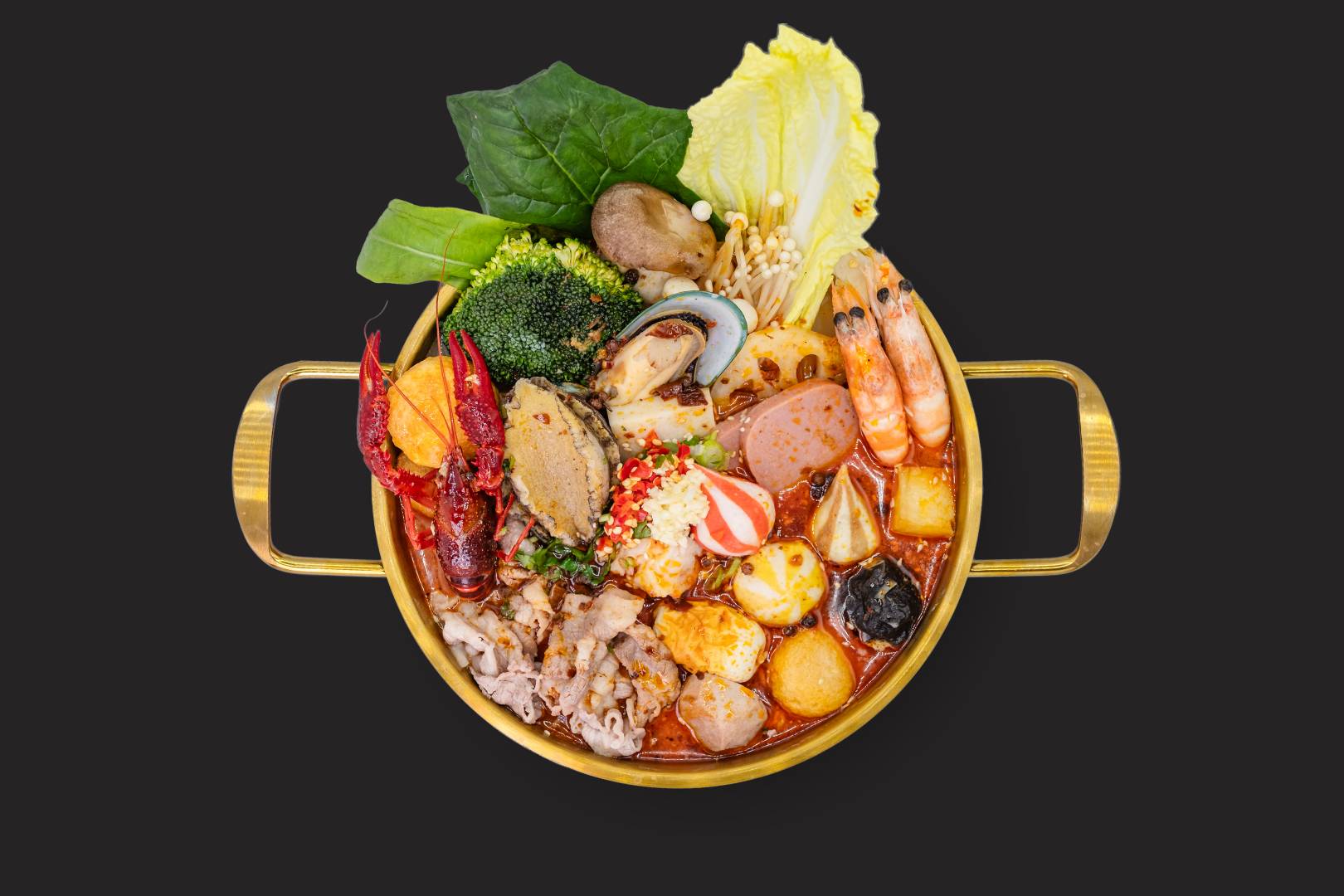
The value proposition is control over taste, portion and theoretically budget. Historical Vancouver reviews put the rate around C$3.68 to C$3.99 per 100 grams, though current prices vary by market. In a 2025 interview, Luo said the average US check tended to land between US$20 and US$25. That makes Big Way accessible for a diner who chooses carefully, and much less so for one who discovers that tofu, corn and crab are delicious little dumbbells.
“What you see is what you’re going to get.”Christiana Luo, co-founder
What failed first was the shared assumption
The useful founding insight was not that hot pot had failed. It was that one part of its operating system had become awkward. During the pandemic, a communal pot - hands and chopsticks orbiting one broth - suddenly read as a health risk. Yao and Luo did not discard the category. They separated the pot from the party.
That change kept the fun part: scanning unfamiliar ingredients, composing a meal and eating something theatrically hot. It removed the stove work and the argument over broth. The decision also made the format legible to customers already trained by salad, burrito and poke chains to move down a line and build a bowl. Luo has compared the desire for customization to ordering a personal drink at Starbucks. The cultural translation is the business.
The restaurant sits in an unusual market gap. Haidilao, Happy Lamb and The Dolar Shop sell the full-service, cook-at-table ritual. Local malatang shops offer closer product cousins. KPOT combines Korean barbecue with hot pot. Big Way competes with all of them, but it also competes with the Tuesday-night convenience of any fast-casual bowl. Its restaurants can stay open late, some until 4 a.m. on weekends, giving the brand another lane after the ordinary dinner rush.
The scale is also the stage
Pay-by-weight looks like billing, but Big Way turned it into entertainment. In its guess-the-price game, a diner who predicts the bowl's cost within ten cents can get it free. Friends compare guesses. Cameras appear. A moment usually associated with mild financial dread becomes a compact game show. The promotion works because it is welded to the product mechanics, not pasted on as a coupon.
This is the chain's marketing intelligence in miniature. The gold bowl is recognizable. Ingredient towers are inherently showy. The result varies enough that every post has a tiny plot: what went in, what it weighed, whether the diner misjudged the density of tofu. Labubu giveaways and rotating ice cream flavors add topical bait, but the core content loop was already sitting at checkout.
Forty-three million dollars, with the brakes on
In July 2025, Jiumaojiu agreed to buy an initial 10 percent interest. In February 2026, it signed a larger transaction: US$28 million for newly issued preferred shares and US$15 million to buy shares from existing holders. Together, the deals took the investor to approximately 49 percent. Jiumaojiu said Big Way had done something particularly valuable: built a Chinese food brand in North America with meaningful appeal beyond Chinese customers.
The money is not a public valuation, and Big Way does not disclose revenue. It is a strategic vote from a group that understands restaurant standardization, supply chains and the bruising economics of expansion. Oddly, the most reassuring response came from Yao: he said the investment would not change operations or automatically accelerate openings. In a difficult economy, the company would proceed cautiously. After years of multiplying stores, restraint became part of the pitch.
Big Way's decision to keep locations company-owned fits that caution. Franchising can turn store openings into someone else's capital problem, but a wall of fresh food creates relentless quality-control work. Corporate ownership keeps site selection, training, purchasing and service standards close. It costs more and grows slower. It also gives the brand fewer places to hide when something looks tired.
What a reader can steal
- Change the unit, not the category. Big Way kept hot pot's abundance and heat, then redesigned it around one person.
- Make choice visible. A wall of ingredients explains the product faster than a paragraph of menu copy.
- Turn the transaction into a ritual. The weighing step creates suspense, pricing and social content at once.
- Give variability a fixed ending. The free miniature ice cream is cheap, recognizable and emotionally precise.
- Localize the constraint. US stores began with fewer ingredients while the supply chain caught up, instead of pretending operations were identical.
The conditions hiding behind the fun
Customization is not free. One hundred ingredients create procurement complexity, spoilage risk and a long cold display that must look abundant and fresh at every hour. The kitchen must preserve speed while cooking different combinations safely. The scale must feel trustworthy. The price must remain understandable even though the final total is unknown until a customer has already committed to the bowl.
That last point is the model's most interesting weakness. Pay-by-weight gives disciplined customers control, but it can punish beginners. A heavy selection can turn a casual dinner into a C$40 or C$50 surprise. If value-conscious diners learn that an all-you-can-eat competitor is more predictable, choice starts to feel like a trap. The format also loses some of hot pot's communal theatre. Groups still sit together, but they no longer cook together.
When this playbook does not work
It breaks when the ingredient wall cannot stay fresh, rent requires impossible throughput, the kitchen bottlenecks, local diners prefer a shared ritual, or weight-based pricing produces more sticker shock than agency. The visible abundance is the promise. Any operational shortcut is visible too.
Big Way's real expertise, then, is not broth alone. It is choice architecture with a cold chain attached. The company makes an unfamiliar ordering style easy enough to understand in one lap of the room. It makes an old communal meal compatible with individual diets and budgets. And it gives a restaurant operator a format that can meet poke and burrito bowls on their own ground without sanding away the pleasure of mala, fish balls and a small cone on the way out.
The US$43 million bet says the system may travel farther. Whether it does will depend less on how many choices Big Way can advertise than how consistently it can make those choices look irresistible at 11 p.m. in the twenty-third, thirtieth and fiftieth store. That means clean displays, reliable broth, calm staff and a checkout price that feels like the result of a choice, not a trick. A golden bowl is an invitation. A chain is the machinery that keeps earning the yes.