The trouble with marketing a famous thing is that everybody arrives carrying a version of it in their head. A strip. A rip. Two sides that meet with cheerful finality. The VELCRO Brand needs little introduction, which leaves Chitra Ebenezer with the more interesting assignment: what do you say after hello?
Ebenezer is the chief marketing officer of Velcro Companies, a role she took in 2021 after joining the business two years earlier as vice president of global communications and brand. Her remit sits across a peculiar expanse. At one end is the shopper trying to tame a cable drawer. At the other is an industrial customer looking for a fastening system with precise performance requirements. One audience wants a quick idea. The other wants a reliable specification. Both have to recognize the same company when it speaks.
Her answer, visible across recent campaigns, packaging and conversations, is less about insisting on importance than demonstrating possibility. Show the use. Make selection easier. Let creators put the product into motion. Protect what makes the original recognizable, then keep widening the field of problems it can solve.
Recognition gets the first glance. Usefulness earns the second.
A change of diagnosis
The career did not begin as a grand plan for consumer goods. In a 2025 appearance on Career Talks at CAK, Ebenezer was introduced with a college-age pivot: she had planned to become a doctor, then changed her mind while at Duke University. Marketing offered a different combination of things she cared about - writing, strategy and understanding how people make decisions.
That trio is a tidy description of the work she went on to do. Writing gives a product language. Strategy decides which promise deserves the scarce space. Curiosity about decisions asks what happens in the few seconds between noticing and choosing. Her bachelor’s degree from Duke was followed by an MBA at the University of Virginia’s Darden School of Business, where her public LinkedIn record places her from 1994 to 1996.
Then came a procession of products that live near the rhythms of ordinary life. She began her marketing career at Kimberly-Clark on the HUGGIES Brand. She spent 11 years at Kraft Foods Group in a variety of leadership roles. In 2009, while serving as marketing director for Philadelphia cream cheese, she was connected to a campaign built around the invented word “pheeling.” Its aim was to get consumers thinking about the product more often, and its small theatrical flourish was an original jingle offered for free download. A cream cheese had acquired a mood and a soundtrack. Marketing, even when serious about frequency, may still enjoy a pun.
The useful life of a familiar name
After Kraft came work as global communication director at Tate & Lyle, followed by leadership of the U.S. marketing team at fresh-pasta maker Rana Meal Solutions. The products changed, but a common discipline remained: turn broad recognition or technical capability into a reason to care now. In September 2019, Ebenezer brought that discipline to Velcro Companies.
The company occupies an enviable and occasionally awkward position. Its trademark is famous enough to drift into casual speech, yet the commercial story is broader than the familiar craft-aisle strip. Consumer products coexist with applications in transportation, packaging, construction, personal care, footwear, apparel and industrial markets. The CMO therefore has to manage both abundance and precision. Say too little and the range disappears. Say everything and the customer disappears first.
Lead with a recognizable problem, an easy project and visible proof that the idea works.
Lead with application fit, performance needs and a solution built for a defined job.
On the BRAVE COMMERCE podcast in July 2025, Ebenezer discussed how those B2B and B2C approaches can complement each other. Consumer communication makes utility vivid. Industrial communication keeps the promise exact. The brand holds them together, not by flattening the differences, but by returning to a consistent idea: a fastening product becomes meaningful through the problem it solves.
That conversation also put weight on influencers and user-generated content. The logic is particularly suited to a versatile product. A conventional ad has limited room to enumerate uses; a community can keep demonstrating them. A creator organizing electronics, mounting a household object or inventing a craft project does more than endorse an item. The creator supplies the missing verb. Here is what you can do with it.
A versatile product does not need one perfect demonstration. It needs a living library of uses.
The package as a patient salesperson
The purest expression of Ebenezer’s practical style may be a rectangle of cardboard. In August 2024, Velcro Companies introduced redesigned U.S. consumer packaging created with Landor. The system used a white logo on a red masthead, color-coded categories, application photography and clearer product attributes. The ambition was not mysterious. It was to help a person standing in a crowded aisle locate the right solution with less effort.
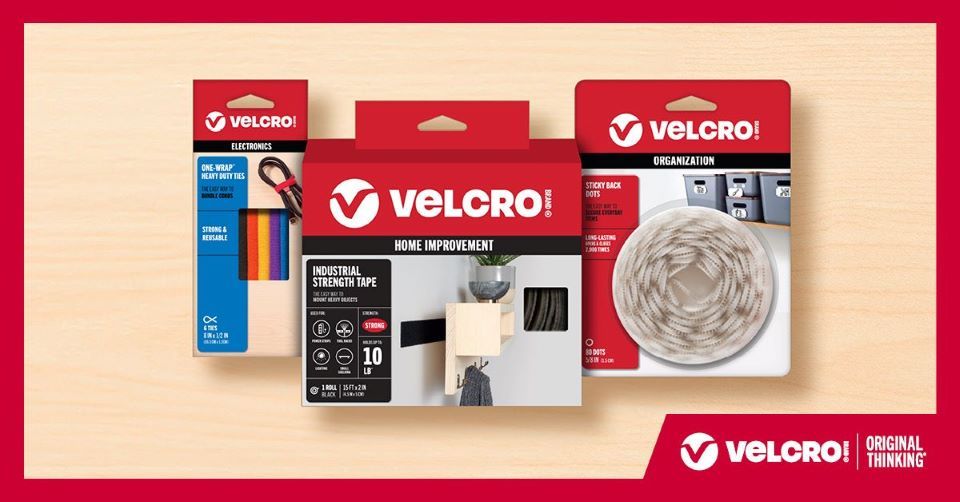
Ebenezer said at the launch that a growing field of fastening options made clearer categories and application imagery useful to shoppers. Her next sentence supplied the broader frame: “Our new packaging reflects our spirit of innovation and commitment to delivering fastening solutions that solve real-world challenges every day.”
There is a stealable idea inside that corporate phrasing. Innovation is often presented as novelty, but a better buying experience can be innovative because it respects the customer’s attention. The package answers small questions in sequence. What kind of job is this for? How strong is it? How much is inside? Is the attachment permanent, removable, adjustable or reusable? Each answer removes a tiny tax from the decision.
The rollout was concrete, too. The new design was slated for nearly 4,000 Walmart stores in the United States, followed by Amazon, Home Depot and Lowe’s, with more countries beginning in early 2025. A brand strategy had become shelf architecture at retail scale.
It is worth pausing on how ordinary the tools are. Red and white. Photographs. Category names. A few crisp facts about size and strength. None asks the shopper to learn a new visual language. The craft lies in arranging familiar signals so they answer questions in the order those questions arise. First, catch the eye. Next, establish the job. Then, make comparison possible. Finally, provide enough confidence to choose. Grand brand theories eventually have to survive this mundane little obstacle course, under fluorescent lights, beside several alternatives.
That sequence also explains why the redesign belongs in a story about Ebenezer rather than only a story about graphic design. Her career has repeatedly sat where an established product meets a new occasion. The package is one more translation device. It turns the company’s broad portfolio into a set of legible choices, while the imagery lets shoppers picture the outcome before opening the box. The design does not demand admiration. It offers directions.
A career built in translations
Kimberly-Clark, working on the HUGGIES Brand
Kraft Foods Group, across a variety of leadership roles
Tate & Lyle global communications, then Rana’s U.S. marketing team
Joins Velcro Companies to lead global communications and brand
Becomes chief marketing officer and joins the executive leadership team
Read as a whole, Ebenezer’s career is less a march through categories than a long practice in translation. A household brand must become an occasion. A food-ingredient company must make technical value intelligible. Fresh pasta must earn space in an American meal. A fastening company must sound coherent whether it is speaking to a weekend organizer or a product engineer.
The connective tissue is the decision itself. People rarely buy “versatility” in the abstract. They buy the moment when a cable stays bundled, a package closes cleanly or a project becomes manageable. Industrial customers likewise buy against a defined need. Marketing’s work is to bring that need and the product into the same frame without making either one less precise.
Ebenezer’s public record is unusually free of the cult-of-personality flourishes that gather around modern marketing. The work sits forward. A package explains itself. A creator demonstrates an application. A portfolio speaks to distinct audiences without pretending they are identical. There is some elegance in that restraint. The person responsible for selling fastening solutions appears most interested in the points of connection.
The second look
Familiarity can make a brand easy to notice and easy to overlook. That tension is the center of Ebenezer’s present job. Heritage supplies credibility. A memorable sound supplies recognition. Neither automatically tells today’s customer which product to choose or what else might be possible.
So the strategy returns to teaching without behaving like a lecture. Put the right cue on the package. Let a creator reveal a use. Give consumer imagination and industrial performance different forms of evidence. Keep the original identity visible while making room for new contexts.
The young student who left medicine for writing, strategy and decision-making ended up with a fittingly diagnostic career. Find the point of hesitation. Understand what the audience needs to see. Apply clarity. Then listen for the small, satisfying sound of a choice clicking into place.