In 2004, Charles Liang took his children to see The Day After Tomorrow. A father looking for a family outing came away thinking about server power supplies. Cinema has sent people into all sorts of questionable enterprises; this one sent an electrical engineer back to his arithmetic.
The film’s climate catastrophe prompted him to consider how much electricity computers wasted. Supermicro, the company he had co-founded eleven years earlier, began developing energy-saving servers that year. By the time artificial intelligence made cooling equipment a subject for investors, Liang had been worrying about wasted watts for roughly two decades.
That interval is the interesting part. A business habit can look unremarkable for years, then find itself in the middle of everybody else’s emergency. Liang’s career offers a view of the AI boom from the less photographed side of the machine: the boards, enclosures, power connections and cooling equipment that allow expensive chips to do useful work.
The engineer before the boom
Liang was born in Chiayi, Taiwan. His route into technology ran through electrical engineering, including studies at Taipei Institute of Technology, the predecessor of Taipei Tech. He graduated from that program in 1978 and worked as a teaching assistant. The future manufacturer of computing infrastructure first spent time helping people learn its foundations.
He also earned a bachelor’s degree in electrical engineering from National Taiwan University of Science and Technology and a master’s in the same field at the University of Texas at Arlington. The geography changed. The subject stayed remarkably consistent. Before the titles accumulated, there was a person learning how electrical systems worked.
From July 1991 to August 1993, he was president and chief design engineer of Micro Center Computer, a motherboard business. The pairing of those jobs is revealing: the person responsible for the enterprise also had responsibility for the design. Liang’s later career would retain that close relationship between the business and the thing being built.
In 1993, he founded Supermicro with his wife, Sara Liu, and Wally Liaw. It is worth keeping the partnership in view. Founder stories have a habit of reducing a group effort to one person and a conveniently empty garage. This one began with colleagues and family, and developed into a company headquartered in San Jose.
Supermicro went public in 2007. Liang remained president, CEO and chairman, the combination of roles he still holds. He has patents in server technology, but the larger expression of his engineering career is an organization that moved from motherboards and subsystems to complete racks and data-center equipment.
“I’ve always thought of myself as lucky.”
Charles Liang
A disaster movie, followed by arithmetic
The cinema anecdote gives his environmental interests a domestic scale. There are children to entertain, a film to discuss, and a father whose thoughts wander toward the power supply. The resulting question was practical: could a relatively small improvement in a component, repeated across a very large installed base, make a meaningful difference?
That is an engineer’s way of approaching a large subject. Begin with something measurable. Find where energy is lost. Work on the component. The moral ambition may be expansive, but the next action still has to survive a circuit diagram and a customer’s budget.
Liang’s environmental interests also extend beyond Supermicro. He founded the Green Earth Foundation, whose aims include combating deforestation. His career puts an unusual pair of subjects in the same conversation: server technology and trees. In both cases, he has made conserving resources part of his public identity.
There is a commercial discipline in efficiency, too. A customer keeps paying for electricity after buying the hardware. Cooling adds another demand on the facility. Thinking about those continuing costs changes what a useful machine looks like, and gives an engineer reasons to care about the whole installation.
The motherboard gets a bigger address
The other durable Liang idea is modularity. Supermicro’s building-block approach allows combinations of computing, storage, networking, power and cooling components. The appeal is easy to understand even if a motherboard looks, to you, like a particularly unfriendly city map: different jobs need different arrangements of parts.
In his 2025 conversation with semiconductor analyst Dylan Patel, Liang described an engineering philosophy centered on performance for the money. He also discussed keeping design and manufacturing close enough to control the details. That attention can extend from a board’s layout to airflow and the behavior of an entire rack.
The company now calls its broader approach Data Center Building Block Solutions, or DCBBS. The acronym does have the charm of a shipping label. The underlying proposition is more inviting: coordinate the pieces needed to put computing capacity into service, rather than leave every connection as a separate customer project.
At Supermicro’s May 2025 keynote during COMPUTEX week, Liang appeared with Nvidia founder Jensen Huang to present that approach. Their presence together explains something about the industry. A processor needs a surrounding system; the system needs processors worth installing. On stage, a complicated industrial relationship becomes two people discussing equipment.
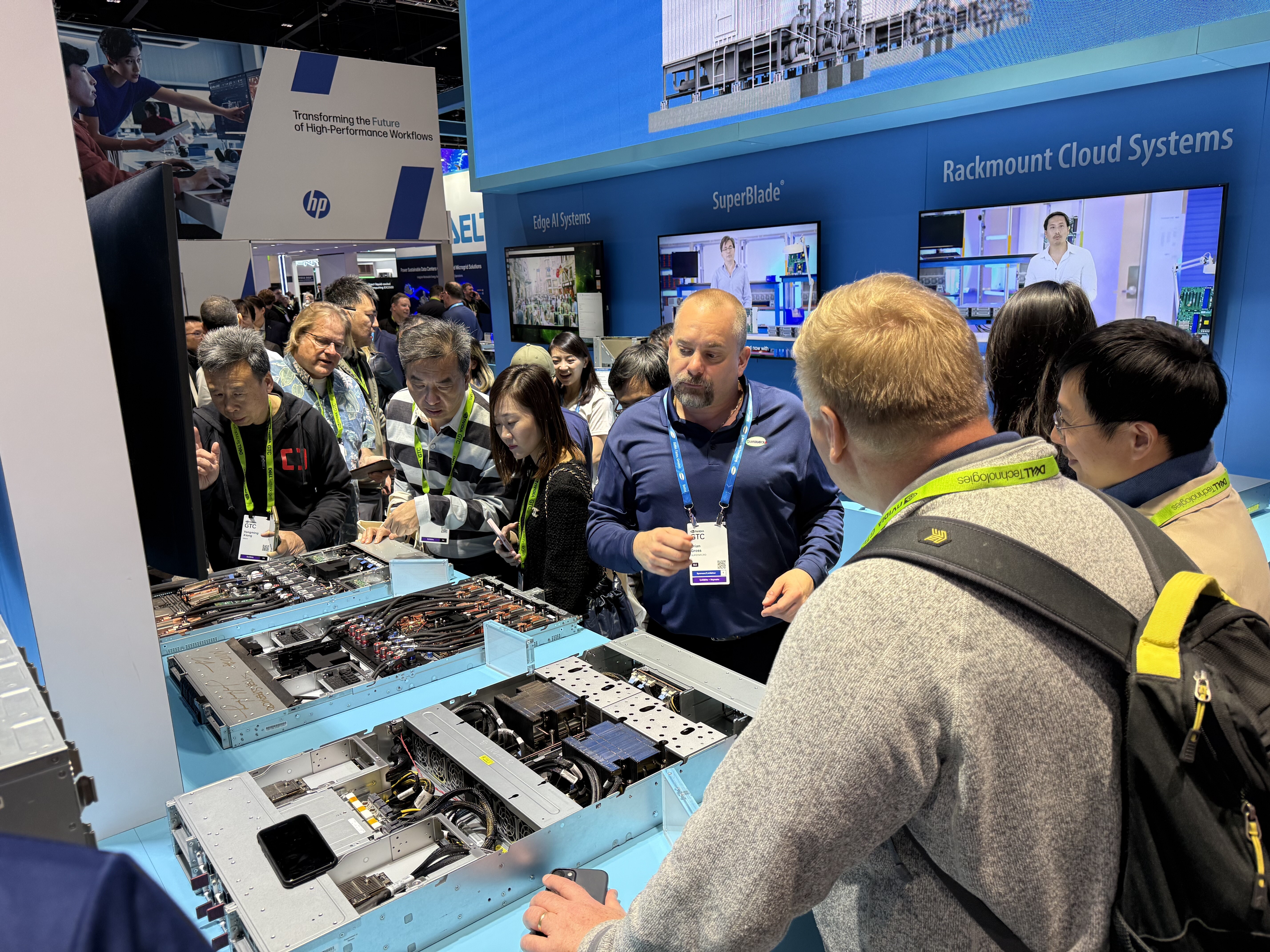
By September 2026, Supermicro was announcing shipments of Nvidia Vera Rubin NVL72 racks with its direct liquid-cooling equipment. The offering reaches from cold plates near the processors through fluid-distribution equipment to cooling towers. That is a considerable distance from a motherboard, although the habit of thinking about connected parts remains recognizable.
The attraction of following Liang is that these changes have a human continuity. He has stayed at the same company while the size of the system under discussion has expanded. A founder who once worked on boards now talks about the equipment required to bring whole clusters online.
When the numbers stop fitting on the workbench
The revenue curve gives that expansion its scale. Supermicro reported fiscal 2023 sales of $7.12 billion and fiscal 2024 sales of $14.94 billion. For fiscal 2025, the figure was $22.0 billion. In fiscal 2026, it reached $39.1 billion. Each fiscal year ends in June.
Four years of net sales
Those numbers describe the company, rather than Liang’s personal wealth or the performance of a particular product. They also describe a change in his assignment. A founder can remain interested in the same technical questions while becoming responsible for a much larger institution, with more customers, employees, money and opportunities for mistakes.
In October 2026, Supermicro appointed Mark Long as chief financial officer, reporting to Liang. Long had previously held the finance and strategy posts at Western Digital. Liang welcomed him with an emphasis on operational and financial execution. The wording is useful: it identifies work that cannot be completed by improving a server’s cooling loop.
The other systems that have to work
Supermicro’s history supplies reasons to take that work seriously. In 2020, the company agreed to a $17.5 million SEC penalty concerning accounting violations, including revenue recognized prematurely. It settled without admitting or denying the findings. Liang was not charged with misconduct, but agreed to reimburse approximately $2.1 million in stock-sale profits under a statutory clawback provision.
The distinction matters. A personal misconduct charge and a reimbursement obligation are different things. So are an engineering achievement and a record of adequate financial controls. A fair portrait has room for the product history and the accounting history without allowing either to erase the other.
A separate challenge arrived in March 2026, when three people associated with Supermicro were indicted over an alleged export-control conspiracy. One was co-founder Wally Liaw. The company was not named as a defendant in that indictment. The allegations concerned the diversion of advanced servers to China, bringing the global trade in computing equipment directly into the company’s leadership agenda.
In August, Supermicro said a review led by independent directors had found no evidence that current senior management knew of the alleged diversion. It also announced personnel actions, including terminations, and adopted recommendations to strengthen compliance. Government investigations continued. The board-led review’s findings should be understood as the company’s announced findings, with that scope intact.
For Liang, the broader leadership question is unavoidable. The systems around a hardware business include its sales procedures, financial reporting and controls over where products go. These need sustained attention alongside manufacturing. The responsibility grows with the institution, even when the founder’s original enthusiasm still lives in the machine.
Back to the classroom
There is another way to measure the distance Liang has traveled. In June 2024, he returned to Taipei Tech to speak at commencement. He had received an honorary engineering doctorate there in 2011. Now he addressed the graduating class and donated ten AI GPU servers for teaching and research. Some alumni arrive with a speech; Liang also brought computing capacity.
His advice emphasized perseverance and considering other people’s interests. The gift made that advice concrete. Equipment that his company sells to customers would become equipment students could study and use. The connection to his own early technical education needed very little explanation.
Liang’s story remains open at a demanding point. He is still pursuing efficient computing, now on a scale that places cooling towers in the same picture as processors. He is also responsible for an institution whose operating systems extend far beyond its products. The next chapter will depend on how well he attends to both.
The family trip to the cinema belongs near the beginning because it captures his curiosity so neatly. A film ends. The children go home. An engineer keeps thinking about the electricity.
Follow the circuit
Charles Liang at SupermicroCharles Liang on XWatch: Liang and Jensen Huang, COMPUTEX 2025Read: Liang’s conversation with Dylan PatelTaipei Tech commencement, 2024Supermicro’s fiscal 2026 resultsSEC accounting settlement, 2020Board-led export-compliance review, 2026Mark Long’s CFO appointment, October 2026More reporting: Supermicro’s earlier chaptersProfile updated October 23, 2026.