The least glamorous corner of ecommerce may be the one where a customer tells a bank, “I do not recognize this charge.” The merchant has already shipped the shoes, booked the room or streamed the subscription. Now the money has reversed course, a fee has appeared, and a clock is ticking. Someone needs to collect order records, delivery proof, messages and refund terms, then translate that pile into the card network’s language. Chargeback Gurus built a company around that miserable afternoon.
The Plano, Texas firm helps merchants handle payment disputes from end to end. Its software and managed teams gather evidence, decide which cases are worth contesting, submit representments, watch chargeback ratios and feed the patterns back into prevention. The company calls the loop “Fight, Prevent, Recover.” The phrase is tidy. The work underneath is not.
First they had chargebacks. Then they had a company.
Co-founders Srii Srinivasan and Suresh Dakshinamoorthy ran into dispute problems in an earlier international call-center business. They could not find a useful playbook, learned the machinery themselves and began helping other merchants. Chargeback Gurus launched in 2014.
A dispute is a tiny courtroom
In a chargeback, the issuing bank reverses a card transaction after the cardholder disputes it. The merchant can accept the loss or respond with evidence. That response is called representment. The vocabulary sounds legal because the process behaves like a compressed trial: a reason code stands in for the allegation, the evidence has a prescribed shape, and missing the deadline can settle the case before the argument begins.
Chargeback Gurus plugs into processors, gateways, customer systems and commerce platforms to assemble that evidence. Its FPRONE platform tracks cases and recovered dollars; builds custom dispute packages; and reports patterns by issuer, product, channel, reason code and merchant account. Merchants can buy managed service, software-led workflows or a blend. That flexibility matters because a travel operator with delayed fulfillment does not have the same evidence as a subscription company defending a recurring charge.
The company’s interesting move is to treat the response as only half the product. A merchant that wins one “item not received” case gets its money back. A merchant that notices those cases cluster around one warehouse, carrier or delivery promise can change the operation. That is the difference between processing tickets and building an intelligence loop.
“Every chargeback tells a story.”Chargeback Gurus’ recurring product idea
Three verbs, one feedback loop
Fight → Prevent → Recover
A merchant operating system
disguised as dispute work
Build the case
Pull transaction data, match the reason code, package the evidence and submit before the deadline.
Catch it earlier
Use network alerts and order details to refund, clarify or deflect a complaint before it becomes a chargeback.
Keep the lesson
Track won revenue, identify root causes and change the process that produced the dispute.
Prevention can look counterintuitive. Sometimes the rational decision is to issue a refund quickly. Networks such as Verifi and Ethoca can warn a merchant that a dispute is coming. The merchant may have only a short window to respond. Refunding a low-value transaction can avoid the formal chargeback, its handling cost and its contribution to a dangerous dispute ratio. It is not surrender. It is arithmetic.
Order Intelligence pushes further upstream. Through card-network programs, Chargeback Gurus can send issuers a digital receipt, merchant contact details and verified order information while a cardholder is asking about a transaction. A forgotten trading name can become a recognized purchase. A confusing charge can be redirected to customer service. Qualifying historical transactions can help establish that the cardholder has dealt with the merchant before.
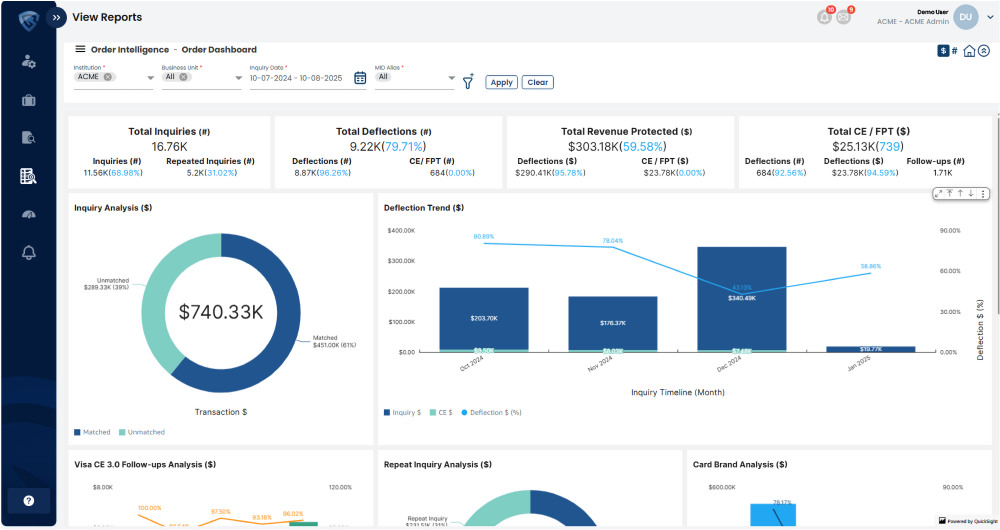
What the merchant is really buying
Chargeback Gurus sells software, but the budget argument is labor and loss. A chargeback can include the refunded sale, a network or processor fee, the product already delivered, the acquisition cost of the customer and the employee time spent responding. Too many disputes can push a merchant into monitoring programs or threaten its ability to process cards. The buyer is often a payments, risk, finance or operations leader who has discovered that a “small” back-office queue can jeopardize a much larger revenue stream.
The company does not publish a simple price list. Service documents and FAQs show that fees can vary by alerts, case volume, custom integration and delivery model; the company also says performance-based structures may be available. That makes the economic test straightforward even when the quote is not: recovered revenue plus avoided loss must comfortably exceed vendor fees, refunds and internal effort.
Good fit
- Hundreds or thousands of disputes
- Multiple processors or merchant IDs
- Evidence scattered across systems
- Chargeback ratios near monitoring limits
- A team willing to fix root causes
Probably not
- A handful of simple cases
- Thin or unreliable order records
- Products that were never delivered
- No owner for operational changes
- Recovery worth less than the workflow
The human component is part of the positioning. Pure software competitors promise greater automation. Traditional service providers emphasize specialist review. Chargeback Gurus sits between them: machine-assisted triage and analytics, APIs where available, robotic automation where they are not, and analysts for industry-specific evidence and judgment. Competitors include Chargebacks911, Justt, Chargeflow and Midigator/Kount, plus the in-house team and the quiet decision to accept every dispute.
Its advantage is strongest when a merchant wants both execution and diagnosis from one vendor. Its disadvantage is the same bundle: a capable internal payments team may prefer modular software, direct network relationships and full control over case strategy.
The playbook worth stealing
First, sort the queue by economics, not outrage. A dramatic customer complaint is not necessarily a winnable or valuable case. Estimate the sale value, goods lost, evidence quality, response cost and effect on the dispute ratio. Fight when the expected return is positive. Refund early when that protects more value. Accept the loss when the evidence is poor.
Second, create a small root-cause vocabulary. Was the charge truly unauthorized? Did the customer forget the billing descriptor? Was delivery late? Was cancellation painful? Did support fail to answer? Consistent labels turn hundreds of isolated reversals into a product map. The map is the asset. It tells marketing which promises overreach, operations which vendors fail and product where customers get confused.
Third, separate machine work from judgment. Pulling records, matching transactions, checking deadlines and generating routine reports are automation jobs. Deciding whether a traveler received a service, whether a subscription disclosure was clear or whether an unusual case deserves escalation is still judgment. The goal is not to remove people. It is to keep them out of copy-and-paste work.
Chargeback software cannot repair a dishonest offer, missing merchandise or a cancellation maze. It also struggles when merchants cannot produce clean order, communication and fulfillment records. Better casework can recover valid revenue. It cannot make a bad transaction good.
Security and compliance are part of the sale because dispute systems touch sensitive transaction data. Chargeback Gurus lists PCI, SOC 2 and GDPR controls and announced ISO/IEC 27001:2022 certification in 2025. It has also built tools around Visa’s Acquirer Monitoring Program, which combines fraud and dispute signals in ways that can make ratio management a board-level concern for a large merchant.
The business changed hands without losing its origin story. Falfurrias Capital Partners made a majority investment in 2021. In 2023, former Bank of America Merchant Services chief Tim Tynan became CEO; Srinivasan moved to the board and Dakshinamoorthy became strategist. The company has since pushed deeper into analytics, order intelligence and compliance tooling while retaining the managed-service layer that made it useful before “AI orchestrated” entered the homepage vocabulary.
A dull problem can be a fine market
Chargeback Gurus fits into fintech’s unphotogenic middle: after checkout, before final loss, between the merchant, processor, card network, issuer and customer. It is not the company approving the payment or shipping the box. It is the one making sense of what happened when trust broke down.
That position is valuable precisely because it sees failure from several directions. The dispute file contains the ad promise, transaction record, order history, support conversation and fulfillment proof. Properly structured, it can answer more than “Did we win?” It can answer “Why did the customer go around us and call the bank?”
The most portable lesson has little to do with chargebacks. Find a costly queue that everyone treats as clerical. Measure it. Give failures names. Automate the predictable parts. Route ambiguous cases to specialists. Then close the loop so the front of the business learns from the back. Chargeback Gurus did that with reversed card payments. There are plenty of ugly queues left.