A customer can choose a shirt on a phone, place an order, then walk into a shop to pay in banknotes. The purchase is digital. The money is physical. Somewhere between the two, software has to tell the seller that the order is paid. That small handoff is a useful way into Conekta, a Mexican payments company whose history keeps returning to the same question: what is preventing this particular customer from finishing?
- Cards, cash and bank transfers share one payment platform.
- A failed storefront experiment led the founders toward payments.
- New bank-app payments and direct acquiring extend the original idea.
01 / The directory had visitors. Where was the business?
Héctor Cárdenas, Cristina Randall and Leo Fischer studied engineering at Waterloo. Their early project was a Mexican business directory. It gathered listings and attracted visitors. Monetizing that attention was harder. Premium advertising made little sense to merchants who lacked even a website.
“Everybody wanted to use it, but we couldn’t monetize it.”
Héctor Cárdenas · LAVCA interview, 2016
The next experiment supplied online stores. In Cárdenas’s later account, six merchants paid ahead of launch. But stores could open without selling. Shipping and payments remained obstacles; the founders also spent time handling small customization requests. The storefront had exposed a more consequential problem.
They chose payments. Conekta was incorporated in October 2012 and launched officially in March 2013. An API let developers and larger businesses build their own front end around its processing. The lesson is available to anyone selling software: watch what customers need after the feature works. Their unfinished task may point to a different business.



02 / Give the banknote an online address
Conekta Efectivo generates a reference or barcode for an online purchase. The buyer pays at a participating location; the merchant receives confirmation. Conekta advertises more than 19,000 collection points, including convenience stores, pharmacies and BBVA Practicaja machines. The reference supplies the missing connection between a physical payment and a digital order.
- 01Choose online
- 02Get a reference
- 03Pay in person
- 04Order confirmed
There are two clocks. Confirmation can arrive in seconds. Settlement follows a different timetable: the cash product page says retail collections are deposited on Wednesday of the following week, while Practicaja collections reach merchants the next business day. Fast confirmation does not mean immediate access to the funds.
Expired references must be regenerated. Cash transactions have a published MX$10 minimum and MX$35,000 maximum. A merchant selling urgent, low-margin goods must consider the extra trip, the collection fee and the wait for settlement. Cash acceptance solves access; it does not remove every purchasing obstacle.
03 / A checkout with several doors
Cash is one entrance. Cards and SPEI bank transfers are others. Conekta offers identifiable transfer references, an embedded or redirected checkout, ecommerce plugins and payment links. A seller can send a link in a WhatsApp conversation; a developer can use the API for a more tailored flow.
The technical work continues after the button. Conekta’s card tools tokenize payment details, screen transactions for fraud and retry eligible failures through different acquiring routes. Its recurring-collection offering covers subscriptions and merchant-triggered charges. A gym collecting memberships and a retailer selling individual orders can therefore need different pieces of the same infrastructure.
Merchants can also choose providers such as Stripe, Mercado Pago, Openpay or PayPal. Conekta’s argument centers on Mexican payment habits and local processing. A useful comparison asks which customers can pay, which purchases get approved, how disputes are handled and when funds arrive. A familiar logo alone answers none of those questions.
04 / The price of finishing a sale
Conekta earns fees on successful transactions. Its published standard starting prices include 3.4% plus MX$3 for cards, 2.6% plus MX$3 for retail and ecommerce cash payments, and MX$12.50 for transfers. IVA is additional. Enterprise merchants can negotiate volume-based rates.
Integration and checkout carry no additional integration fee. Physical cash locations can charge the buyer separately. The commercial question is whether an extra completed purchase pays for the processing and operational costs. Merchants need their own ticket sizes, margins and payment mix to answer it.
05 / A parking gate is an impatient customer
Parco, a parking-payment app, makes the problem unusually tangible. A driver at an exit wants the transaction finished now. Parco integrated Apple Pay through Conekta in October 2025. Conekta’s case study says it accounted for 33.2% of Parco transactions by January 2026.
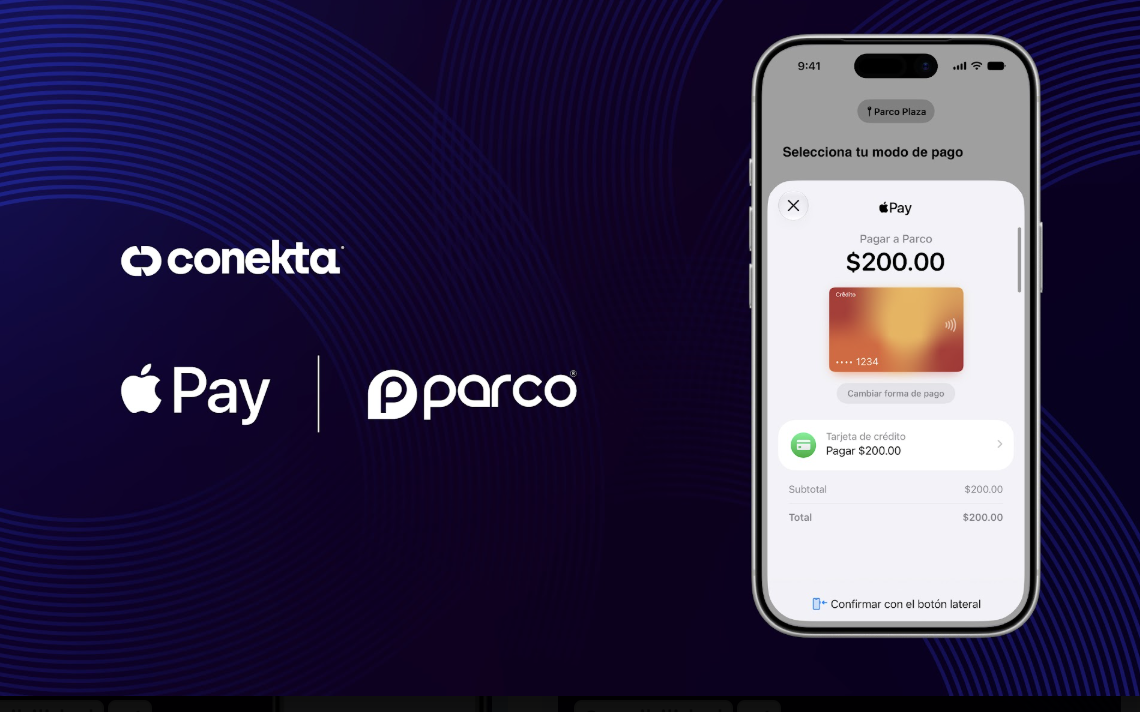
The study reports approval rates up to 14% higher and chargeback rates fifteen times lower than conventional cards, using internal transaction data. Those are results for this deployment, rather than promises for every merchant. The useful idea is smaller: put the customer’s available payment method where the urgency is.
06 / Closer to the machinery
Capital helped build the processing business: Conekta raised a US$6.6 million Series A in 2016 and US$13 million Series B in 2019. FEMSA supplied a strategic relationship as well as investment. In April 2024, Digital@FEMSA announced an agreement to buy the assets enabling OXXO Pay. Conekta said the move would give it greater independence while it continued developing other products.
The subsequent additions follow that logic. BBVA identifies Conekta as its first Pago Directo partner, beginning in August 2025. Buyers authorize purchases inside the BBVA MX app. In January 2026, the bank reported 26,000 pilot transactions totaling MX$25.3 million and 389 integrated companies.
In September 2026, Conekta announced authorization from the CNBV to operate as a direct nonbank acquirer. It reported more than 428 million transactions and US$15 billion processed. The new role gives it a more direct connection to card networks. The directory founders have traveled a long way into the payment system. Their original discovery still holds: getting a shop onto the internet is only the beginning.