A new software system makes an excellent entrance. It has a name, a presentation and, usually, someone quite keen to demonstrate it. The work it is supposed to improve is less theatrical. Orders wait. Approvals wander. The same information gets typed twice. Chandana Ranasinghe has spent a career close to this less glamorous side of business. His route to founding Acentura passes through software quality assurance and apparel manufacturing, two places where a promising plan must eventually survive contact with an actual process.
That history makes his current argument about technology worth considering. Start by understanding where a business creates value and where it loses it, he says. Then decide what to change. For a company selling technology services, it is an interesting order of proceedings: the software has to wait its turn.
A quality engineer learns to run the room
Ranasinghe began his career as a software engineer at Virtusa. Over a twelve-year period, he rose to lead an independent software quality practice in Colombo with more than 700 people and over US$25 million in profit-and-loss responsibility. Those figures belong to that earlier Virtusa chapter. They describe the scale of the operation he was entrusted to run before his own company entered the picture.
The progression matters as much as the numbers. Writing software, checking its quality and taking responsibility for an entire practice demand different kinds of attention. A defect can be isolated. A delivery organisation requires coordination across people, schedules and commercial obligations. His career moved through those levels of responsibility, giving the future founder experience of an enterprise from inside its operating machinery.
Historical figures from his leadership of Virtusa’s software quality practice.
His education also joins the technical and managerial sides of the job. He earned a bachelor’s degree in computer engineering at the University of Moratuwa and an MBA at the Postgraduate Institute of Management. His professional profile lists further executive leadership training at INSEAD in 2012. The combination suits a career in which the engineering question increasingly came with a second question about how to organise the people answering it.
His additional qualifications include a Certified Quality Analyst credential from QAI, issued in June 2004, and a Lean Manufacturing Bootstrap course from Total Systems Development in January 2012. The subjects trace the same professional interests that appear in his work: software quality, operational improvement and leadership.
The factory chapter
Then came Brandix. Ranasinghe headed process improvement and lean manufacturing at the apparel group, taking his operating interests into a different physical setting. Here, the work involved production processes rather than an independent software testing practice. Re-engineering and the practical business of improving operations became central parts of his remit.
It is a useful interruption to the conventional technology biography. Apparel brings materials, production schedules and the movement of goods into the frame. The business has to coordinate many activities before a customer receives anything. An enterprise application enters that existing arrangement, with all its dependencies already in place. A process-improvement role offers a view of what a software specification alone may leave outside the picture.
That chapter remained relevant as his later business developed. The 2025 CACCI conference placed him on the speaker list for a session about regional supply-chain resilience. His speaker biography connected his manufacturing experience with Acentura’s enterprise resource planning and advanced planning work. The link is practical: production knowledge helps frame the questions a planning system must answer.
The conference ran in Colombo on 10 and 11 November, bringing together chamber leaders, executives, policymakers and investors under the theme of entrepreneurship in Asia. In that setting, Ranasinghe’s background gave him a route into the discussion through both operations and enterprise software. His career had already crossed the organisational boundaries that such conversations often ask businesses to bridge.
Two beginnings, then a new name
In 2014, Ranasinghe co-founded Auxenta with Prasath Nanayakkara and Dr. Shahani Markus. He served as its chief operating officer and vice president of quality assurance. He has described defining the young company’s focus as an early challenge, including the move into enterprise solutions and work with multinational accounts.
Acentura followed as a spin-off in 2019. The distinction between that beginning and the later brand announcement is worth keeping: Auxenta Digital Labs announced its change of name to Acentura in March 2021. The business therefore has a history that precedes the name on its current website. A company can acquire a new identity considerably faster than it acquires the experience behind it.
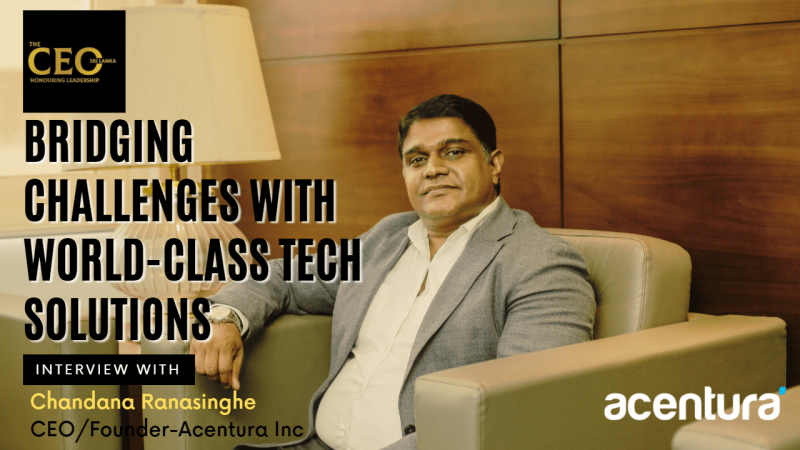
At the time of the name change, Ranasinghe described an intention to build on digital transformation and enterprise applications while widening the company’s services footprint. The announcement identified offices in the United States and Sri Lanka, with project locations elsewhere. International delivery was already part of the proposition.
The people behind the process
There is a distinctly organisational streak in how Ranasinghe discusses the business. Customer feedback, management involvement and the development of staff recur alongside the technology. His descriptions of Acentura include several points of contact with customers and a Client Delight Index, treated as part of the delivery routine. The name is cheerful; the underlying task is the serious business of hearing whether a client thinks the work is going well.
His team-building philosophy puts particular weight on developing talent from within. It is a useful statement of intent for a services company, where the work depends heavily on the abilities of people assigned to deliver it. Training belongs close to the commercial model.
“We believe in building leaders and experts rather than hunting for them.”
Chandana Ranasinghe
Acentura’s Career Accelerator supplies a concrete example of the company’s university-facing activity. Its advertised structure includes six- and twelve-month tracks, mentored project work and technical streams covering development, quality assurance and SAP. It is a fee-based program. The published design also gives partner employers routes to review project portfolios and meet participants.
His own university connection extends beyond his degree. An interview with him appeared in IMPETUS, the IEEE Uva Wellassa University student branch magazine launched in October 2022. It places a technology executive in the reading material of students preparing for professional life, a modest but specific connection between the established industry and its next intake.
Before the software, follow the value
In May 2026, Ranasinghe published an article on the starting point for digital transformation; Acentura carried it on its own blog in June. His central question was direct: “Where is value being created, delayed, lost, duplicated, or hidden across the organization?” It invites a business to inspect the journey of its work before deciding which application deserves the budget.
He describes familiar complications: an enterprise system surrounded by departmental tools, spreadsheet workarounds, manual approvals and reporting that does not quite agree with itself. His proposed approach combines an assessment of the existing systems with value-stream mapping. The resulting roadmap separates problems involving processes, data, systems, people and governance, so that a purchase is attached to a defined business need.
- 01Follow the workMap processes and handovers
- 02Find the frictionExamine delays and duplication
- 03Choose the changeSequence systems and process improvements
An editorial illustration of his value-stream approach.
Read against his career, the argument has continuity. Quality assurance examines whether something works as intended. Process improvement asks how the work itself can function better. Company leadership adds the question of how to repeat delivery across customers and teams. His current thinking brings those concerns into the same conversation. The vocabulary has expanded; the interest in how things operate remains recognisable.
There is also a commercial reason to care about those distinctions. Acentura implements and supports enterprise platforms including SAP, RELEX and Acumatica, combining that work with a wider set of services. Its work includes implementation and managed services. That places the company close to the recurring work of configuring, connecting and supporting systems. For Ranasinghe, the operating questions persist after the initial technology decision has been made.
A new partner at the table
The next business chapter arrived in early January 2026, when a Tempest PE Partners-led consortium acquired a significant minority stake in Acentura. The transaction was publicly reported in May. The stated plan includes overseas expansion, new international sales connections and closer work on budgeting, financial planning and performance indicators.
Ranasinghe has described the partnership as a way to support expansion into new markets, capabilities and larger enterprise opportunities. In his own announcement, he put corporate governance and strategic support alongside access to capital. That grouping gives a fairly clear picture of what he wants from the relationship: assistance with running the next stage as well as financing it.
For a founder with his background, this is a further change in the scale of the operating question. The early career involved responsibility within a large technology company. Auxenta and Acentura brought the work of building organisations. International expansion now asks those organisations to carry their practices into additional markets, with new partners helping to set priorities and monitor progress.
The partnership’s published plans make that work unusually tangible. Tempest is expected to help identify international sales partners while working with Acentura on financial planning and performance monitoring. Sales relationships and budget discipline are less photogenic than a signing ceremony, but they help explain how an expansion is meant to proceed. The announcement sets out activities against which the next chapter can be judged.
The attractive part of Ranasinghe’s story lies in that accumulated experience. There is engineering, then management; software, then apparel; a co-founding, a spin-off and a new investment relationship. Each chapter adds another setting in which good intentions require working arrangements. The presentation may be polished. He keeps returning to what happens after everyone closes the laptop.