A chamber of commerce is an unlikely place to look for help with a phone full of receipts. Yet that is where CCI Bénin’s story gets interesting. The institution behind business representation in Benin also backs e-Tchité, software for tasks such as invoicing, tracking stock and keeping the accounts in order. For an entrepreneur, the connection is refreshingly literal: the organisation that speaks for businesses can also help with the business of getting paid.
That puts a different face on an institution created in 1908. CCI Bénin works across commerce, industry and services, with a remit that stretches from advice for a first-time founder to international opportunities for established firms. Its digital programmes sit alongside incubation, training and market information. The common thread is practical: helping an enterprise turn an intention into something it can actually do.
The pandemic brought the daily ledger into focus
The immediate spur for E-Tchité was Covid-19. In its account of the project, the chamber described a business community under pressure and cited research suggesting that firms that had invested in digital tools weathered the disruption better. That observation helped shape a programme aimed at strengthening micro, small and medium-sized enterprises through digitalisation.
The response combined listening and delivery. The project gathered businesses’ needs, offered practical training, helped firms work on their online presence and introduced management software developed by 41 DEVS. Its funding came through a European Union grant delegated to the Agence Française de Développement and implemented by Expertise France.
“D’un projet né en réponse à une crise, vous avez su faire une très belle opportunité.”
Jérôme Bertrand-Hardy, AFD Cotonou director · December 2023
At the December 2023 closing, the message was that a crisis response had become an opportunity. The next ambition was continued support for beneficiaries and further software development. That matters because the end of a funded project and the end of a business’s need for help rarely arrive on the same day.
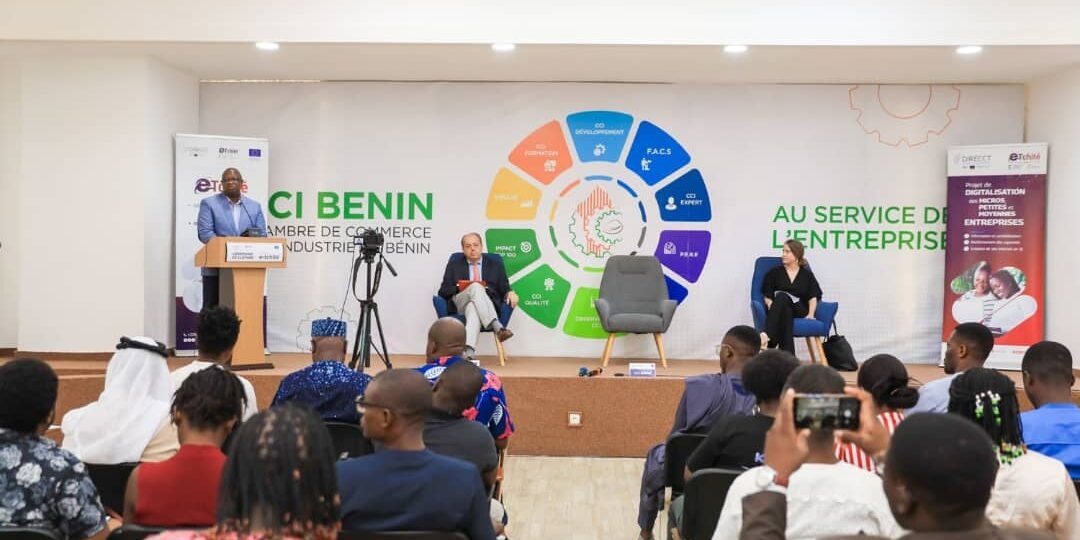
A workshop is a beginning, not a balance sheet
The closing account provides unusually concrete activity figures. They are useful because they describe what the programme delivered, rather than wrapping every intervention in a claim about economic transformation.
Three measures of practical reach
Reported participants or beneficiaries. Groups may overlap; these are not a combined customer total or a measure of profit growth.
The distinction is essential. Attending a session, joining a platform and using an application every week are different behaviours. These figures establish reach. A judgement about commercial impact would also need to follow what happened inside the participating firms: whether records improved, work became easier or customers returned. Keeping those questions separate makes the programme more intelligible.
The owner works. The accountant follows.
Today’s e-Tchité proposition centres on a shared working relationship. The business owner records activity; the accounting professional reviews and handles the accounting work. The product website reports more than 5,000 MPMEs supported since December 2023 and more than 200 partner accounting firms. Those are the provider’s programme figures, rather than a count of independently verified active users.
The advertised web tools bring together products, customer and supplier records, quotations, invoices and cash movements. A quote can become an invoice; records can connect to the accountant’s work. The appeal is easy to understand for anyone who has entered the same number into several files and then wondered which version was right.
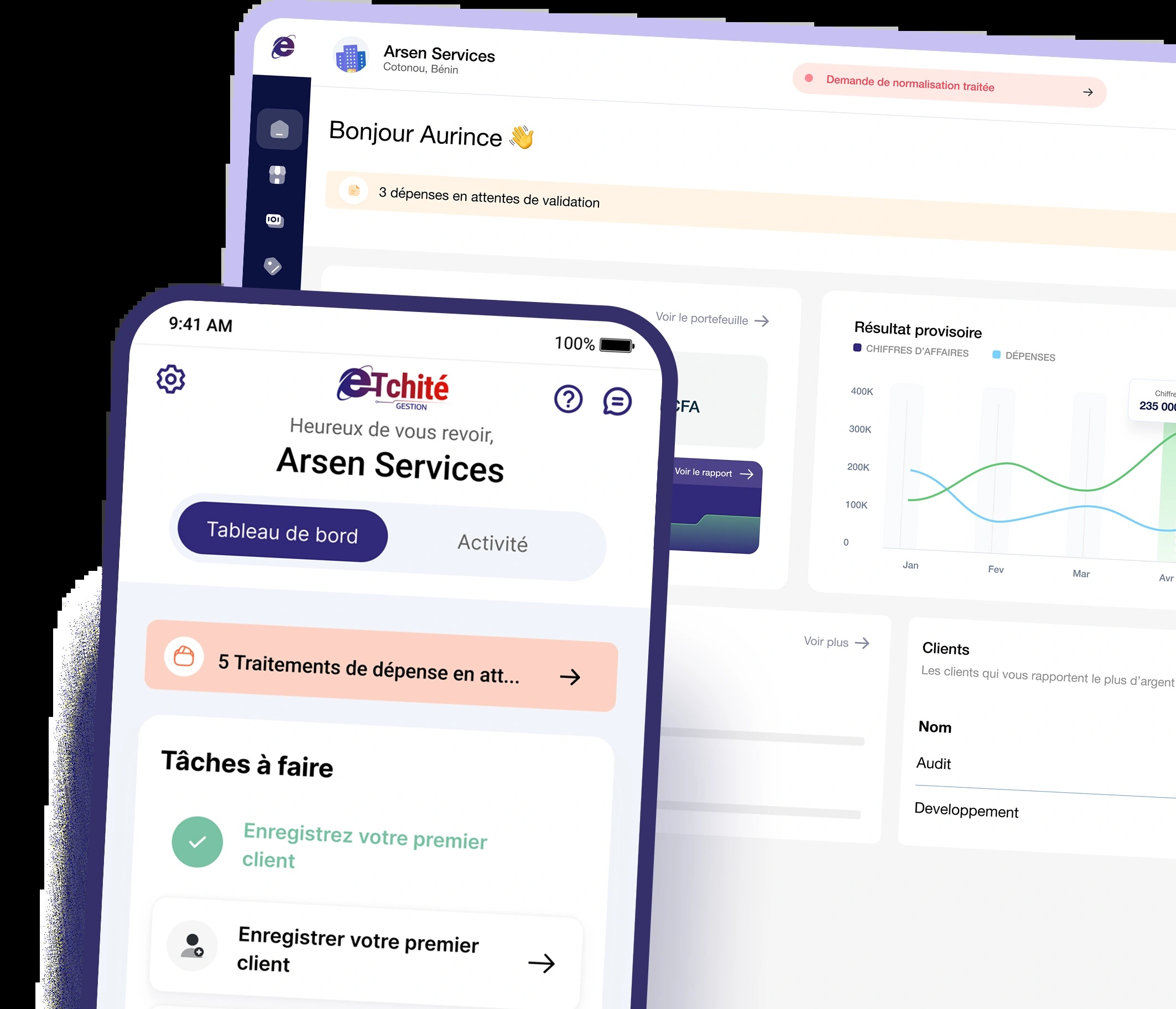
The mobile offering also advertises offline recording with synchronisation when connectivity returns, plus receipt capture using a phone camera. These are product claims, but they show the design priorities: fewer repeated entries and a workflow that can tolerate interruptions. The promise is especially relevant to an owner whose working day does not unfold neatly in front of a desktop computer.
There is still a professional in the loop. The platform’s terms require validation for accounting profiles and identify the registered Beninese businesses and accounting professionals the service is intended to support. An application can organise the work; the quality of the information and the attention given to it remain part of the job.
Free access has an institutional backstory
For eligible registered Beninese MPMEs, the current programme offers e-Tchité without subscription or installation fees. Its institutional page also includes accounting firms and qualifying company accountants. That gives the product a particular position: software delivered through a business-support institution, with access tied to a defined constituency.
It is sensible to read “free” at that level of precision. The offer describes access to this programme. It does not make every service a company might need costless. An owner still has to spend time preparing records and learning a process. The programme’s access page also provides for notice and consent if pricing changes or premium modules are introduced.
The chamber itself has a broader financial structure. A public institution with financial autonomy, it receives operating support through business contributions described in its July 2023 business-law guide. That historical schedule ranged from CFA20,000 to CFA2 million annually, depending on turnover. Those dated figures explain the model; they should not be treated as a current bill. Partner-funded projects add another way of paying for specific interventions.
- AskIdentify the business problem.
- EquipPair advice with a usable tool.
- PractiseTrain people on the actual task.
- FollowCheck what becomes a habit.
An editorial reading of the approach, not a measured impact model.
Before the app, there may be an idea
CCI Bénin’s audience is wider than software users. Its website addresses business creators, company leaders, investors and institutions. These groups arrive with different questions. Someone testing an idea needs a different conversation from an established supplier trying to understand an overseas market.
ImPulse covers pre-incubation, incubation and acceleration. The offer includes workspace, logistical resources, mentoring, help gaining visibility and preparation for financing. Its description favours agile approaches and rapid validation. That is a useful programme philosophy: learn whether a proposition works while there is still time to change it.
The Rendez-vous des experts programme supplies another entry point, connecting entrepreneurs with specialists in management and business development. For a firm with a specific obstacle, a targeted conversation can be more useful than a broad event. The chamber’s value here lies partly in knowing whom to bring into the room.
In July 2026, it highlighted Business Check-up, a digital self-assessment and guidance tool supported by technical assistance from FUND.lab. Alongside the software and expert appointments, that adds a preliminary question: what needs attention first? The portfolio makes more sense when read as several starting points for different businesses, rather than a single course everyone must follow.
From the cashbook to the contract
Better internal management is only one side of enterprise development. Firms also need buyers. CCI Bénin publishes opportunity notices and market information and points businesses toward trade events and international contacts. Its services include business verification, helping address the basic question behind a prospective deal: who, exactly, is on the other side?
On 21 April 2026, the chamber hosted around 40 business leaders for a two-and-a-half-hour session on responding to World Bank-funded tenders. Participants came from works, supplies and services. The session illustrates a concrete form of market access: helping firms understand the requirements for competing. Training is one step toward a credible bid, not a promise of a contract.
Representation remains part of the work, too. A November 2024 dialogue brought women entrepreneurs together with public decision-makers to discuss financing, taxation and social protection, including difficulties affecting informal businesses. These are problems that software alone cannot settle. They require conversations about the rules and institutions around a company.
The advantage is the connection
Private advisers, accountants, incubators and business associations offer alternatives for parts of this work. They also make plausible collaborators. CCI Bénin occupies a particular place among them: a national public institution under the ministry responsible for commerce, combining a representative role with enterprise services.
Its institutional history helps explain that breadth. The original chamber combined commerce, industry and agriculture; a 1962 decree reshaped that arrangement. Today’s business services are another layer in a long sequence of adaptation. The useful question is whether that institutional reach makes help easier to find and put to work.
Other business-support organisations can borrow a practical sequence from this case: ask firms about their needs, connect instruction to an actual task, enlist specialist partners and follow up after delivery. It depends on people having the time, eligibility and support to participate. A tool will do little for an unrecorded transaction; a market introduction cannot repair an unsuitable offer.
For an entrepreneur, the sensible starting point is therefore a specific problem. Bring the invoicing problem to the software, the management question to an expert and the growth idea to an incubator. CCI Bénin’s digital turn is most persuasive at that scale: an old institution making itself useful in the next working hour.
Explore the tools and the conversation
CCI Bénin website · Business services · e-Tchité web tools · Mobile tools · Request a demonstration · Chamber news · LinkedIn · Facebook